
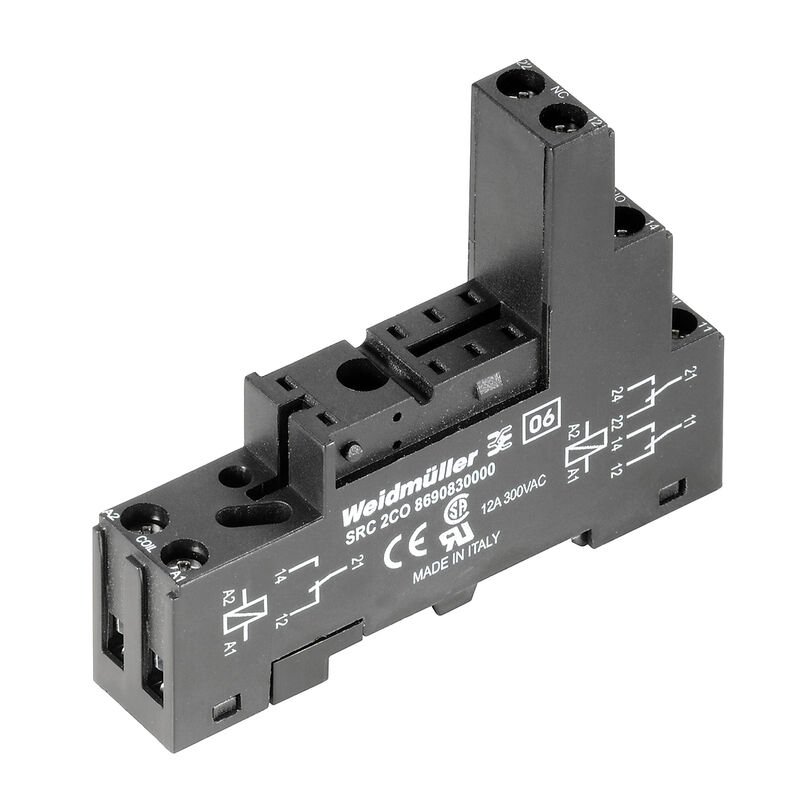
Weidmüller 8690830000 SRC 2CO Relay Socket Technical Overview
The Weidmüller 8690830000 SRC 2CO relay socket is designed to accept an industrial plug-in relay and provide an organized, serviceable mounting and wiring interface inside the control panel. Relay sockets may look simple, but in a professional automation environment they play a critical role. They influence wiring quality, replacement speed, service safety, and how cleanly the relay system fits into a DIN rail-based architecture.
What the Weidmüller SRC 2CO Relay Socket Does
The Weidmüller SRC 2CO relay socket is a relay base intended for industrial plug-in relays. Its function is to create the physical and electrical interface between the relay and the panel wiring. That matters because relay systems are rarely judged only by the relay itself. In practice, maintainability often depends on how well the socket supports conductor entry, terminal identification, and fast replacement under service conditions.
Product data shows this relay socket is intended for DIN rail use and supports conductor cross-sections that fit common industrial control wiring practice. For finely stranded conductors with wire-end ferrules according to DIN 46228/4, the range is listed from 0.5 mm² to 2.5 mm². Similar limits are given for flexible conductors and for certain two-conductor clamp configurations.
Technical Characteristics That Matter in Real Panels
The Weidmüller 8690830000 SRC 2CO relay socket is designed around practical control-panel needs. A relay socket must do more than hold a relay in place. It must support reliable conductor termination, consistent spacing, and a logical maintenance process when a relay needs replacement. In that respect, conductor range is one of the most important details because it determines whether the socket fits standard cabinet wiring practices without forcing awkward compromises.
With conductor support up to 2.5 mm², this socket aligns with a common wiring size used in industrial control work. That makes it suitable for many typical relay interface tasks, whether the relay is switching control signals, distributing status contacts, or acting as an interposing element between PLC logic and field circuits.
Why Relay Sockets Matter More Than They Seem
In many control cabinets, the relay socket becomes the real service interface. When a relay fails or needs to be exchanged during maintenance, the socket allows the relay to be replaced without rewiring the entire circuit. That can significantly reduce downtime. The Weidmüller SRC 2CO socket supports that maintenance logic by providing a defined relay base within a DIN rail installation concept.
Relay sockets also help standardize the cabinet structure. Instead of hard-wiring relays in an ad hoc way, panel builders can create repeatable, modular arrangements. That improves documentation quality and makes future servicing more predictable.
Best-Fit Application Areas
The Weidmüller 8690830000 SRC 2CO relay socket is well suited for machine control panels, utility cabinets, building automation panels, and industrial interface stations where plug-in relay architecture is preferred. It is especially useful in systems where easy relay exchange, organized terminal access, and DIN rail consistency are considered important design priorities.
For more information about Weidmüller, it is worth looking at the wider relay interface portfolio, since relay, socket, retainer, and marking accessories typically work best as a coordinated system.
FAQ
What is the purpose of the Weidmüller 8690830000 SRC 2CO relay socket?
The purpose of the Weidmüller 8690830000 SRC 2CO is to provide a structured base for an industrial plug-in relay. It organizes the connection points, supports DIN rail mounting, and makes relay replacement easier during servicing. In real industrial use, that improves maintainability and reduces wiring disruption.
Why is the conductor range important on a relay socket?
The conductor range defines which wire sizes the socket can reliably accommodate. Since industrial control panels often use standardized wiring sizes, a compatible socket simplifies panel construction and avoids problematic terminations. The SRC 2CO supports common conductor sizes up to 2.5 mm², which fits many routine control applications.
Is a relay socket only useful when a relay is frequently replaced?
No. Even if relay replacement is rare, the socket still improves cabinet structure, wiring organization, and documentation clarity. It also helps keep maintenance safer and more efficient if replacement eventually becomes necessary. In industrial engineering, good serviceability is valuable even when faults are infrequent.
Why choose a socket-based relay system instead of direct wiring?
A socket-based system offers better modularity, easier replacement, and more consistent panel layout. It also supports clearer identification and more disciplined wiring practices. For OEM panels and infrastructure cabinets, these advantages often matter throughout the full operating life of the installation.