
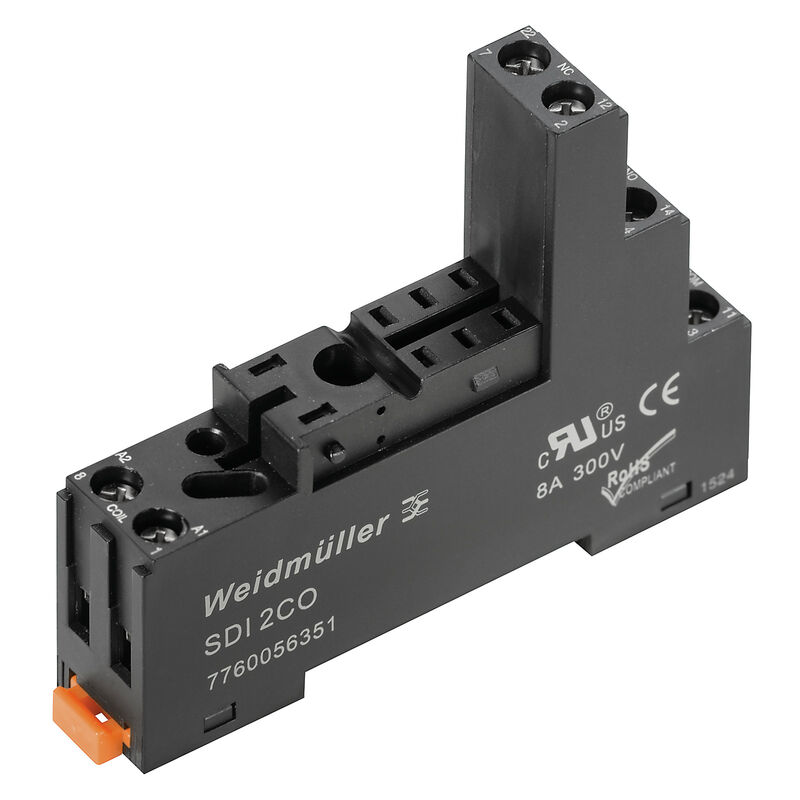
Weidmüller 7760056351 SDI 2CO Socket Guide
Relay sockets define how well a relay integrates into the real life of an industrial panel. The Weidmüller 7760056351 SDI 2CO relay socket is designed for accepting an industrial plug-in relay and belongs to the D-SERIES ecosystem. For professionals searching for a Weidmüller SDI 2CO socket, 2 CO relay socket, or industrial plug-in relay base, this model is relevant because it combines structured wiring support with a practical multi-conductor acceptance range.
What Is the SDI 2CO?
The Weidmüller SDI 2CO is a relay socket developed for an industrial plug-in relay with 2 changeover contacts. Its role is to provide the fixed mechanical and electrical interface between the plug-in relay and the cabinet wiring. This type of arrangement is widely used because it improves replacement speed, keeps installation layout cleaner, and supports better maintenance practice over time.
Unlike direct relay wiring, a socket-based approach creates a more modular control cabinet structure. That matters in panels where relays are considered normal service components and fast replacement is part of operational planning.
Weidmüller 7760056351 Technical Features That Matter in the Field
The Weidmüller 7760056351 relay socket supports a wide conductor range. The official product information indicates solid conductors up to 4 mm², finely stranded conductors from 0.25 mm² to 4 mm², and the same 0.25 mm² to 4 mm² range for ferruled or AEH-related flexible conductors. These values make the socket flexible in practical wiring scenarios, especially when projects involve different conductor preparation methods.
That breadth can be very helpful in industrial environments where cabinet internals, retrofit wiring, and field interface conductors may not all follow exactly the same conductor style. A socket that accommodates this variety supports smoother installation planning.
Why 2CO Sockets Are So Widely Used
A 2 CO relay socket supports relays that offer two changeover paths from one coil action. This is a useful middle ground between very simple single-contact logic and more complex multi-contact relay schemes. It gives enough switching flexibility for many everyday industrial tasks, including signaling, logic transfer, interlocking, and interface separation.
The Weidmüller SDI 2CO relay socket therefore fits a broad range of conventional automation and machine control applications. It provides the physical basis for modular switching logic while maintaining order in the cabinet.
Typical Applications
This socket is suitable for machine control panels, signal interface assemblies, relay replacement systems, and industrial automation cabinets where technicians value structured relay handling. It is also useful in retrofit work because socket-based relay design often simplifies future changes.
In many projects, long-term serviceability is just as important as initial assembly speed. That is one reason relay sockets remain a central part of practical panel engineering.
Weidmüller 7760056351 FAQ
What is the Weidmüller 7760056351 SDI 2CO?
It is a relay socket for accepting an industrial plug-in relay with 2 changeover contacts in a structured, service-friendly panel format.
What conductor sizes can this socket handle?
The official product information indicates support for solid conductors up to 4 mm² and finely stranded or ferruled conductors from 0.25 mm² to 4 mm².
Why is a socket-based relay arrangement useful?
Because it simplifies relay replacement, keeps field wiring in place, and helps maintain a cleaner cabinet structure over time.
What kind of applications use 2 CO sockets most often?
They are often used in signaling, interlock logic, PLC interfaces, machine control, and general automation circuits where two changeover paths are sufficient.
Is this useful in retrofit projects?
Yes. Socket-based relay architecture is often easier to adapt and maintain than direct relay wiring in retrofit environments.
Why do engineers care about conductor range on a socket?
Because conductor compatibility affects installation flexibility, tool selection, and how easily the component fits existing panel standards.
For more information about Weidmüller, you can explore the wider socket and relay interface product range.