
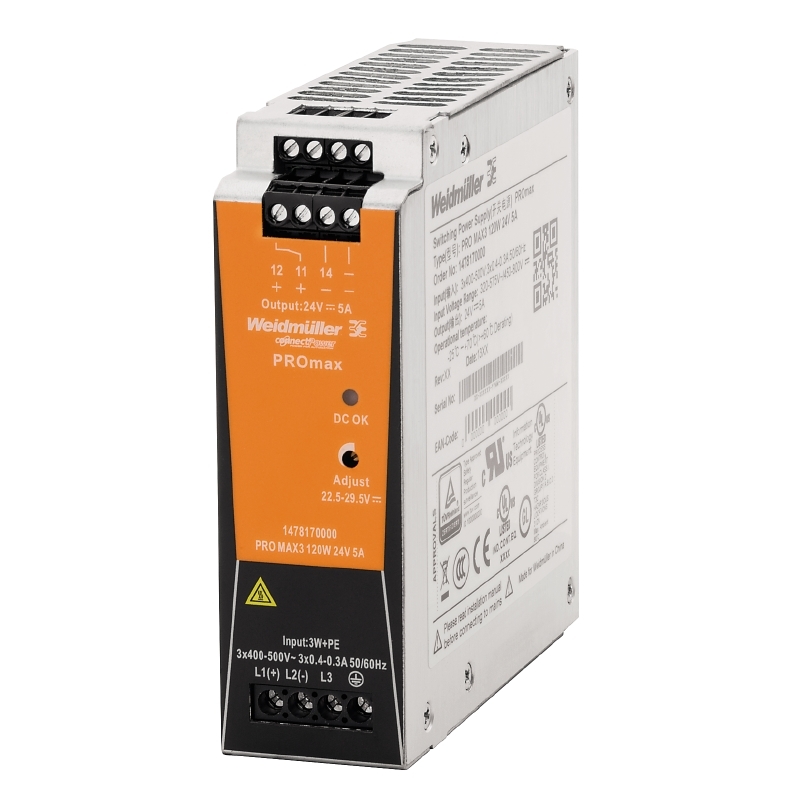
Weidmüller 7760054176 EPAK-CI-VO Signal Converter Guide
The Weidmüller 7760054176 EPAK-CI-VO signal converter is an industrial signal converter and isolator designed to translate one analogue signal format into another in a controlled and structured way. In automation systems, signal conversion is often necessary because not all sensors, transmitters, controllers, and PLC input cards use the same signal type. A dedicated converter helps bridge that gap while maintaining greater clarity and reliability than improvised solutions.
What Is the Weidmüller 7760054176 EPAK-CI-VO?
The Weidmüller 7760054176 is a signal converter / isolator with a 4–20 mA input, a 0–10 V output, and a 20…30 V DC supply voltage. This makes it suitable for applications where a current-based field signal needs to be converted into a voltage signal that can be read or processed elsewhere in the control system.
Signal converters of this kind play an important role in system compatibility. Instead of redesigning a signal source or replacing an input module, engineers can adapt the signal cleanly at the interface level.
Why Signal Conversion Matters
The Weidmüller 7760054176 EPAK-CI-VO matters because mixed-signal environments are common in industrial automation. One subsystem may use 4–20 mA instrumentation, while another expects 0–10 V input. Without a proper converter, the signal chain becomes incompatible.
A dedicated signal converter solves that problem while supporting a more professional and maintainable system design. It can also improve transparency by making the conversion point explicit in both cabinet layout and documentation.
Technical Characteristics in Practical Use
The Weidmüller EPAK-CI-VO signal converter is associated with 4–20 mA input current, 0–10 V output voltage, 20…30 V DC supply, and a compact housing with a width of 17.5 mm. Product data also indicates defined load impedance requirements and operating temperatures suitable for industrial cabinet environments.
These characteristics matter because signal converters are often installed in panels with limited space. A narrow housing supports dense cabinet layouts, while defined input and output characteristics help engineers design the surrounding signal path more accurately.
Typical Application Areas
The Weidmüller 7760054176 EPAK-CI-VO signal converter is commonly relevant for:
- 4–20 mA to 0–10 V signal conversion
- Analogue interface adaptation
- PLC input compatibility projects
- Process signal integration
- Industrial control cabinet signal conditioning
- Retrofit applications involving mixed analogue standards
These applications benefit from a dedicated analogue conversion point that improves signal compatibility without increasing unnecessary complexity elsewhere in the system.
Selection Considerations
Before specifying the Weidmüller 7760054176 EPAK-CI-VO, engineers should verify the source signal, target signal, supply voltage, output loading, cabinet space, and isolation requirements of the application. Signal converters work best when the full signal path is reviewed, not only the input and output labels.
It is also useful to think about maintenance documentation. Analogue conversion points should be clearly labeled so technicians can understand the signal architecture quickly during diagnostics.
FAQ
What does the Weidmüller 7760054176 EPAK-CI-VO do?
It converts a 4–20 mA input signal into a 0–10 V output signal while operating from a 20…30 V DC supply.
Why is a signal converter useful in industrial automation?
A signal converter is useful because different devices may use different analogue signal standards, and conversion allows those devices to work together without redesigning the entire system.
Where is this converter commonly used?
It is commonly used in PLC interface projects, process signal adaptation, retrofit control cabinets, and installations where current-based sensors must connect to voltage-based inputs.
Why is compact housing width important?
Compact housing width matters because signal conditioning components are often installed in dense control cabinets where DIN rail space is limited.
What should engineers check before specifying this converter?
They should check input type, required output type, supply voltage, load impedance, cabinet space, and whether the converter fits the intended signal architecture.
For more information about Weidmüller, you can review interface and signal conditioning products.