
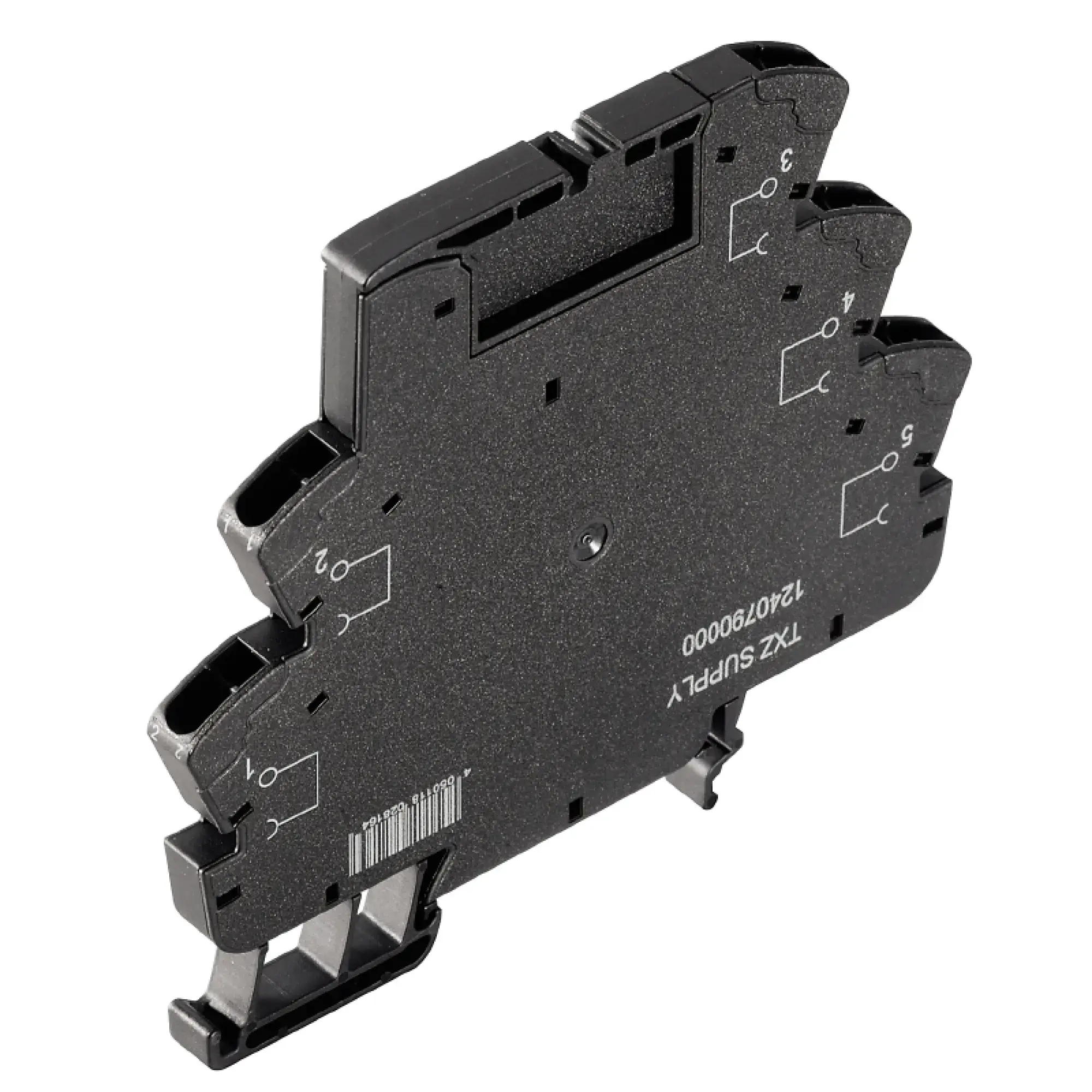
Weidmüller 2639560000 TRS T 24VDC 1CO M3 Timing Relay
The Weidmüller 2639560000 TRS T 24VDC 1CO M3 timing relay is a compact multifunction timing relay intended for automation tasks where controlled delay functions are required. In industrial control systems, timing relays remain important because many sequences cannot rely on simple on-off switching alone. Controlled delays support more orderly machine logic, safer transitions, and more predictable process behavior.
What Is the Weidmüller 2639560000 TRS T 24VDC 1CO M3?
The Weidmüller 2639560000 is a multifunction timing relay from the TERMSERIES range. It uses a 24 V DC control voltage, provides 1 changeover contact, and is intended for compact DIN rail-based applications where timing control must be integrated without consuming excessive cabinet space.
Timing relays of this type are useful because they add a functional layer to the switching path. Instead of immediately activating or releasing a contact, the relay can apply a defined delay, which helps manage startup sequences, stop logic, interlocks, and signal conditioning.
Technical Characteristics in Practical Terms
The Weidmüller TRS T 24VDC 1CO M3 timing relay is associated with 24 V DC ±20% rated control voltage, 1 CO contact, 6 A continuous current, and a screw connection. Product data also shows a free-wheeling diode, Duo-LED status indication, and multiple time ranges from 0.01 seconds up to 100 seconds.
These values matter in real applications because timing accuracy and visibility directly affect commissioning and troubleshooting. LED indication helps technicians understand whether the supply is active and whether the relay output has switched. The adjustable timing ranges make the relay suitable for a broad selection of automation tasks rather than only one fixed delay function.
Why Timing Relays Still Matter in Automation
The Weidmüller 2639560000 timing relay remains relevant because many machine and process sequences still benefit from simple, visible, hardware-based timing logic. In some situations, it is not desirable to shift every timing function into a higher-level controller. A dedicated timing relay can create a clear local function that is easy to understand and easy to maintain.
This approach can be particularly useful in modular machines, smaller panels, or installations where a hardware timing function adds diagnostic clarity and reduces PLC logic complexity.
Typical Application Areas
The Weidmüller TRS T 24VDC 1CO M3 multifunction timing relay is commonly relevant for:
- Start and stop delay logic
- Alarm hold and release timing
- Motor and actuator sequencing
- Machine control interlocks
- Compact relay interface sections
- Automation tasks that require hardware-based delay functions
These use cases benefit from a timing relay that is compact, adjustable, and easy to understand during service.
Selection Considerations
Before specifying the Weidmüller 2639560000 TRS T 24VDC 1CO M3, engineers should check control voltage compatibility, required timing function, load-side switching current, connection method, and diagnostic expectations. Timing relays are most effective when the chosen function and range are matched carefully to the machine sequence they support.
It is also useful to group timing functions logically in the cabinet. Clear labeling and thoughtful placement can make future maintenance much easier.
FAQ
What type of product is the Weidmüller 2639560000 TRS T 24VDC 1CO M3?
It is a multifunction industrial timing relay with a 24 V DC control voltage and one changeover contact, intended for compact automation control tasks.
Why use a timing relay instead of a standard relay?
A timing relay adds delay functionality, making it useful for controlled sequencing, delayed activation, delayed release, and other time-dependent switching tasks.
What is the benefit of the LED indication?
LED indication helps technicians quickly identify supply status and output switching state, which supports faster commissioning and troubleshooting.
Where is this timing relay commonly used?
It is commonly used in machine sequencing, alarm timing, motor control logic, actuator delay functions, and compact control panels requiring dedicated hardware timing.
What should engineers verify before specifying this relay?
They should verify the control voltage, timing range, load current, connection method, and how the relay fits into the overall machine logic and maintenance concept.
For more information about Weidmüller, you can review the TERMSERIES control range.