
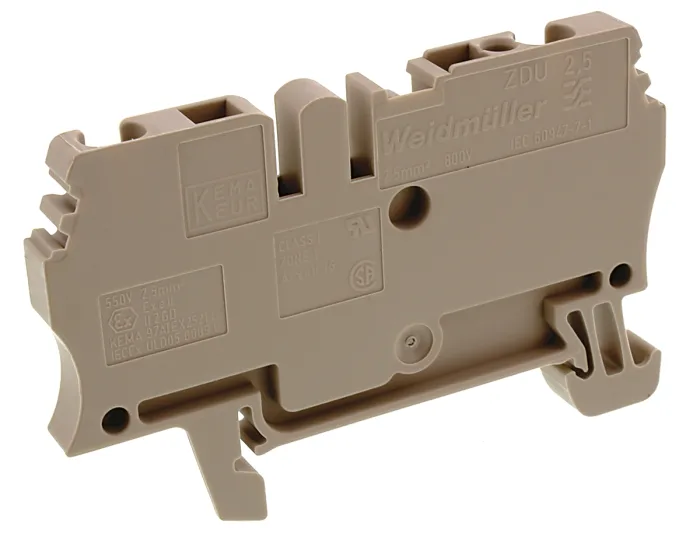
Weidmüller 1608510000 ZDU 2.5 Terminal Block Guide
Terminal blocks are among the most fundamental components in any electrical cabinet, yet their role is often underestimated. The Weidmüller 1608510000 ZDU 2.5 terminal block is a feed-through terminal block designed for connecting or joining conductors with permanently secure contact. For professionals searching for a Weidmüller ZDU 2.5 terminal block, 2.5 mm² feed-through terminal, or DIN rail terminal block 24 A 800 V, this model represents a straightforward and dependable connection solution.
What Is the ZDU 2.5?
The Weidmüller ZDU 2.5 is a feed-through terminal block with screw connection, a conductor capacity of 2.5 mm², a 24 A current rating, and a rated voltage of 800 V. It is also described as having two connections and a dark beige housing. In practical panel-building terms, this makes it a classic terminal solution for structured conductor routing and dependable electrical continuity.
Feed-through terminals are used where incoming and outgoing conductors need a clean, secure junction point on a DIN rail. That sounds simple, but in real cabinets, the quality of these connection points affects safety, maintenance speed, and long-term wiring stability.
Technical Features That Support Reliability
The official product information describes the Weidmüller 1608510000 terminal block as a component for permanently secure contact. It also highlights the material logic behind that reliability: hardened steel withstands mechanical forces, while tin-coated copper supports dependable electrical conductivity. These details matter because terminal blocks must handle both electrical and mechanical stress over long service periods.
The 2.5 mm² conductor size makes the terminal useful across a wide range of control and distribution tasks, while the 24 A and 800 V values position it as a capable solution for many standard industrial applications.
Where the ZDU 2.5 Is Commonly Used
The Weidmüller ZDU 2.5 feed-through terminal block is commonly used in control cabinets, distribution panels, machine wiring assemblies, and building infrastructure systems. It is especially relevant in installations where conductors must be joined in a clear, documented, and DIN rail-organized format.
Because terminal organization is central to serviceability, products like the ZDU 2.5 help make panel layouts easier to read and maintain. They also support clearer schematic-to-cabinet correlation, which is critical during troubleshooting.
Why Feed-Through Terminals Remain Essential
Despite advances in electronics and compact automation, the need for secure conductor termination has not changed. The Weidmüller 1608510000 ZDU 2.5 terminal block remains relevant because it provides a reliable physical interface for conductor management. It supports structured installation, predictable maintenance, and long-term cabinet clarity.
Weidmüller 1608510000 FAQ
What is the Weidmüller 1608510000 ZDU 2.5?
It is a feed-through terminal block with screw connection, designed for connecting or joining conductors with permanently secure contact.
What conductor size is associated with this terminal block?
The terminal block is associated with a conductor size of 2.5 mm², making it suitable for many standard control and distribution tasks.
Weidmüller 1608510000 What are the electrical ratings of the ZDU 2.5?
The official product information associates it with 24 A current rating and 800 V rated voltage.
Why is material construction important in a terminal block?
Because terminal blocks must withstand both electrical demands and mechanical forces over time. Hardened steel and tin-coated copper support that long-term reliability.
Where is the ZDU 2.5 typically used?
It is typically used in industrial control cabinets, machine wiring, building systems, and other DIN rail terminal applications.
Why are feed-through terminals still so important?
Because they provide clear, secure, and maintainable conductor junction points, which are essential for safe and organized panel construction.
For more information about Weidmüller, you can review related terminal blocks and connection technologies.