
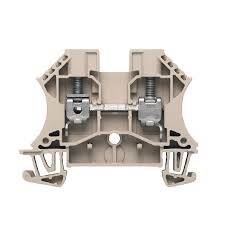
Weidmüller 1006740000 PCB Terminal Block Guide
The Weidmüller 1006740000 PCB terminal block, named LUP 12.70/06/90 3.2SN GY BX SO, is a much heavier-duty board connection solution than the smaller 5.08 mm plug families. It is designed for high-power PCB applications where conductor size, current carrying capability, and physical spacing are more demanding than in standard signal or control connectors.
Anyone searching for Weidmüller 1006740000 terminal block, LUP 12.70 PCB terminal, or high-current PCB terminal block 12.70 mm is usually looking for a product built for power electronics rather than ordinary low-power board wiring. This model fits that need directly.
Weidmüller 1006740000 Technical foundation of the product
Recent product references describe the connector as a printed circuit board terminal with 12.70 mm pitch, 6 poles, and 90° conductor outlet direction. The solder pin length is listed as 3.2 mm. Most importantly, the official data sheet states that this terminal provides connections for 1000 V, 76 A, and conductor cross-sections up to 16 mm², using a clamping yoke connection. :contentReference[oaicite:11]{index=11}
Why this PCB terminal block stands apart
The difference between this product and smaller PCB connection parts is significant. A 12.70 mm pitch is not chosen for convenience alone. It is typically selected when the electrical and mechanical demands of the application call for greater spacing, stronger conductor support, and more robust power handling on the board.
That makes the Weidmüller 1006740000 PCB terminal block relevant in areas such as inverter assemblies, motor drive electronics, power supply designs, energy control systems, and industrial boards where larger cable cross-sections are a real requirement rather than an exception.
Why 16 mm² conductor support matters
Supporting conductors up to 16 mm² changes the role of the component entirely. This is no longer a small board connector for routine control lines. It becomes part of the power path. In industrial design terms, that often means the product is involved in systems where current transfer, thermal management, and mechanical retention all matter at a higher level.
The Weidmüller LUP 12.70/06/90 3.2SN GY BX SO PCB terminal block therefore belongs in discussions about power-stage architecture, not just connector selection. Engineers working on higher-load board assemblies will recognize that distinction immediately.
Weidmüller 1006740000 Why the 90° design is practical
The 90° conductor outlet orientation can be highly useful when larger conductors need to approach the board from a controlled direction. In many power-electronic layouts, this helps manage cable bend radius, enclosure constraints, and alignment with other mechanical features in the system.
Combined with a 6-pole layout, the connector offers meaningful connection capacity while still preserving an organized board interface. For complex power modules, that can support cleaner assembly and better service visibility.
Weidmüller 1006740000 FAQ
What is Weidmüller 1006740000?
It is a high-capacity PCB terminal block designed for power-oriented board applications. It has 6 poles, 12.70 mm pitch, 90° conductor outlet direction, and a clamping yoke connection system.
What makes this different from smaller pluggable PCB connectors?
This product is intended for much higher electrical demand. It supports up to 1000 V, 76 A, and conductor sizes up to 16 mm², which puts it in a different category from smaller control-focused connector families.
Where is this PCB terminal block typically used?
Typical applications include inverter systems, motor drives, power supplies, energy distribution assemblies, industrial power electronics, and other board designs where larger conductors and higher current levels must be managed directly on the PCB.
Why is 12.70 mm pitch important here?
A wider pitch helps support higher-power design requirements by giving more physical spacing for conductor handling and electrical separation. In demanding board layouts, that is often a critical design factor rather than a cosmetic choice.
Why would engineers choose a 90° conductor outlet?
A 90° outlet can improve the approach path for heavier conductors, support more controlled routing, and make integration easier in enclosures where cable direction and bending space must be carefully managed.
For more information about Weidmüller, you can review additional PCB terminal and industrial interconnection solutions.