
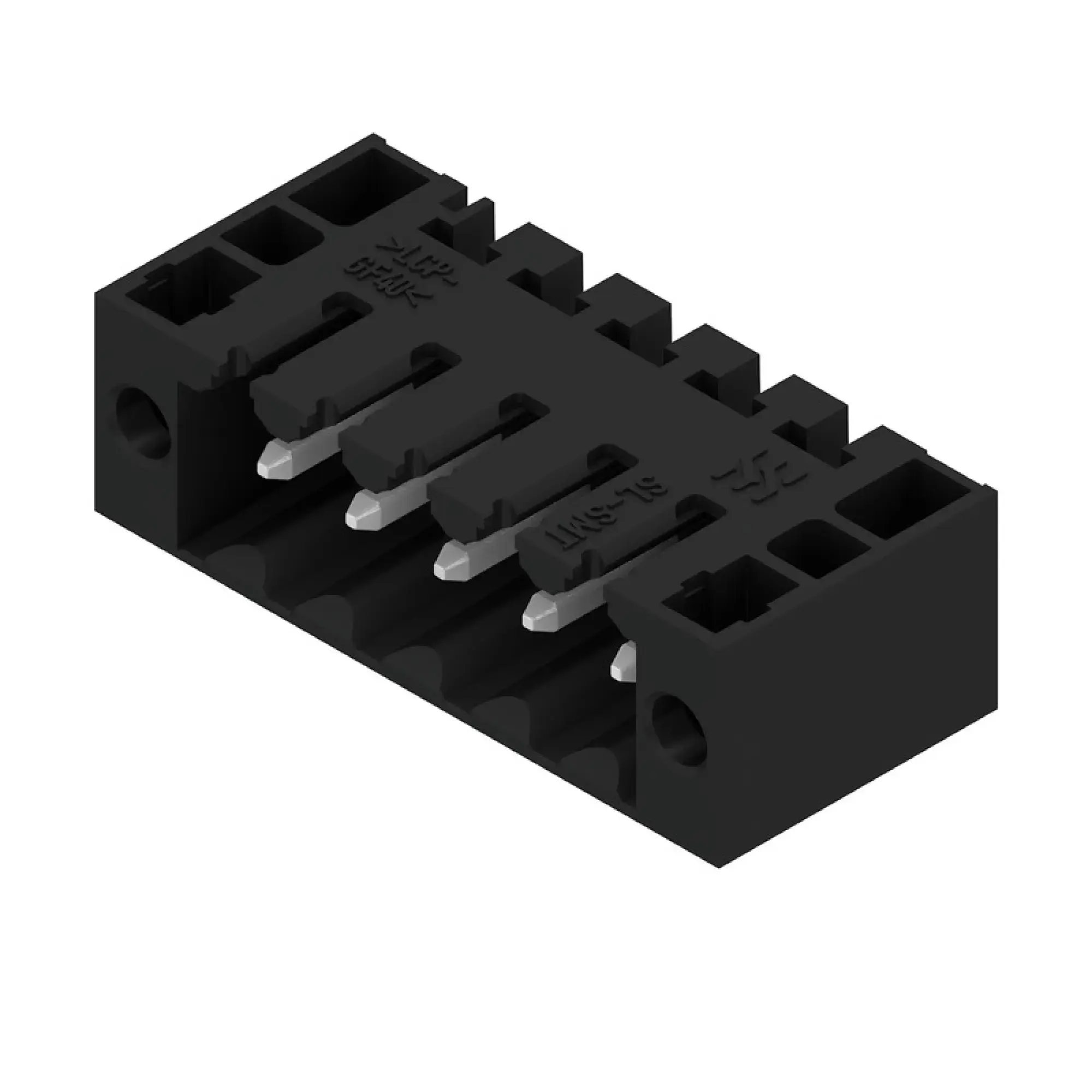
Weidmüller 1003520000 SL-SMT 3.50/03/135F 3.2SN BK BX Guide
The Weidmüller 1003520000 SL-SMT 3.50/03/135F 3.2SN BK BX is a 3-pole PCB male header intended for compact, structured board connectivity in professional electronics. It belongs to a connector style that works especially well where engineers need a small pluggable interface without giving up predictable alignment, reliable solder anchoring, and clean mating geometry.
Core product identity
As a Weidmüller 1003520000 PCB plug-in connector male header, this part combines a 3.50 mm pitch, 3 poles, a 135-degree orientation, and a THT/THR solder connection. It also includes a flange, which supports more controlled mounting and handling in many connector arrangements. The black housing and tinned contact finish reflect a practical industrial design language rather than a consumer-oriented one.
Three-pole connectors are often selected for signal combinations such as supply, return, and control line arrangements, or for compact field interfaces where a balanced but minimal circuit grouping is needed. That makes this product type particularly useful in smart control modules and compact electronic subassemblies.
Technical profile
The official product data for the Weidmüller SL-SMT 3.50/03/135F 3.2SN BK BX male header lists IEC 320 V / 15 A and UL 300 V / 10 A. The solder pin length is 3.2 mm, and the part is packaged in a box. Those numbers indicate that, despite its compact size, the connector is engineered for serious board-level use in professional electrical and electronic equipment.
The 135-degree form is another important design element. In real assemblies, connector angle affects routing, mating access, and usable space inside the housing. Choosing the right angle can simplify everything from harness layout to technician access during maintenance.
Application relevance
The Weidmüller 1003520000 SL-SMT 3.50/03/135F 3.2SN BK BX product type can be relevant in sensor interfaces, control electronics, measurement devices, compact industrial communication modules, and building automation products. In all of those areas, a connector must do more than fit electrically. It also needs to support layout discipline, assembly efficiency, and repeatable field handling.
A three-pole header is often a sweet spot. It gives a bit more design flexibility than a 2-pole version while still remaining compact and easy to position on crowded PCBs. For engineers trying to keep a product small without making the connectivity look improvised, that balance can be highly valuable.
Weidmüller 1003520000 Design perspective
Good connector selection is about system thinking. The board footprint, the counterpart, the wire path, the enclosure shape, and the maintenance workflow all influence whether a part performs well in practice. The Weidmüller 1003520000 3-pole male header supports a disciplined PCB connection strategy because it combines a compact footprint with a defined pluggable architecture.
Weidmüller 1003520000 Weidmüller 1003520000 For more information about Weidmüller, it is useful to compare other members of the same 3.50 mm family when a project may require multiple pole counts under one common connector platform.
Weidmüller 1003520000 FAQ
What kind of connector is Weidmüller 1003520000?
It is a 3-pole PCB plug-in connector male header with flange, THT/THR solder connection, and a 135-degree orientation.
Why is a 3-pole header useful?
A 3-pole header provides a practical compact interface for applications needing one more connection point than a basic 2-pole design, such as supply-plus-signal combinations or simple control groupings.
What does the 3.50 mm pitch mean?
It describes the spacing between poles. A 3.50 mm pitch is widely used in compact industrial PCB connector families because it supports efficient board use without becoming overly delicate.
Does the flange make a difference?
Yes. A flanged design can help with positioning, mechanical consistency, and integration depending on the mating and mounting concept used in the final assembly.
Is this only for signal circuits?
Not necessarily. Its official ratings show that it can serve a range of compact board connection needs, provided the complete application design and relevant standards are properly considered.
What should engineers confirm before specifying it?
They should confirm the mating counterpart, board layout compatibility, required insulation distances in the final product, and the mechanical effect of the 135-degree orientation inside the enclosure.