
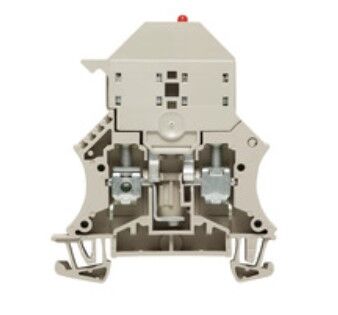
Weidmüller 1003370000 HDC CM BUS M1 CT WLD in Modular Heavy-Duty Connectivity
The Weidmüller 1003370000 HDC CM BUS M1 CT WLD is a modular insert developed for heavy-duty connector systems that require a configurable internal structure. In modern industrial engineering, flexibility at the connector level has become a real advantage. Machines are increasingly modular, product variants are more common, and interface requirements can change across installations. That is why modular insert concepts such as the Weidmüller HDC CM BUS M1 CT WLD are relevant.
The product is officially listed as a Heavy-duty connectors, HDC insert, ConCept module. Its physical dimensions are approximately 46.1 mm depth, 15.5 mm height, and 15.5 mm width, with a net weight of 30.2 g. The module also carries a UL 94 V-0 flammability rating, is described as low smoke according to DIN EN 45545-2, and is rated for at least 500 plugging cycles.
What the Weidmüller HDC CM BUS M1 CT WLD Is Designed To Support
The Weidmüller 1003370000 ConCept module is intended for modular heavy-duty connector assemblies where the internal connector layout should be adaptable. This makes it useful in applications where fixed inserts are too restrictive or where one connector family must support several technical variants.
Rather than forcing designers into a one-size-fits-all insert arrangement, modular connector systems allow a more selective build strategy. That improves engineering flexibility and can simplify both platform design and long-term maintenance planning.
Technical Characteristics That Matter
The module belongs to the ConCept module series and shares the design logic typical of modular HDC systems. The listed UL 94 V-0 rating is relevant for material performance, while the low-smoke statement tied to DIN EN 45545-2 can be important in transport-related or enclosed equipment environments. The ≥ 500 plugging cycles specification indicates that the module is intended for repeated industrial service rather than one-time assembly only.
The dimensional profile also matters. At 46.1 mm deep, the product has a different geometry than the F1 version, which shows that modular systems often use differently shaped components for specific positions or roles within the carrier arrangement.
Why Modular Connector Strategy Is Increasingly Useful
OEMs and integrators are under constant pressure to reduce redesign work while still supporting multiple equipment variants. A modular heavy-duty connector concept helps by making the connector interface more configurable. The Weidmüller 1003370000 HDC CM BUS M1 CT WLD fits that strategy by offering a module-level building block within a robust industrial connector environment.
That approach can improve spare-part planning as well. Once a connector housing framework is standardized, only the relevant module positions may need to change between applications.
Application Areas
This product is relevant in modular machine building, rail-related and transport systems, advanced industrial automation equipment, and heavy-duty connector assemblies where flexibility is part of the original design brief.
Weidmüller 1003370000 For more information about Weidmüller, reviewing the full ConCept module portfolio provides helpful context for system configuration.
Weidmüller 1003370000 FAQ
What is the Weidmüller 1003370000 HDC CM BUS M1 CT WLD?
It is a modular insert for heavy-duty connector systems in the ConCept module range.
What are the dimensions of the product?
The listed dimensions are approximately 46.1 mm depth, 15.5 mm height, and 15.5 mm width.
How durable is the module in terms of mating cycles?
The module is rated for at least 500 plugging cycles.
What material classification is listed?
The product is associated with a UL 94 V-0 flammability rating.
Why is a modular insert useful in industrial connectors?
It allows the internal connector arrangement to be configured more flexibly, which is valuable for machine variants and application-specific interface requirements.
Where is the Weidmüller HDC CM BUS M1 CT WLD typically used?
It is typically used in modular heavy-duty connector systems for machinery, industrial automation, and transport-related equipment.