
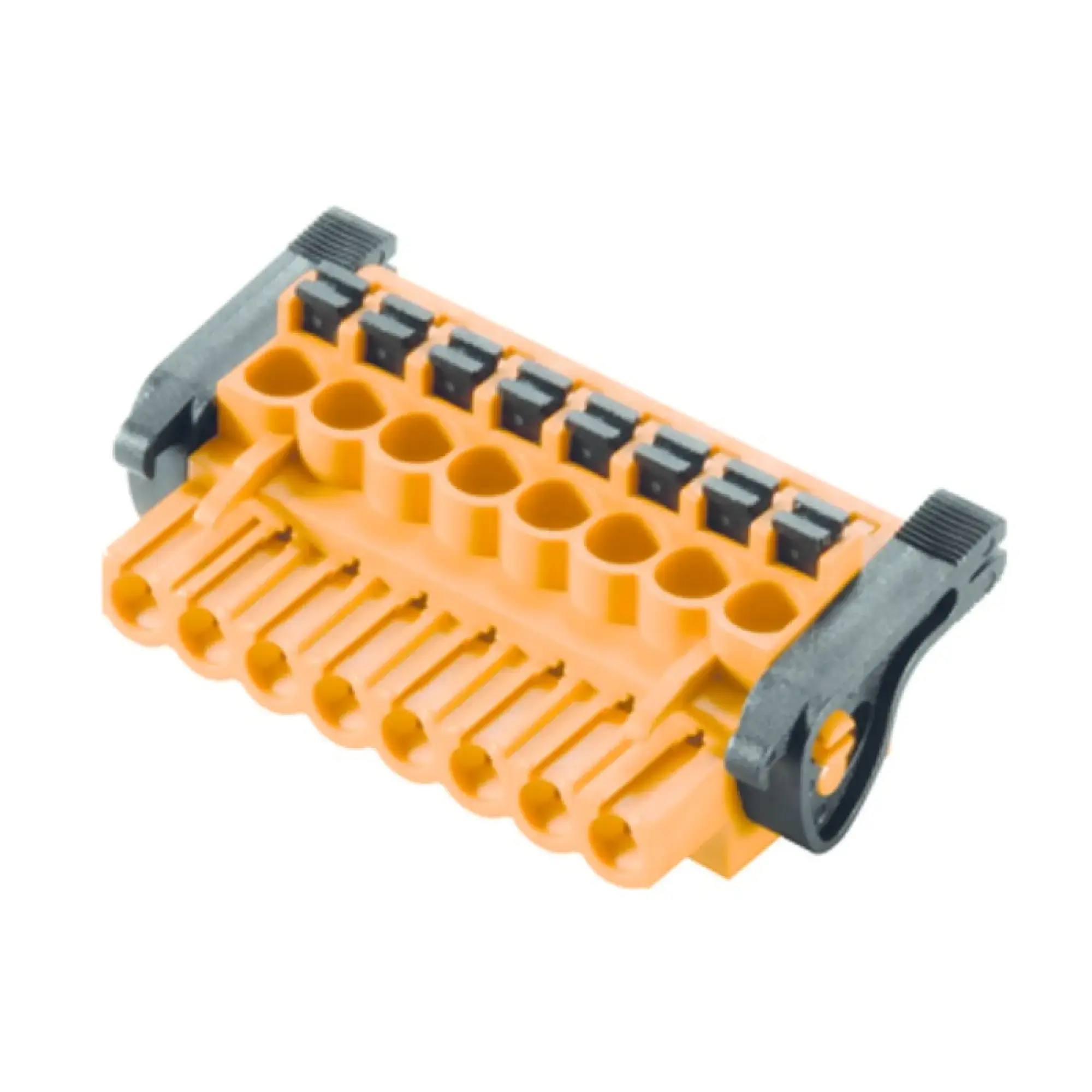
Weidmüller 1002290000 BLF 5.08HC/03/90LR SN OR BX PCB Plug-in Connector Guide
The Weidmüller 1002290000 BLF 5.08HC/03/90LR SN OR BX PCB plug-in connector is a 3-pole female plug designed for dependable field wiring in compact industrial electronics. It belongs to the OMNIMATE Signal BL/SL 5.08 family and uses a 5.08 mm pitch, a 90° conductor outlet, and a PUSH IN connection with actuator. In this exact version, users get a 3-pole layout, a rated cross-section of 2.5 mm², a clamping range up to 3.31 mm², IEC values up to 400 V / 24 A, UL values up to 300 V / 18.5 A, IP20 protection when plugged, and a compact body width of 25.06 mm with L1 of 10.16 mm.
What Makes the Weidmüller BLF 5.08HC/03/90LR SN OR BX Relevant?
In industrial PCB design, connector selection is rarely a minor decision. A connector has to support electrical performance, assembly speed, serviceability, and long-term reliability. The Weidmüller BLF 5.08HC/03/90LR SN OR BX female plug connector answers that requirement with a format that is practical for control boards, interface modules, power distribution sections, and signal-level industrial devices where three positions are exactly what the design calls for.
Weidmüller 1002290000 Because this is a 3-pole PCB plug-in connector, it is particularly useful in applications that need line, neutral, and protective or control conductors in a clearly organized arrangement. Engineers often choose a 3-pole architecture when they want a straightforward, service-friendly termination concept without wasting board space on unused positions.
Core Technical Characteristics
The Weidmüller 1002290000 connector uses PUSH IN technology with an actuator, which helps simplify conductor insertion while maintaining a stable and durable connection. That matters in control cabinets and industrial devices where installers value fast wiring and maintenance teams value repeatable results. The conductor outlet is angled at 90 degrees, which is especially helpful where enclosure depth is limited or where wire routing must remain flat and controlled.
The material platform also supports real industrial use. The insulation is based on PBT, the flammability class is UL 94 V-0, the contact material is copper alloy, and the contact surface is tinned. These details matter because the connector is not just a mechanical accessory; it is a functional electrical interface that has to remain reliable under thermal stress, repeated handling, and typical industrial environmental conditions.
Weidmüller 1002290000 Why the 3-Pole Version Is a Practical Choice
A 3-pole connector often fits projects where designers need balanced functionality and compactness. The Weidmüller BLF 5.08HC/03/90LR SN OR BX connector gives enough positions for common three-conductor layouts while keeping the footprint lean. On dense PCBs, that can be the difference between a clean layout and a compromised one.
Another advantage is clarity in service. When a field technician opens a device, a 3-pole pluggable connector is easy to understand, easy to label, and easy to reconnect correctly. In real-life industrial maintenance, simple and obvious connection architecture reduces avoidable downtime.
Electrical and Installation Considerations
From a specification perspective, this connector supports solid and flexible conductors from 0.2 mm² to 2.5 mm², with a stripping length of 10 mm. It is also suitable for AWG 26 to AWG 12. For many control and interface applications, that range gives engineers useful flexibility during product development and during regional adaptation for different wiring practices.
The product is also designed with touch safety in mind. When plugged, it offers IP20 protection, which aligns with many cabinet-based applications where connector protection and safe handling both matter. The fact that it can also be coded is valuable in modular systems, because coding helps avoid mismating and supports cleaner service workflows.
Weidmüller 1002290000 Where This Connector Is Commonly Used
The Weidmüller 1002290000 BLF 5.08HC/03/90LR SN OR BX PCB connector fits a broad set of industrial scenarios. Typical examples include compact controller boards, machine interface electronics, building automation modules, signal adaptation boards, industrial power interface sections, and sensor or actuator distribution assemblies. It is especially relevant when the product architecture benefits from plug-in service access instead of permanent wiring directly on the PCB.
That serviceability point should not be underestimated. In many control systems, field replacement time directly affects total maintenance cost. Pluggable connector systems help shorten intervention time and reduce handling errors during replacement or inspection.
Weidmüller 1002290000 FAQ
Is the Weidmüller 1002290000 suitable for industrial control boards?
Yes. Its electrical ratings, flame-retardant housing, tinned copper-alloy contacts, and pluggable design make it well suited for industrial control and interface boards where structured, maintainable wiring is important.
What is the benefit of the 90-degree outlet in this connector?
A 90-degree outlet helps route wires parallel to the PCB or enclosure wall. This can improve space usage, reduce cable stress, and support neater internal layout in compact housings.
Why would someone choose a 3-pole connector instead of a larger version?
A 3-pole version is ideal when the circuit genuinely needs three conductors and nothing more. It preserves board space, keeps the wiring concept simple, and avoids unnecessary connector width.
Does PUSH IN technology help during installation?
Yes. PUSH IN with actuator is widely appreciated because it supports quick conductor insertion and straightforward handling during initial assembly and later maintenance work.
Can this connector support both solid and flexible wires?
Yes. It is designed for a broad conductor range, covering both solid and flexible wires commonly used in industrial applications. Ferruled conductors can also be used within the specified range.
Is the product appropriate for service-friendly device design?
Absolutely. A pluggable connector architecture is often chosen specifically to improve field service, reduce rewiring effort, and simplify module replacement.
For more information, visit Weidmüller.