
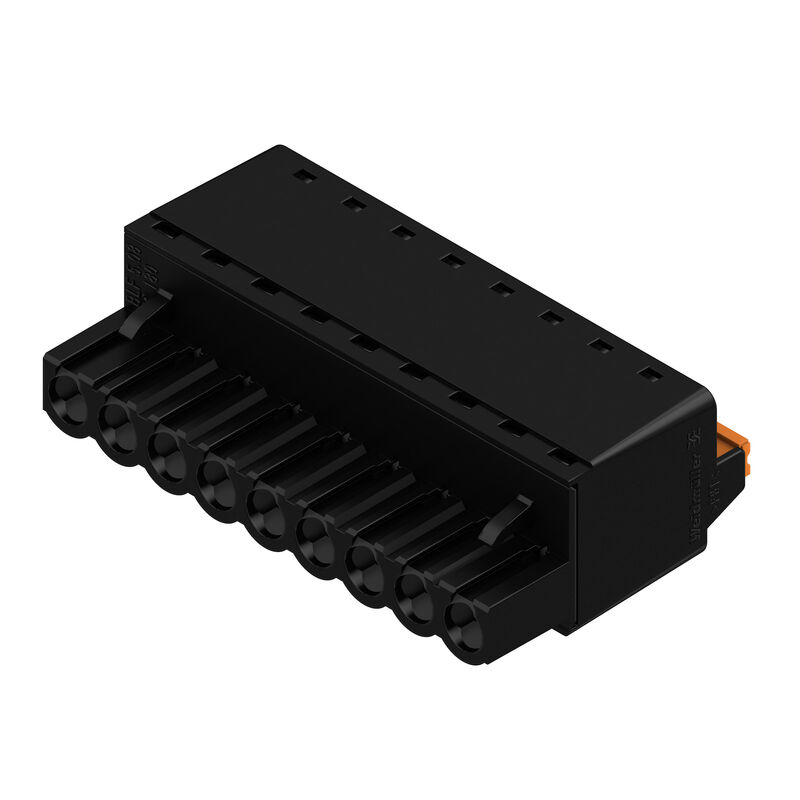
Weidmüller 1000120001 BLF 5.08HC/11/90 SN BK BX In-Depth Guide
The Weidmüller 1000120001 BLF 5.08HC/11/90 SN BK BX PCB plug-in connector is an 11-pole female plug designed for removable wire-to-board connectivity in industrial electronics. Engineers evaluating an 11-pole PCB connector, a Weidmüller pluggable terminal block, or a 5.08 mm right-angle connector for automation boards will find this model relevant when higher channel counts are required in one structured interface.
In advanced devices, connection density often increases faster than available board space. That is where the Weidmüller BLF 5.08HC/11/90 SN BK BX becomes useful. It combines a relatively high pole count with a familiar 5.08 mm connector format, allowing designers to keep wiring consolidated without moving away from a known industrial connection standard.
Weidmüller 1000120001 Why the 11-Pole Format Is Useful
An 11-pole connector may sound specialized, but it can be a very practical choice in control electronics, interface hardware, machine subsystems, and modular devices where the required conductor count does not align with round numbers like 8 or 10. Using the correct pole count helps avoid unused positions, supports cleaner labeling, and preserves the logic of the wiring design.
The Weidmüller 1000120001 PCB plug-in connector is therefore valuable not only for electrical reasons, but also for system organization. It helps the product reflect the real wiring requirement rather than forcing the design into an oversized component.
Weidmüller 1000120001 Technical Characteristics in Context
The Weidmüller 1000120001 BLF 5.08HC/11/90 SN BK BX female plug is based on a 5.08 mm pitch and a right-angle conductor entry. It uses PUSH IN spring connection technology with actuator support and is intended as a removable PCB connection solution. The black housing format and family-level compatibility make it suitable for industrial device platforms where consistency and reliability are important.
In operation, this connector supports an orderly relationship between PCB design and field wiring. That matters because the connector is one of the few components that directly links internal electronics to external installation practice. When that link is well designed, assembly and service both become easier.
Common Application Scenarios
The Weidmüller 11-pole PCB connector can be used in automation controllers, monitoring devices, energy management boards, communication modules, HVAC electronics, and equipment interfaces where eleven conductors must be grouped into one removable connection point. The 90-degree layout is especially useful in shallow housings or side-entry wiring concepts.
Many designers also prefer this type of pluggable connector when products need modular assembly. Wiring can be handled in a structured way, and replacement workflows become more manageable because the interface is clearly defined.
For more information about Weidmüller, it is worth comparing the wider BLF 5.08HC portfolio for neighboring pole-count alternatives.
Why It Matters for Product Lifecycle Efficiency
The real value of the Weidmüller 1000120001 is not limited to initial installation. Over the product lifecycle, removable connectors can support faster diagnostics, easier board exchange, and cleaner maintenance procedures. In professional equipment, these factors directly affect downtime, service cost, and technician experience.
That is why a connector like this should be viewed as a strategic mechanical-electrical interface rather than a commodity part. The right choice at the connector level often improves the overall usability of the device.
FAQ
What makes the Weidmüller 1000120001 different from lower-pole models?
Its 11-pole layout provides more conductor positions in one connector body, which is useful for more complex circuits and grouped wiring concepts.
Is an 11-pole connector really necessary in some applications?
Yes. In many devices, the actual conductor count does not align with common even-number formats. Choosing 11 poles can avoid oversizing and keep the interface aligned with the circuit design.
What role does the right-angle design play?
It helps route wires sideways instead of vertically, which can improve internal space usage and support cleaner cable organization.
Why is removable PCB connectivity important?
It improves installation flexibility, simplifies replacement, and supports service-friendly product architecture in professional equipment.
Is the BLF 5.08HC family suitable for standardization?
Yes. The family structure allows engineers to keep a consistent connection philosophy across multiple device versions while varying the pole count as needed.