
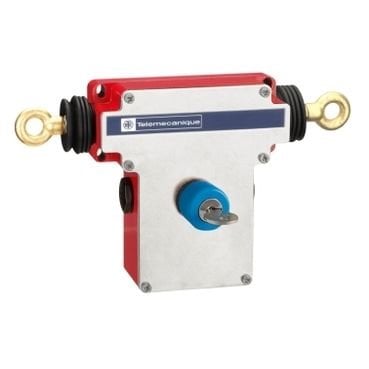
Telemecanique XY2CEDA590 Dual Emergency Stop Rope Pull Switch
The Telemecanique XY2CEDA590 dual emergency stop rope pull switch is built for machine safety systems that require emergency stop access across two rope directions. It belongs to the Telemecanique XY2CED family and is commonly selected for conveyors, automated handling equipment, industrial process lines, and machinery where operators may need to stop movement from either side of a protected zone.
Product Overview
XY2CEDA590 is a dual emergency stop rope pull switch with right-hand and left-hand anchor points. It has a 2 x (1 NC + 1 NO) contact configuration and a key-release pushbutton reset. This reset method supports controlled restart procedures because the device remains in a safe tripped condition until a qualified person performs the reset.
The switch is supplied without a pilot light. It has a red RAL 3000 housing, a Zamak body, a stainless steel cover, and nitrile bellow material. The contact operation is slow-break, and the connection is made through screw clamp terminals suitable for 0.5 to 1.5 mm² conductors.
Key Technical Characteristics
- Brand and code: Telemecanique XY2CEDA590
- Product type: Dual emergency stop rope pull switch
- Device short name: XY2CED
- Anchor points: Right-hand and left-hand sides
- Contacts: 2 x (1 NC + 1 NO)
- Reset: Key-release pushbutton
- Key number: 455
- Contact operation: Slow-break
- Protection: IP65 according to IEC 60529
- Body material: Zamak
- Cover material: Stainless steel
Safety Function
The main purpose of the XY2CEDA590 is to provide a reliable emergency stop input across extended machinery. When either rope is pulled, the device changes contact state and sends the stop command through the connected safety circuit. The normally closed contacts are typically used in the safety loop, while the normally open contacts may be used for feedback or status indication.
Why Key-Release Reset Is Important
The key-release pushbutton reset helps prevent uncontrolled restart after an emergency stop event. Once the rope pull switch has been activated, the machine should not be returned to operation until the cause has been reviewed. This supports safer restart discipline and helps maintenance teams maintain better control over hazardous areas.
Industrial Applications
The Telemecanique XY2CEDA590 dual emergency stop rope pull switch is well suited for conveyor lines, sorting equipment, transfer systems, bottling lines, packaging machines, process automation cells, and long machinery zones. The dual anchor layout is practical when the switch is installed near the center of a machine section and rope access is needed on both sides.
Installation Guidance
Installers should ensure that the rope is clearly visible, easily reachable, and correctly tensioned. Both sides of the system should be checked for movement, obstruction, excessive sag, and possible mechanical damage. Electrical wiring must follow the safety relay or safety controller documentation, and the final design should be validated according to the required performance level.
For additional information, see more about Telemecanique.
FAQ
What is Telemecanique XY2CEDA590?
It is a dual emergency stop rope pull switch used to provide emergency stop coverage in two cable directions.
How is it different from XY2CEDA290?
Both are dual rope pull switches with 2 x (1 NC + 1 NO) contacts. XY2CEDA590 uses a key-release pushbutton reset, while XY2CEDA290 uses a booted pushbutton reset.
Does XY2CEDA590 include a pilot light?
No. The official specification lists it without pilot light signalling.
What is the IP protection rating?
The model is specified with IP65 protection according to IEC 60529.
What safety level can it support?
When correctly wired with suitable monitoring equipment, it can support PL e, category 4, and SIL 3 safety architectures.
What materials are used?
The body is Zamak, the cover is stainless steel, and the bellow material is nitrile.
Where is this switch commonly installed?
It is commonly installed on conveyor systems, handling lines, automated processing machines, and other long equipment zones.
Why is routine testing necessary?
Routine testing confirms that the rope, reset mechanism, contacts, terminals, and connected safety circuit respond correctly when the device is actuated.