
Telemecanique XUYFANEP40080 Photoelectric Fork Sensor: Specifications and Use
Fork sensors are a practical choice when you want a controlled sensing geometry without the alignment overhead of separate emitter/receiver components. The Telemecanique XUYFANEP40080 photoelectric sensor is a fork design using a through-beam detection system with an infrared LED (modulated). This configuration is frequently used for precise passage detection on compact conveyors, vibrating rails, label dispensing lines, and other stations where repeatability is critical.
Why a Fork Sensor Architecture Helps
A fork sensor places emitter and receiver in a single rigid body, so the optical path is fixed by design. This is useful when maintenance teams need predictable results after replacement, or when the machine environment includes vibration. For the Telemecanique XUYFANEP40080 photoelectric sensor, the fork opening provides a defined “window” that the target must pass through, supporting consistent trigger points for counting and verification tasks.
Key Technical Specifications (From Datasheet)
- Product type: Telemecanique photoelectric sensor (XU series), fork sensor (XUY)
- Detection system: Through-beam
- Emission: Infrared LED, modulated
- Fork opening: Passage width 80 mm; passage depth 42 mm
- Nominal sensing distance: 80 mm
- Supply: 12…24 V DC (limits 10…30 V DC), reverse polarity protection
- Wiring: 4-wire
- Outputs: PNP and NPN; programmable 1 NO or 1 NC
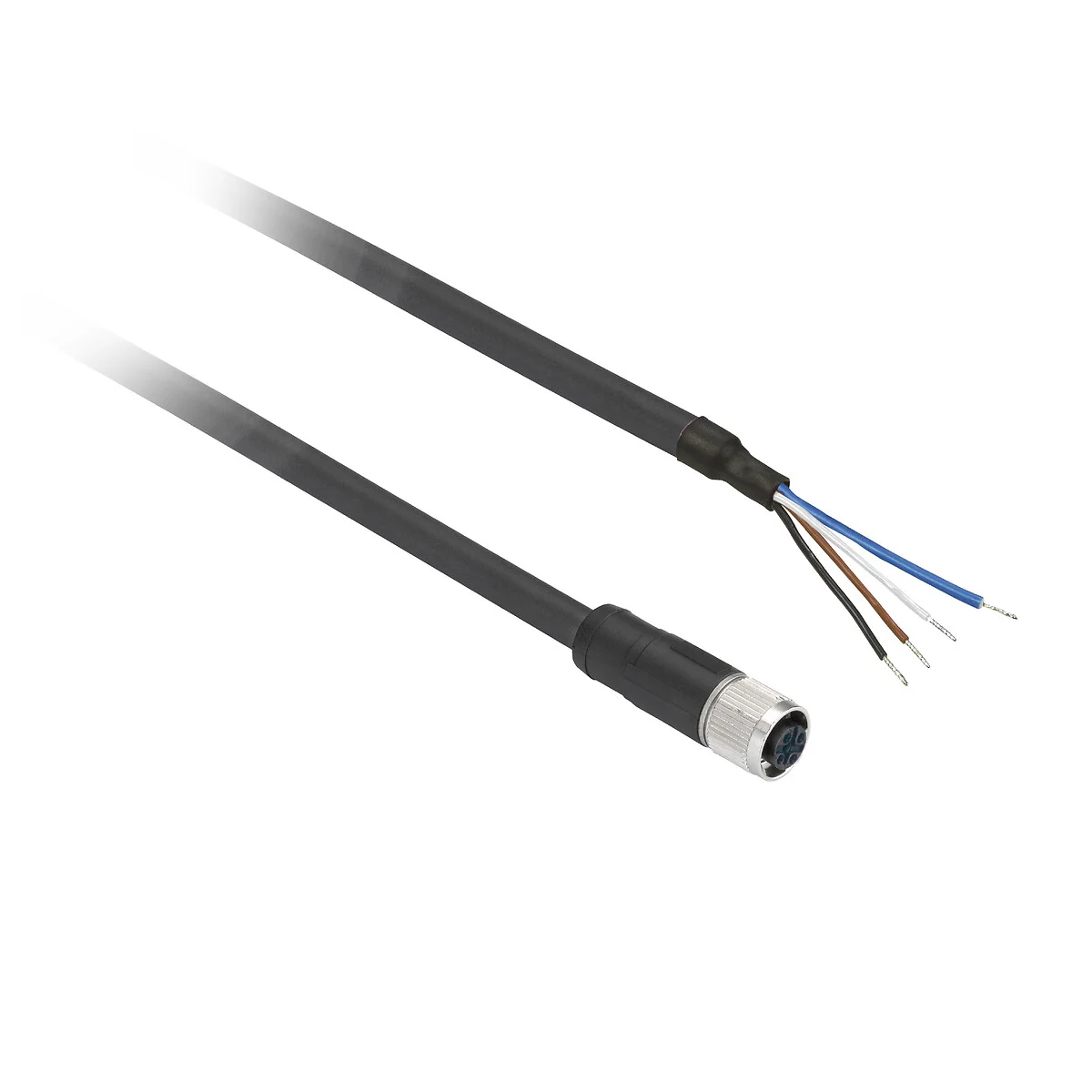
- Connection: 1 male connector M8, 4 pins
- Switching frequency: 10 kHz
- Current consumption: 40 mA no-load
- Response time: 20…20 µs (as listed in datasheet table)
- Protection: IP65
- Operating temperature: -20…60 °C
In practical terms, the Telemecanique XUYFANEP40080 photoelectric sensor combines a fixed optical path with high switching frequency, making it well suited for rapid detection tasks such as label gaps, sheet edges, and small-item counting where timing jitter can create downstream errors.
Commissioning: Achieving Stable Detection
The datasheet notes a “self teaching” setup approach. In commissioning, ensure the target passes through the center of the fork opening and that mechanical guides keep the product path consistent. When used for labels or thin materials, maintain a stable edge presentation so the sensor sees repeatable transitions. For vibrating rails or feeders, mount the sensor rigidly and confirm that the rail vibration does not cause the material path to drift against the fork edges.
If you are building a broader standard for parts selection and documentation, it can be helpful to review related families under the Telemecanique sensor category and align on connector type (M8 vs M12), output logic (PNP/NPN), and IP rating for each machine area.
Wiring and Control Logic
The Telemecanique XUYFANEP40080 photoelectric sensor supports both PNP and NPN outputs, plus a programmable NO/NC function. This is valuable in plants where different PLC input standards exist across older and newer lines. In documentation, define a consistent rule for signal naming (for example “part present” vs “beam broken”) so that programming teams can reuse function blocks without confusion. The M8 4-pin connector simplifies maintenance swaps and reduces termination variation compared to loose wires.
Common Applications
- Label detection: Detect labels or gaps on dispensing machines.
- Vibrating rail passage detection: Confirm part flow and prevent starvation.
- Small conveyor counting: High switching frequency supports rapid item flow.
- Double-sheet detection support: Suitable for detecting reference marks and sheet presence when configured correctly.
These use cases reflect how the Telemecanique XUYFANEP40080 photoelectric sensor is positioned in its datasheet: compact, fast, and mechanically guided to deliver stable results.
FAQ
1) What kind of sensor is Telemecanique XUYFANEP40080?
The Telemecanique XUYFANEP40080 photoelectric sensor is a fork-type through-beam sensor with a fixed optical path.
2) What is the fork opening size?
The datasheet lists 80 mm passage width and 42 mm passage depth, with nominal sensing distance 80 mm.
3) What output options are available?
It supports PNP and NPN outputs and allows a programmable 1 NO or 1 NC output function.
4) What is the electrical connection?
It uses a male M8 connector with 4 pins, supporting clean and maintainable wiring.
5) Is it suitable for high-speed detection?
Yes. The datasheet specifies a switching frequency of 10 kHz, which supports fast material flow and rapid transitions.