
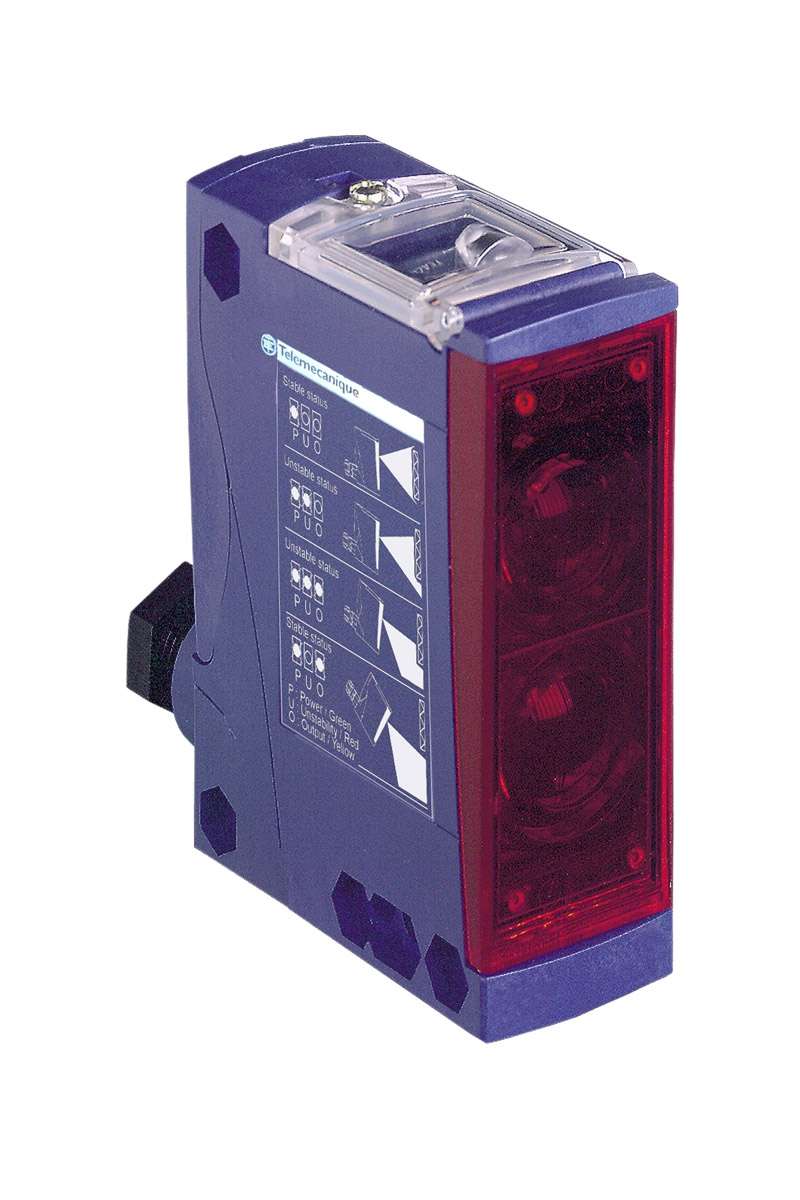
Telemecanique XUX9ARCNT16 Polarised Reflex Photoelectric Sensor: Background-Resistant Reflective Detection
The Telemecanique XUX9ARCNT16 polarised reflex photoelectric sensor is selected when you want reflector-based sensing but need stronger discrimination against reflective noise. In conventional reflex sensing, shiny targets or nearby metal surfaces can return stray reflections that create false detection. Polarisation improves selectivity by filtering the returned light path, which helps the sensor “prefer” the reflector return and ignore random reflections. This becomes valuable in packaging lines with glossy films, pallet stations with reflective wrap, or conveyor corridors with stainless guarding.
Confirmed product characteristics
Official datasheet sources describe XUX9ARCNT16 as a compact 92 × 71 XUX sensor using a polarised reflex detection system with Sn 11 m, a 24…240 VAC/DC supply range, and terminals. Sensitivity adjustment is referenced as a setup feature, and relay-style terminal wiring (NO/NC via common) is shown in connection schema.
Technical snapshot
- Brand + code + type: Telemecanique XUX9ARCNT16 polarised reflex photoelectric sensor
- Detection system: Polarised reflex
- Nominal distance: Sn 11 m
- Supply: 24…240 VAC/DC
- Connection: Terminals (relay wiring schema)
- Setup feature: Sensitivity adjustment
Why polarisation is operationally meaningful
In reflective environments, false positives are expensive: they can stop conveyors, trigger miscounts, or cause mistimed actuations. Polarised reflex sensing reduces sensitivity to random reflective returns. For the Telemecanique XUX9ARCNT16 polarised reflex photoelectric sensor, the practical benefit is fewer nuisance alarms when products vary in gloss or when background surfaces are reflective.
That said, polarisation is not magic. Reflector quality, alignment discipline, and cleanliness still determine performance. The best results come from treating the sensor and reflector as a single engineered pair, not as separate parts.
Commissioning governance: align, validate, then tune sensitivity
A high-reliability commissioning sequence typically looks like this:
- Mount sensor and reflector on rigid brackets with repeatable datums.
- Align at the intended operating distance and verify a stable baseline return.
- Interrupt with the smallest required object and confirm clean switching at line speed.
- Remove the object and confirm there is no background-induced switching.
- Only then use sensitivity adjustment to optimize the margin—avoid over-sensitizing.
Sensitivity adjustment is referenced as a setup function; use it to improve stability, not to compensate for poor alignment or dirty optics.
Mechanical integration: long corridor means small errors become big
At 11 m, small angle deviations can move the beam significantly at the reflector. If the station vibrates, locking hardware is recommended. Route cables to avoid applying a slow twisting force to the terminal block area. Add protection where forklifts, pallets, or operator tools might hit the reflector. With the Telemecanique XUX9ARCNT16 polarised reflex photoelectric sensor, mechanical protection is often the difference between “works in commissioning” and “works for years.”
Electrical integration: relay terminals and control architecture
Terminal wiring indicates relay output behavior (NO/NC via relay common). In modern architectures, relay contacts are commonly used to signal PLC inputs rather than directly switching loads. This reduces electrical stress and improves lifecycle. If you must switch an inductive load, define suppression and verify contact ratings within the sensor’s electrical durability expectations.
For broader family alignment, consult Telemecanique sensor.
Telemecanique XUX9ARCNT16 FAQ
- What detection system is used by XUX9ARCNT16?
It is specified as polarised reflex. - What is the nominal sensing distance?
Sn 11 m is listed. - What supply range is supported?
24…240 VAC/DC is specified. - Does it offer sensitivity adjustment?
Yes, sensitivity adjustment is referenced as a setup feature. - What is the most common cause of instability in reflex systems?
Reflector contamination or alignment drift; preventive inspection and rigid mounts reduce failures.
Entity recap: The Telemecanique XUX9ARCNT16 polarised reflex photoelectric sensor provides Sn 11 m reflective detection with 24…240 VAC/DC supply and terminal/relay-style interface, designed to reduce reflective noise when aligned and governed correctly.