
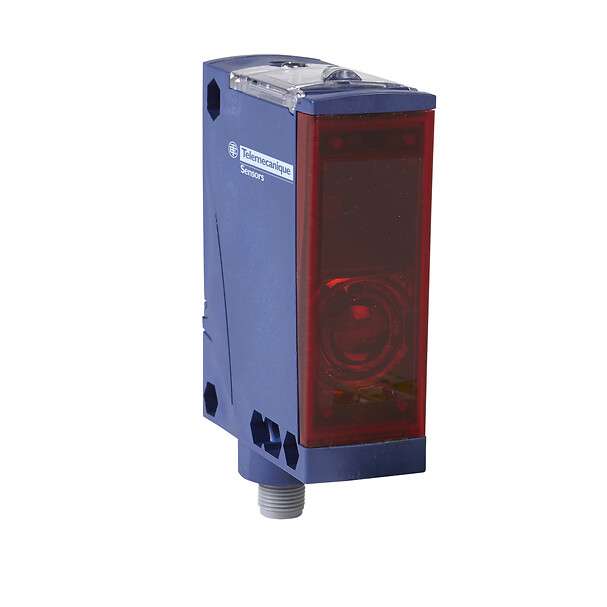
Telemecanique XUX5APANM12 Diffuse Photoelectric Sensor: Practical Guidance for Stable Short-to-Mid Range Detection
The Telemecanique XUX5APANM12 diffuse photoelectric sensor is used when you want a single-device presence detector without a reflector or a paired receiver. Diffuse sensing works by emitting light and detecting the portion reflected back from the target. This makes installation straightforward, but it also introduces a key engineering reality: target surface properties influence sensing reliability. A disciplined commissioning approach transforms diffuse sensing from “sometimes unstable” to “predictable and governed.”
Confirmed technical characteristics
The product reference documentation lists XUX5APANM12 as an XUX compact 92 × 71 photoelectric sensor with a diffuse detection system, DC supply, 3-wire wiring technique, PNP discrete output type, and 1 NO output function. The nominal sensing distance is specified as Sn 2.1 m for diffuse operation, and the connection is referenced with M12 in the product designation context.
Technical snapshot
- Brand + code + type: Telemecanique XUX5APANM12 diffuse photoelectric sensor
- Sensor design: Compact 92 × 71
- Detection system: Diffuse
- Nominal distance: Sn 2.1 m (diffuse)
- Electrical: DC, 3-wire
- Output: PNP, 1 NO
Diffuse sensing reality: reflectivity is part of your specification
Two targets at the same distance can behave differently if their surfaces reflect light differently. Glossy labels may return strong signals; matte black rubber may return weak signals. With the Telemecanique XUX5APANM12 diffuse photoelectric sensor, the most effective commissioning method is to validate using the worst optical case first: the darkest, most absorbent, or most angled target that will appear in production. When the worst case is stable, typical products will be stable as well.
Commissioning governance: a repeatable setup sequence
To reduce nuisance stops, implement a consistent setup sequence:
- Mount the sensor with a rigid bracket and prevent cable torque from rotating the body.
- Set the sensor orientation so the background behind the product is as non-reflective as possible.
- Validate switching on the worst-case target at the intended speed, not only static conditions.
- Remove the target and confirm the background does not trigger detection (background immunity check).
- Run a sustained trial to observe drift due to dust accumulation or vibration.
This governance approach is often more impactful than changing hardware models. The Telemecanique XUX5APANM12 diffuse photoelectric sensor becomes a reliable asset when the station’s optical assumptions are validated and documented.
Mechanical integration: avoid accidental “optical redesign”
A common failure pattern is an unintentional background change: a new stainless guard is installed, a painted panel becomes glossy after cleaning, or a reflective barcode label is added near the sensing corridor. Diffuse sensors can start triggering on those new surfaces. Treat background surfaces as part of the system design. If the station is expected to change, define an optical corridor that remains stable: consistent distance, predictable angle, and controlled background.
Electrical integration: PNP NO logic and PLC mapping
Because the device is specified as PNP with 1 NO function, document the PLC input logic accordingly. If your plant standard uses a particular naming convention, include the full identifier Telemecanique XUX5APANM12 diffuse photoelectric sensor in the I/O list and wiring drawings. This avoids substitution mistakes when multiple XUX sensors share the same housing but differ in optical mode or output behavior.
For broader selection mapping and family references, see Telemecanique sensor.
FAQ
- What detection mode is XUX5APANM12?
It is specified as a diffuse photoelectric sensor. - What is the nominal sensing distance?
Sn 2.1 m is listed for diffuse operation. - What output type is provided?
PNP with 1 NO function is specified. - Why can detection change when product color changes?
Diffuse sensing depends on reflected light; darker or matte surfaces return less light. - What is a fast troubleshooting checklist?
Clean the lens, verify bracket rigidity, check background reflectivity changes, then re-test worst-case targets.
Entity recap: The Telemecanique XUX5APANM12 diffuse photoelectric sensor is a compact 92 × 71, DC 3-wire PNP NO device with Sn 2.1 m diffuse range, optimized for governed presence detection where target variability is validated.