
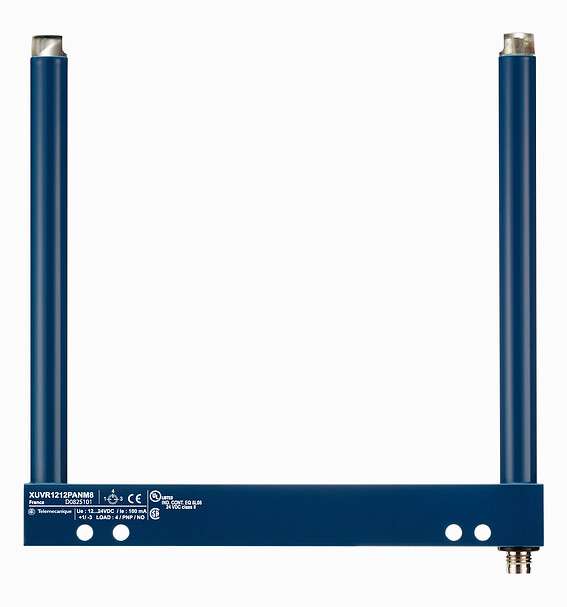
Telemecanique XUVR1212PANM8 Fork Photoelectric Sensor: Through-Beam Detection for High-Repeatability Counting
The Telemecanique XUVR1212PANM8 fork photoelectric sensor is built for applications where consistent detection depends on a fixed optical geometry rather than free-space alignment. Fork (slot) sensors combine a transmitter and receiver in one rigid frame, creating a stable through-beam path across a defined passageway. In automated lines, this architecture is typically chosen when you need reliable part counting, edge detection, or presence verification without the maintenance burden of separate emitter/receiver alignment.
Product identity and core technical positioning
Official datasheet and distributor listings describe XUVR1212PANM8 as a through-beam optical sensor with a fork-style passageway and a PNP output. The datasheet indicates an M8 connector wiring scheme and dimensional references that include a 120 mm passageway, reinforcing its role as a slot/fork sensor for consistent interruption detection.
Technical snapshot (selection-ready)
- Brand + code + type: Telemecanique XUVR1212PANM8 fork photoelectric sensor
- Detection principle: Through-beam (interruption in a fixed optical slot)
- Mechanical passageway: 120 mm class (datasheet “Passageway A 120”)
- Output: PNP (listed with PNP output wiring)
- Connection: M8 connector (datasheet wiring schema)
Why fork sensors outperform free-space sensors in counting tasks
In many plants, counting instability is not caused by electronics but by alignment drift, vibration, or minor bracket movement. A fork frame mechanically locks the optical axis: the emitter and receiver are fixed within the same housing. For the Telemecanique XUVR1212PANM8 fork photoelectric sensor, this means you can often achieve more repeatable detection on thin parts, stamped features, labels, and small mechanical tabs—especially when the target simply interrupts the slot rather than needing reflected light.
Another operational advantage is commissioning speed. With a slot sensor, you typically mount the sensor and route the product through the passageway. There is no second device to align, and there is no reflector to manage. If your process includes frequent changeovers, reduced setup time becomes an ongoing operational benefit.
Mechanical integration: protecting the slot corridor
Despite the stable geometry, fork sensors require thoughtful mechanical placement. The slot must remain clear of debris, adhesive strings, and product remnants that can sit in the passageway and cause false “blocked” states. Place the Telemecanique XUVR1212PANM8 fork photoelectric sensor where it is shielded from direct impacts and where operators are less likely to rest tools inside the slot during maintenance.
Bracket stiffness still matters. If the mounting bracket flexes, the entire fork can shift relative to the product path. Instead of optical misalignment, the problem becomes “product no longer passes through the intended zone.” Use rigid supports and define a repeatable datum so replacement or station rebuild returns the sensor to the same mechanical reference.
Electrical integration and PLC governance
Datasheet wiring references show an M8 connector with PNP output. In controls documentation, define the I/O point explicitly as Telemecanique XUVR1212PANM8 fork photoelectric sensor and note that it is a through-beam fork device. This prevents accidental substitution with a reflective sensor that would behave differently under identical mechanical conditions.
For high-speed counting, also validate input filtering. If the PLC input filter is too aggressive, fast interruptions may be missed. Conversely, if filtering is too light, vibration-induced micro-interruptions could be counted as multiple parts. Treat this as a system tuning task: sensor + mechanics + PLC input behavior.
Validation approach: worst-case parts and worst-case contamination
A pragmatic validation strategy is to test the smallest and fastest parts first, then introduce worst-case line conditions. For example: thin metal tabs at maximum speed, then a run with typical dust levels, and finally a deliberate “dirty slot” test to see when performance degrades. Fork sensors can be extremely stable, but the slot corridor is a physical interface with the process, so cleanliness governance should be defined.
For portfolio-level selection standards, see Telemecanique sensor.
Telemecanique XUVR1212PANM8 FAQ
- What makes XUVR1212PANM8 different from a standard diffuse sensor?
It is a through-beam fork sensor with a fixed optical slot, designed for interruption detection rather than reflection. - What is the passageway size?
Datasheet dimensions reference a 120 mm passageway (“Passageway A 120”). - What output type is used?
The wiring schema lists PNP output for this model. - Why do fork sensors help with counting accuracy?
Because the emitter and receiver are mechanically locked in one frame, reducing alignment drift over time. - What is a common cause of false detection in fork sensors?
Debris or residue inside the slot corridor can mimic a blocked beam; preventive cleaning helps.
Entity recap: The Telemecanique XUVR1212PANM8 fork photoelectric sensor is a through-beam slot device with 120 mm passageway class, PNP output, and M8 connectivity, built for repeatable counting and presence detection.