
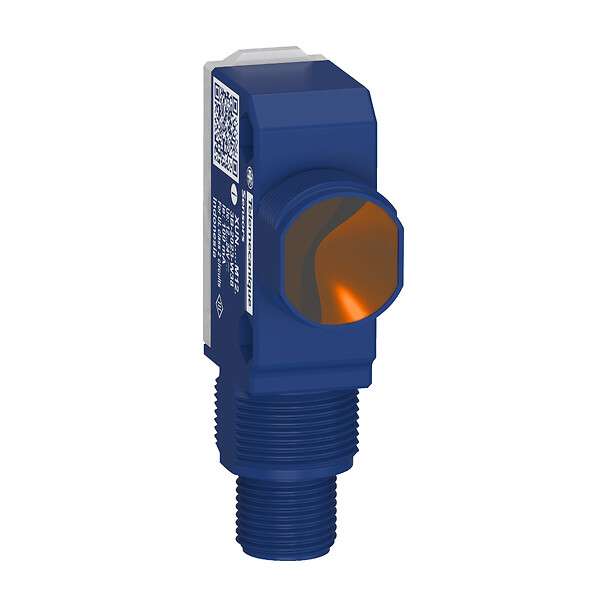
Telemecanique XUN6APXNM12 Photoelectric Sensor: Hybrid Diffuse Detection for General-Purpose Automation
General-purpose photoelectric sensing is rarely “general” in real factories. Lighting conditions change, product surfaces vary, and mechanical layouts evolve over time. A sensor that performs reliably is one that balances detection performance with practical anti-interference behavior and serviceable connectivity. The Telemecanique XUN6APXNM12 photoelectric sensor is positioned in that space as a hybrid diffuse sensor designed for reliable, compact deployment with M12 connectivity and PNP switching logic.
This guide explains how the Telemecanique XUN6APXNM12 photoelectric sensor fits into PLC-based architectures, what its diffuse sensing approach implies for installation, and how to build repeatable commissioning outcomes across multiple machines.
Detection Concept: Hybrid Diffuse for Controlled Sensing Windows
Diffuse sensors detect objects based on light reflected from the target. The key operational variable is reflectivity: matte black parts reflect differently than glossy labels, and transparent films can behave unpredictably depending on background geometry. Hybrid designs aim to improve stability across typical industrial variation while remaining simple to mount and service.
In product listings for the Telemecanique XUN6APXNM12 photoelectric sensor, the sensor is described as a hybrid diffuse proximity sensor with a medium-range class (commonly referenced around 0.5–0.6 m in distributor and product references).
Core Technical Characteristics
- Technology: photoelectric, hybrid diffuse proximity class.
- Range class: medium diffuse distance (commonly listed around 420 mm to ~0.6 m depending on reference conditions).
- Output: PNP discrete switching, typically NO/NC variants in distributor listings.
- Connection: M12 connector for field serviceability.
- Supply class: DC supply used in standard 24 V control panels (typical for this family).
These characteristics make the Telemecanique XUN6APXNM12 photoelectric sensor relevant when you need a compact sensor that can be replaced quickly, with predictable wiring conventions and stable behavior in typical industrial backgrounds.
PLC Integration: PNP Output and Signal Governance
PNP outputs align with many PLC input strategies where the sensor sources current into the input channel. The integration discipline is straightforward but important:
- Confirm input type and common reference wiring at the IO module.
- Standardize cordsets so replacements do not introduce pinout errors.
- Define whether the controller interprets “ON” as presence or absence, and document it.
When governance is weak, machines drift into inconsistent logic patterns. When governance is strong, the Telemecanique XUN6APXNM12 photoelectric sensor becomes a predictable building block that supports standard troubleshooting playbooks across the plant.
Mounting and Commissioning Practices That Improve Stability
Diffuse sensing is sensitive to geometry. For stable outcomes with the Telemecanique XUN6APXNM12 photoelectric sensor:
- Mount on a rigid bracket to prevent distance drift under vibration.
- Validate detection on the real product, including worst-case surface finishes.
- Avoid aiming directly at glossy background parts that can reflect like a target.
- Capture commissioning photos or notes so alignment can be restored after maintenance.
In many facilities, these steps reduce the need for repeated “re-teaching” and keep nuisance stops under control.
Operational Use Cases
- Presence detection on conveyors where targets are within a controlled distance.
- Part confirmation in assembly cells with limited mounting space.
- Packaging stations where quick replacement and standardized cabling reduce downtime.
For broader selection logic and compatible ecosystem components, see Telemecanique sensor references.
FAQ
- What sensing method is used by the Telemecanique XUN6APXNM12 photoelectric sensor?
It is listed as a hybrid diffuse proximity photoelectric sensor. - What range class should be expected?
Distributor references list medium diffuse distances (e.g., ~420 mm; some references cite ~0.6 m class under stated conditions). - What output type is provided?
PNP discrete switching (NO/NC variants are referenced in listings). - Why is an M12 connector useful?
It enables fast replacement and standardized wiring in the field. - What causes false detection in diffuse sensing?
Uncontrolled background reflections and mechanical drift that changes the target distance.
With controlled geometry, consistent wiring governance, and validation on real product materials, the Telemecanique XUN6APXNM12 photoelectric sensor provides dependable diffuse detection for general-purpose industrial automation.