
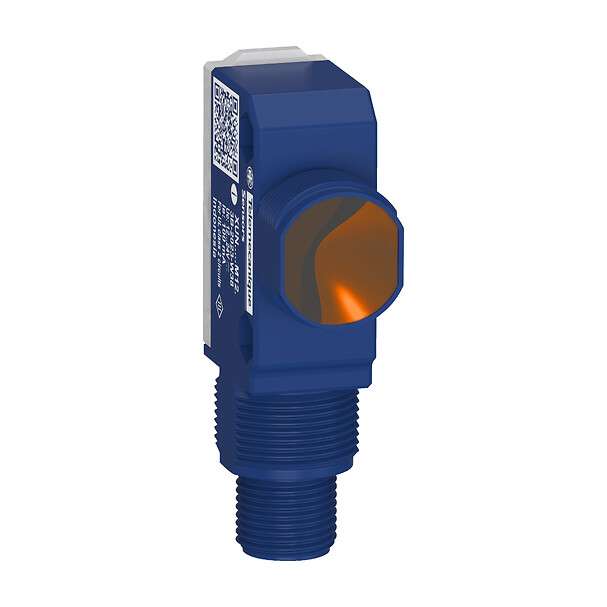
Telemecanique XUN5APXNM12 Photoelectric Sensor: Hybrid Diffuse Long Detection up to 1 m
Longer diffuse sensing is attractive because it eliminates reflectors and simplifies the mechanical design. Yet it also increases the importance of stable alignment and controlled backgrounds. The Telemecanique XUN5APXNM12 photoelectric sensor is specified as a hybrid diffuse long sensor with an Smax class of 1 m, providing a practical balance between distance and maintainable installation in industrial automation.
This technical guide explains how the Telemecanique XUN5APXNM12 photoelectric sensor is specified, what “diffuse long” means for real applications, and how to integrate it into PLC logic with predictable results.
Detection Concept: Hybrid Diffuse Long
Diffuse sensors detect reflected light from the target. At longer distances, reflectivity variation becomes more significant, and background geometry plays a larger role in false switching. A hybrid approach is intended to stabilize detection across typical industrial variation while keeping installation simple.
The official product reference describes the Telemecanique XUN5APXNM12 photoelectric sensor as “Hybrid, Diffuse long, Smax 1 m, PNP, Connector M12,” and references environmental protection including IP65, IP67, and IP69K for the family listing.
Core Technical Characteristics
- Technology: photoelectric, hybrid diffuse long.
- Maximum sensing distance class: Smax 1 m.
- Output: PNP discrete switching (listed as PNP in the product reference).
- Connection: M12 connector.
- Environmental protection: IP65, IP67, IP69K referenced in listing.
These characteristics make the Telemecanique XUN5APXNM12 photoelectric sensor suitable for conveyor detection, packaging presence checks, and assembly-line confirmation where a reflector is inconvenient or mechanically risky.
Installation Strategy for Long Diffuse Sensing
At 1 m class distances, stable geometry becomes the main success factor. Apply these practices with the Telemecanique XUN5APXNM12 photoelectric sensor:
- Mount on a rigid bracket with minimal vibration amplification.
- Avoid aiming at glossy guards or stainless panels that can reflect like a target.
- Validate performance with real products, including worst-case surface finishes.
- Capture alignment references so maintenance can restore the setup after interventions.
If product surfaces vary significantly, define an acceptable detection window and test at the boundaries rather than validating only on a single “ideal” sample.
PLC Integration: PNP Output and Signal Interpretation
PNP discrete output integration is typically straightforward. The key is to standardize signal meaning across the line. For example, define whether “ON” means product present or product absent and keep that definition consistent across stations. This reduces human-error risk when operators and technicians switch between machines.
For high-speed lines, validate response behavior under real conveyor speed and ensure the PLC scan time can reliably capture the switching event. The product listing also references status LEDs for supply/stability and output state, which supports quicker on-machine diagnostics.
Use Cases That Benefit from IP69K-Class Environments
When equipment is regularly cleaned, sealing performance matters. The family listing references IP69K alongside IP65/IP67, which is frequently relevant in washdown or frequent-cleaning environments. In such cases, consistent connector tightening and strain relief are essential to preserve sealing at the cable interface.
For broader selection logic and compatible ecosystem components, see Telemecanique sensor references.
FAQ
- What sensing method does the Telemecanique XUN5APXNM12 photoelectric sensor use?
It is listed as a hybrid diffuse long photoelectric sensor. - What is the distance class?
It is referenced as Smax 1 m in the product listing. - What output type is provided?
PNP discrete switching is referenced in the product listing. - What connector interface is used?
M12 connector is referenced in the product listing. - What typically causes instability in long diffuse sensing?
Background reflections, variable target reflectivity, and bracket drift under vibration.
With controlled background geometry and consistent installation discipline, the Telemecanique XUN5APXNM12 photoelectric sensor provides reliable long diffuse detection with maintainable M12 connectivity.