
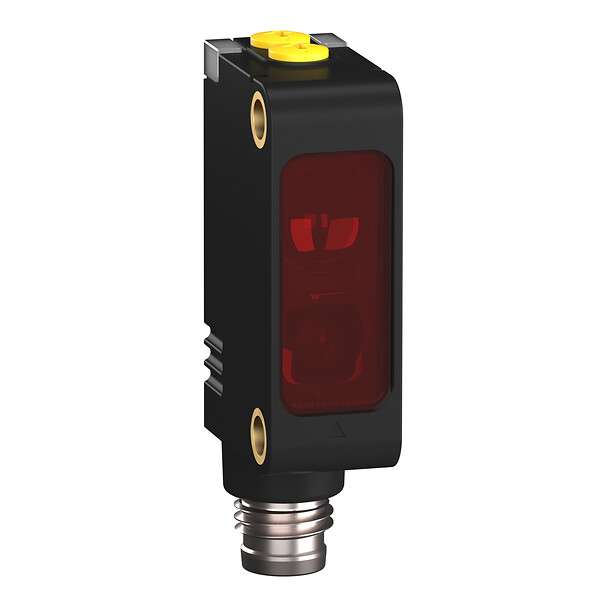
Telemecanique XUM9PLPXM8 Reflex Laser Photoelectric Sensor: Polarized Precision in a Miniature Body
In compact automation cells, the sensor is often asked to do two conflicting things at once: detect reliably and fit into a space that was never designed for sensing hardware. The Telemecanique XUM9PLPXM8 reflex laser photoelectric sensor addresses that reality with a miniature form factor, a polarized reflex principle, and a red Class 1 laser emitter for crisp beam control in demanding production layouts.
This guide explains how the Telemecanique XUM9PLPXM8 reflex laser photoelectric sensor is specified, how polarized reflex behavior impacts real installations, and how to integrate it into PLC logic with repeatable commissioning outcomes.
Detection System: Polarized Reflex Laser
The Telemecanique XUM9PLPXM8 reflex laser photoelectric sensor is specified with a polarised reflex detection system and a product-specific application described as reflex laser. :Ia a reflex architecture, the sensor reads the light returned from a reflector; detection occurs when the beam is interrupted by the target. Polarization improves discrimination in reflective environments by helping to reduce false returns from shiny backgrounds or machine guards.
For practical projects, this method is frequently chosen when you want stable presence detection while keeping wiring simple: one sensor body, one reflector, and a well-defined optical corridor.
Core Technical Characteristics for Integration
- Discrete output type: PNP
- Discrete output function: 1 NO or 1 NC programmable
- Electrical connection: M8, 4 pins
- Emission: red laser, polarized reflex, Class 1, 650 nm (EN/IEC 60825-1)
- Response time: 0.25 ms
- IP degree of protection: IP65 / IP67
Because the response time is specified at 0.25 ms, the Telemecanique XUM9PLPXM8 reflex laser photoelectric sensor is well aligned to fast conveyor events and high-cycle assembly operations where a slower switching device could miss short transitions.
Range Planning and Reflector Strategy
In reflex sensing, the reflector is part of the sensing system. Its placement and rigidity directly influence stability. For this model, application references commonly position it as a long-distance miniature reflex laser solution (for example, a 12 m class is cited in application guidance).
To keep results consistent, treat the optical corridor like a controlled “measurement lane”:
- Mount the reflector on a rigid surface to avoid micro-movement under vibration.
- Keep the beam corridor clear of cable loops, guard edges, and product overhang.
- Avoid placing the corridor parallel to highly reflective stainless planes without validation testing.
PLC Integration: Turning PNP Switching into a Governed Signal
The PNP discrete output of the Telemecanique XUM9PLPXM8 reflex laser photoelectric sensor supports common PLC digital input patterns. The governance step that prevents confusion is defining what the PLC should interpret as “true”:
- Beam made logic: input ON indicates the reflector return is present.
- Beam blocked logic: input ON indicates a target is present (beam interrupted).
Either is acceptable. The operational difference is documentation and consistency across machines. If your fleet mixes both conventions, troubleshooting time rises because symptoms look identical while logic meanings differ.
Commissioning Practices That Prevent “Random” Stops
Most nuisance faults are not caused by sensor defects; they are caused by marginal alignment. For the Telemecanique XUM9PLPXM8 reflex laser photoelectric sensor, the highest-value commissioning steps are:
- Validate detection at real line speed with real products, not only test pieces.
- Check reflector cleanliness in the actual contamination pattern of the machine.
- Document sensor-to-reflector distance and bracket reference points for maintenance restoration.
For additional ecosystem selection and integration patterns, see Telemecanique sensor.
FAQ
- What detection system does the Telemecanique XUM9PLPXM8 reflex laser photoelectric sensor use?
It is specified as a polarised reflex sensor with a reflex laser application. - What is the output type?
It is specified with PNP discrete output and programmable NO/NC function. - What connector does it use?
It uses an M8, 4-pin electrical connection. - What is the laser class and wavelength?
It is specified as Class 1 red laser, 650 nm, conforming to EN/IEC 60825-1. - What is the most common root cause of instability?
A marginal optical corridor caused by flexible reflector mounting, contamination, or alignment drift.
With a rigid reflector strategy and documented logic conventions, the Telemecanique XUM9PLPXM8 reflex laser photoelectric sensor delivers miniature polarized reflex performance that remains stable across production cycles.