
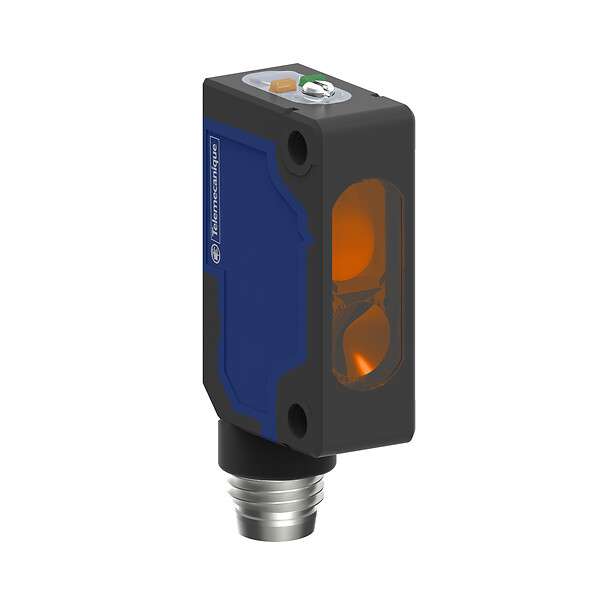
Telemecanique XUM8APXBM8 Photoelectric Sensor: Miniature Background Suppression up to 0.30 m
Compact machines, tight brackets, and high-density sensor layouts have made miniature photoelectric sensing a practical default in many modern lines. The challenge is that compactness cannot compromise stability: reflective frames, guard panels, and belt surfaces can produce false signals if the sensing method is not selective. The Telemecanique XUM8APXBM8 photoelectric sensor addresses this risk by combining a miniature form factor with diffuse detection and background suppression, supporting more reliable object discrimination in close-range applications.
This technical guide explains how the Telemecanique XUM8APXBM8 photoelectric sensor is specified and how to integrate it as a predictable detection asset in PLC-based automation.
Detection Concept: Diffuse with Background Suppression
Diffuse sensors detect targets by receiving light reflected from the object itself. The operational weakness is that the background can also reflect light, especially when surfaces are glossy or when objects are small. Background suppression improves selectivity by enabling the sensor to ignore reflections beyond a defined zone. The Telemecanique XUM8APXBM8 photoelectric sensor is specified as diffuse with background suppression, making it well-suited for short, controlled sensing windows where the target is intentionally close and the background is intentionally farther away.
Core Technical Characteristics
- Sensor design: Miniature.
- Detection system: Diffuse with background suppression.
- Sensing distance class: Smax = 0.30 m.
- Output type: Discrete; PNP switching.
- Supply circuit: DC.
- Connection: M8 connector.
- Output current class: ≤100 mA with overload and short-circuit protection (family listing).
- Ingress protection class: IP65 / IP67 (family listing for the reference page).
These parameters position the Telemecanique XUM8APXBM8 photoelectric sensor as an engineering-friendly option for close-range presence confirmation where mechanical envelopes are constrained and maintenance wants connectorized, repeatable replacement.
Integration Notes: PNP Discrete Output and PLC Wiring
Because the Telemecanique XUM8APXBM8 photoelectric sensor uses PNP switching, it naturally aligns with common PLC digital input architectures. The integration discipline is less about complexity and more about repeatability:
- Standardize M8 cordsets and pinout conventions across the machine zone.
- Route sensor cables away from variable frequency drive outputs and high-current motor feeders.
- Define input filtering only as needed; excessive debounce can mask real process transitions.
In a mature automation governance model, the sensor becomes a measurable asset: you can track switch counts, downtime events linked to the input, and correlation between detection anomalies and cleaning cycles.
Where XUM8APXBM8 Performs Best
- Small part presence detection on fixtures where the background is a metallic plate.
- Conveyor transfer points where the product is close to the sensor but guards exist behind it.
- Packaging stations where short-range discrimination is more valuable than long-range sensing.
Background suppression is particularly valuable when the target has a variable surface finish. Instead of forcing constant re-adjustment, you design a consistent sensing window and keep the background outside the suppression threshold.
Commissioning Checklist for Stable Operation
- Validate the detection zone with the real product material and color.
- Ensure the background sits beyond the intended suppression distance.
- Lock the bracket position after alignment; miniature sensors magnify mechanical drift.
- Document the target distance used at commissioning for maintenance repeatability.
For ecosystem guidance and compatible wiring standards across sensor families, see Telemecanique sensor references to align accessories and installation conventions.
FAQ
- What detection system does the Telemecanique XUM8APXBM8 photoelectric sensor use?
It uses diffuse detection with background suppression. - What is the sensing distance?
It is specified with Smax = 0.30 m. - What output type is provided?
It provides a discrete PNP switching output. - Which connector is used?
It is specified with an M8 connector interface. - What causes most false detections in diffuse sensing?
Uncontrolled background reflections and mechanical drift that moves the target outside the designed sensing window.
When the sensing window is designed deliberately and the bracket is mechanically stable, the Telemecanique XUM8APXBM8 photoelectric sensor delivers consistent, compact detection with reduced sensitivity to background reflections.