
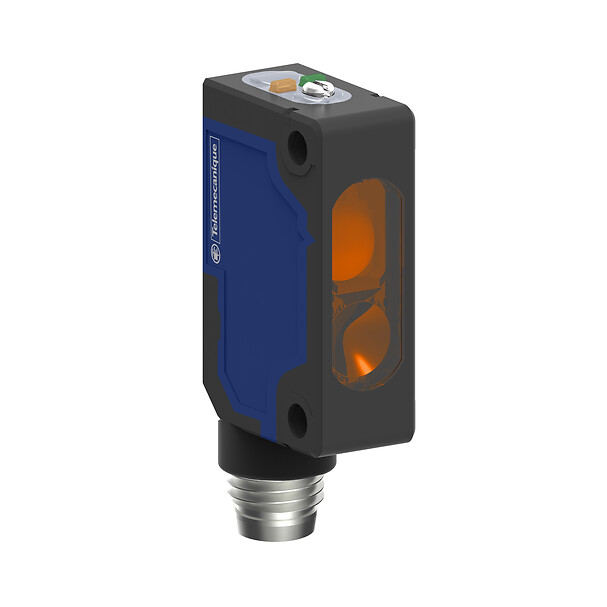
Telemecanique XUM5APXBM8 Photoelectric Sensor: Miniature Diffuse Long Detection with M8 Connector
Compact automation stations require sensors that combine small form factor, stable detection performance, and simplified wiring integration. The Telemecanique XUM5APXBM8 photoelectric sensor is engineered as a miniature diffuse long model within the XU family, offering Smax 1.9 m detection distance and PNP discrete output through an M8 connector interface.
This article provides a structured technical overview of the Telemecanique XUM5APXBM8 photoelectric sensor, including detection principle, electrical characteristics, installation practices, and integration strategy for PLC-controlled systems.
Detection Principle and Optical Behavior
The Telemecanique XUM5APXBM8 photoelectric sensor operates using diffuse detection. In this method, the sensor emits a light beam and detects the light reflected directly from the target object. Unlike retro-reflective systems, no external reflector is required. This simplifies installation and reduces additional hardware components.
The sensor is specified with Smax 1.9 m, positioning it within the diffuse long category. This allows greater mounting flexibility compared to short-range miniature sensors while preserving a compact housing design.
Core Technical Characteristics
- Detection system: Diffuse long
- Sensing distance: Smax 1.9 m
- Output type: Discrete PNP
- Output configuration: 1 NO or 1 NC programmable
- Supply voltage: 12–24 V DC
- Wiring technique: 3-wire
- Electrical connection: Male M8 connector, 4 pins
- Protection rating: IP65 and IP67
The Telemecanique XUM5APXBM8 photoelectric sensor supports switching frequencies suitable for fast-moving production lines, making it appropriate for packaging, material handling, and small component detection.
Electrical Integration and PLC Compatibility
The PNP discrete output of the Telemecanique XUM5APXBM8 photoelectric sensor aligns with common sourcing PLC input modules. Integration governance includes:
- Confirming correct PLC input configuration (sourcing logic)
- Standardizing NO/NC output policy across machines
- Routing M8 cordsets away from high-frequency motor cables
Because detection relies on reflected light, mechanical alignment and target surface characteristics directly affect stability. Engineers should validate detection using the least reflective product variant during commissioning.
Typical Application Areas
- Conveyor presence detection
- Packaging line object confirmation
- Small part transfer monitoring
- Assembly station verification
When background surfaces are highly reflective, angle adjustments may be necessary to prevent unintended reflections.
For additional integration guidance and compatible accessories, refer to Telemecanique sensor ecosystem resources.
FAQ
- What detection method does the Telemecanique XUM5APXBM8 photoelectric sensor use?
It uses diffuse long detection without a reflector. - What is the maximum sensing distance?
The sensor is specified with Smax 1.9 m. - What output type is provided?
It provides a PNP discrete output with programmable NO/NC configuration. - What connector interface is used?
It uses a male M8 4-pin connector. - What causes unstable switching?
Improper mounting alignment, reflective backgrounds, or insufficient detection margin.
With disciplined installation and controlled sensing geometry, the Telemecanique XUM5APXBM8 photoelectric sensor delivers reliable miniature diffuse long detection for compact automation systems.