
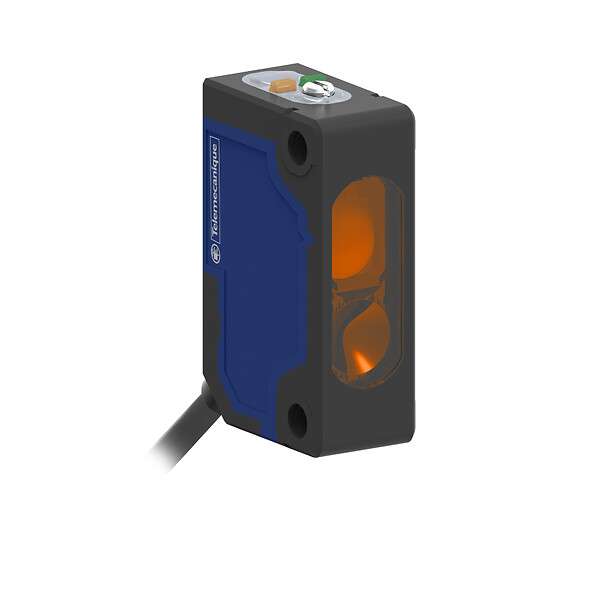
Telemecanique XUM5APXBL2 Photoelectric Sensor: Miniature Diffuse Long Smax 1.9 m with PNP Output
Compact machines often require sensors that fit into tight mechanical envelopes without sacrificing signal stability. In these environments, miniature photoelectric sensors are a standard engineering solution—especially for presence detection on conveyors, small part handling stations, and packaging equipment. The Telemecanique XUM5APXBL2 photoelectric sensor is specified as a miniature “diffuse long” device with a defined maximum sensing distance and an industrial DC wiring architecture. Its product reference describes it as a miniature diffuse long sensor with Smax = 1.9 m, PNP output, and a 2 m cable.
Product Identity and Technical Characteristics
The product datasheet states that the Telemecanique XUM5APXBL2 photoelectric sensor is a general-purpose single-mode photoelectric sensor (XUM design, miniature form factor) using a diffuse detection system, with a DC supply circuit and a 3-wire wiring technique. It is specified with PNP discrete output and includes programmable output behavior (NO/NC). The reference also highlights the environmental protection ratings IP65 and IP67.
- Detection system: Diffuse (diffuse long)
- Sensing distance: Smax 1.9 m
- Output: Discrete, PNP; programmable 1 NO or 1 NC
- Supply: 12…24 V DC, reverse polarity protection
- Wiring technique: 3-wire
- Cable length: 2 m
- Protection rating: IP65 and IP67
Diffuse Long Detection: What Engineers Should Expect
Diffuse sensing depends on light returning from the target surface. As a result, real-world performance can vary with color, surface finish, and target angle. A “diffuse long” design is typically selected when you want a longer practical corridor than short-range diffuse devices, while still keeping a single-sensor installation model. For the Telemecanique XUM5APXBL2 photoelectric sensor, Smax is specified as 1.9 m, which supports longer standoff distances in compact stations where mounting options are limited.
To preserve stability, governance is essential. The most common failure pattern with diffuse sensing is operating too close to the edge of detection margin. A better approach is to design the mechanical layout so the sensor works comfortably inside the stable corridor, even when targets change or contamination increases over time.
Electrical Integration: PNP Output and NO/NC Policy
The Telemecanique XUM5APXBL2 photoelectric sensor uses PNP output and supports NO/NC programmable behavior. This flexibility can improve standardization across machines, but only if you treat it as a policy decision. Choose one interpretation and keep it consistent across line assets. For example, many teams define:
- Output ON = object present (preferred for clarity in operator troubleshooting)
- NO/NC selection aligned to safety or fail-state philosophy (documented)
When conventions differ between machines, troubleshooting time increases because technicians must mentally translate logic on each station. Standardizing output meaning reduces downtime and improves maintenance confidence.
Mechanical Integration: Mounting, Alignment, and Background Control
Miniature sensors often get mounted on light brackets, which can drift under vibration. If the bracket flexes, the detection window shifts, creating intermittent presence faults. A stable implementation of the Telemecanique XUM5APXBL2 photoelectric sensor uses rigid mounting, controlled cable routing, and a protected line-of-sight to the target. If a reflective background exists behind the target, validate that the sensor does not “see through” thin objects or misinterpret background reflections, especially at longer standoff distances.
Because the device is rated for industrial environments (IP65/IP67), it supports challenging conditions when correctly installed. However, sealing is a system outcome: avoid tension at the cable exit and keep routing away from pinch zones that cause micro-damage and long-term intermittency.
Commissioning: A Repeatable Setup Routine
A professional commissioning routine for the Telemecanique XUM5APXBL2 photoelectric sensor includes:
- Validating detection using the least reflective product variant (worst case).
- Testing at maximum line speed and with “no product” conditions.
- Recording the mounting distance and output logic choice (NO/NC) for future replacement.
This routine converts setup into a repeatable process and prevents performance drift after maintenance.
For additional ecosystem references and related selection guidance, use: Telemecanique sensor.
FAQ
- What is the Telemecanique XUM5APXBL2 photoelectric sensor?
It is a miniature diffuse long photoelectric sensor with Smax 1.9 m, PNP output, and 2 m cable. - What sensing distance is specified?
The product reference specifies Smax = 1.9 m. - What wiring technique is used?
The datasheet specifies a 3-wire wiring technique. - Is the output configurable?
Yes, PNP output with programmable 1 NO or 1 NC is specified. - What is a common cause of unstable detection?
Operating near the edge of diffuse margin without validating worst-case target reflectivity and background behavior.
When margin, mounting rigidity, and output conventions are governed, the Telemecanique XUM5APXBL2 photoelectric sensor delivers stable miniature diffuse long detection for compact industrial automation stations.