
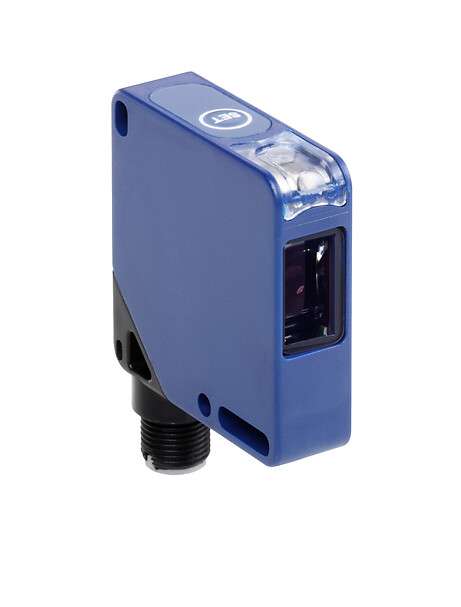
Telemecanique XUKR1PSMM12 Color Mark Photoelectric Sensor: High-Speed Mark Detection for Packaging Lines
The Telemecanique XUKR1PSMM12 photoelectric sensor is a specialized device intended for color mark detection—an important function in packaging environments where printed marks guide cutting, sealing, labeling, or registration control. Unlike general presence detection, color mark sensing requires repeatability at high speeds and stable differentiation between mark and background under changing print conditions. For this reason, color mark sensors are often chosen based on switching frequency, emission characteristics, and spot size rather than long-range distance metrics.
Product definition and verified characteristics
Manufacturer/distributor datasheet documentation describes XUKR1PSMM12 as a Telemecanique Photoelectric sensors XU model with “color mark” function. Key stated parameters include Sn 20 mm (also listed as ~19 mm in some datasheet contexts), NC output function, and M12 connector. Additional characteristics include diffuse detection, white LED emission, compact 50 x 50 design, and switching frequency up to 5 kHz, which aligns with high-speed packaging requirements.
Technical snapshot (packaging-relevant)
- Brand + code + type: Telemecanique XUKR1PSMM12 photoelectric sensor
- Function: Color mark sensing
- Nominal sensing distance: Sn 20 mm (datasheet context ~19 mm)
- Output function: NC
- Emission: White LED
- Switching frequency: Up to 5 kHz
- Connector: M12
Why color mark sensing is operationally distinct
Color mark detection is not only about “seeing” an object; it is about differentiating contrast consistently while the substrate is moving. Film materials can be glossy, prints can vary between batches, and lighting conditions can shift due to machine enclosures or maintenance activities. A device like the Telemecanique XUKR1PSMM12 photoelectric sensor is selected because its design intent is packaging registration: stable mark detection over a small standoff distance with high switching speed capability.
Commissioning method: tune for print variability, not only for one roll
A robust commissioning method is to validate mark detection across realistic variability:
- Validate on multiple samples of film/label stock, including lighter prints and slightly faded marks.
- Confirm stable detection at maximum machine speed; at high speed, timing errors can appear even if detection is correct.
- Verify the sensing spot is centered on the mark path and that web tracking does not shift the mark out of the detection corridor.
- Confirm logic behavior for NC output is correctly interpreted by the controller and that any safety or interlock assumptions match the NC convention.
- Record setup parameters and mechanical alignment references for repeatable replacement.
Because the Telemecanique XUKR1PSMM12 photoelectric sensor is used for registration control, misalignment can manifest as poor cut accuracy or sealing offset, not just an alarm. That is why aligning the sensor is a quality control action, not only a maintenance action.
Electrical governance: NC output and high-speed inputs
NC output selection has operational implications: a broken wire or power loss may be interpreted differently compared to NO strategies, depending on how the controller logic is designed. The datasheet lists NC output, so the PLC input logic must reflect that intentionally. Additionally, with switching frequency up to 5 kHz, the receiving system must be able to process rapid transitions without missing pulses. If the PLC scan time is slow, consider hardware counters or fast inputs where necessary. Document the signal path end-to-end, and label the point as Telemecanique XUKR1PSMM12 photoelectric sensor (color mark, NC).
Maintenance: optical cleanliness and print-change verification
In packaging lines, lens contamination from film dust, adhesive particles, or cleaning residues can shift contrast thresholds. Establish a routine cleaning interval aligned with changeover frequency. After print changes or supplier changes, run a verification sequence and record whether any threshold adjustments were necessary. This creates an operational history that helps prevent recurring micro-stops. The Telemecanique XUKR1PSMM12 photoelectric sensor is most effective when it is treated as part of a controlled quality system rather than an isolated component.
Keyword alignment for technical search
High-intent searches include “color mark sensor,” “packaging registration sensor,” “M12 photoelectric sensor,” and “5 kHz photoelectric sensor.” For procurement and troubleshooting traceability, use Telemecanique XUKR1PSMM12 photoelectric sensor as the primary keyword phrase.
For portfolio mapping and consistent sensor governance, consult Telemecanique sensor references.
FAQ
- What is the primary function of XUKR1PSMM12?
It is specified as a color mark photoelectric sensor for packaging contexts. - What sensing distance is listed?
Datasheet sources indicate Sn 20 mm (and ~19 mm in certain listings). - What output function is specified?
NC output is listed. - Why is switching frequency important for mark detection?
High-speed web motion requires the controller to capture rapid transitions; higher switching frequency supports stable detection at speed. - What emission type is used?
The datasheet indicates white LED emission.
Entity recap: The Telemecanique XUKR1PSMM12 photoelectric sensor is a compact color mark sensor with Sn 20 mm, NC output, M12 connection, white LED emission, and up to 5 kHz switching frequency, optimized for packaging registration and high-speed mark detection governance.