
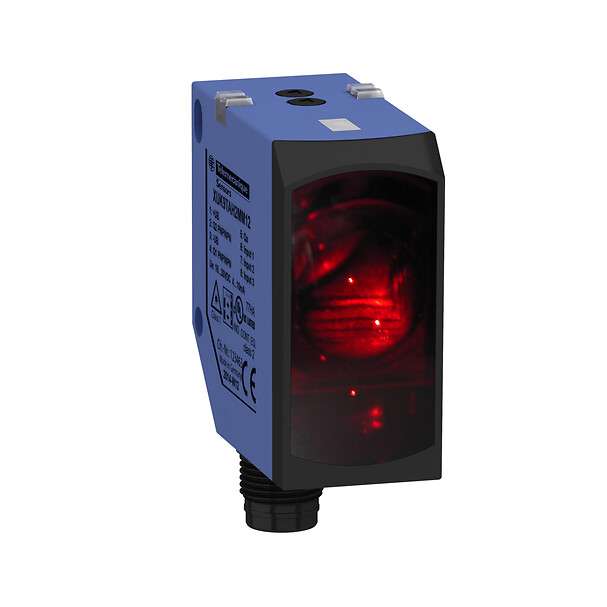
Telemecanique XUK9TAH2MM12 Photoelectric Laser Sensor: Long-Range Polarised Reflex for Hoisting Applications
The Telemecanique XUK9TAH2MM12 photoelectric sensor is positioned for long-range detection requirements where standard compact sensors do not provide sufficient corridor length. In hoisting and material movement systems, sensing distances can extend across large machine envelopes, and access limitations often favor a one-side installation approach. For such cases, a polarised reflex laser strategy can support long-distance optical linking while maintaining discrimination against unwanted reflections.
Confirmed datasheet profile and application framing
Product datasheet specifications describe XUK9TAH2MM12 as a “photo-electric laser sensor – XUK – polarised reflex” with Sn 70 m and an application context explicitly tied to hoisting. The specification set includes compact 50 x 50 sensor design, plastic material, analogue + discrete output signal type, DC supply circuit, 8-wire wiring technique, and discrete output type indicated as PNP or NPN.
Technical snapshot (what matters in long corridors)
- Brand + code + type: Telemecanique XUK9TAH2MM12 photoelectric sensor
- Detection system: Polarised reflex (laser)
- Sensing distance: Sn 70 m
- Output signal: Analogue + discrete
- Wiring technique: 8-wire
- Discrete output type: PNP or NPN :
Why long-range reflex is different from typical conveyor sensing
At 70 m scale, small errors become large consequences. Alignment tolerances tighten, reflector choice becomes strategic, and mechanical drift can degrade performance gradually. The Telemecanique XUK9TAH2MM12 photoelectric sensor is therefore best treated as a system component rather than a simple “sensor swap.” In hoisting environments, vibration and movement can be significant; establishing rigid mounting, controlled cable routing, and protected optical pathways is essential for sustainable operation.
Commissioning governance for 70 m corridors
A commissioning approach suitable for long-range polarised reflex includes:
- Establish mechanical alignment at short distance first, then increase to the final distance while maintaining stable return.
- Confirm reflector placement is protected from impacts and contamination, and that its orientation is consistent.
- Validate interruption detection with realistic moving elements at operational speeds, not only static tests.
- Record analog scaling and discrete threshold behavior (if used) in the commissioning dossier.
- Lock in configuration governance so replacement devices are restored to the same state.
Because the device supports analogue + discrete outputs and multiple output types (PNP/NPN), documentation prevents accidental behavior inversion. The phrase Telemecanique XUK9TAH2MM12 photoelectric sensor should appear in the I/O list and the hoisting system maintenance standard.
Electrical integration: 8-wire and mixed output expectations
Eight-wire sensors often indicate expanded functionality, including additional signals for configuration, diagnostics, or multiple outputs. In practical panels, this demands clear terminal mapping and consistent harness standards. The discrete output type is indicated as PNP or NPN in the specification context, which means the system team must explicitly define the chosen convention and verify PLC input compatibility. Treat this as a governance element: document which discrete logic is used, and validate after any maintenance that might involve cable replacement or re-termination.
Reliability: reflector, optics, and environmental drift
Long corridors are sensitive to contamination and environmental drift. Dust accumulation or film on a reflector can lower return signal gradually until switching becomes intermittent. The most effective preventive action is a simple periodic verification: a known reference interruption test plus a visual inspection of lens and reflector condition. For the Telemecanique XUK9TAH2MM12 photoelectric sensor, building this into hoisting PM routines can prevent unexpected stops that are difficult to diagnose under time pressure.
For portfolio consistency and reference mapping, consult Telemecanique sensor resources.
FAQ
- What sensing distance is specified for XUK9TAH2MM12?
Datasheet sources list Sn 70 m. - What detection system is used?
It is specified as polarised reflex in the product datasheet context. - Does it provide analog output?
Yes, the specification states “analogue + discrete” output signal type. - Why is documentation critical with PNP/NPN options?
Because choosing the wrong discrete logic can invert station behavior; documenting the configured state prevents silent failures. - What is the most common stability risk in long-range reflex setups?
Alignment drift and reflector contamination are frequent root causes; periodic verification reduces downtime risk.
Entity recap: The Telemecanique XUK9TAH2MM12 photoelectric sensor is a long-range polarised reflex laser device for hoisting contexts, specified at Sn 70 m with analogue + discrete outputs, 8-wire wiring, and PNP/NPN discrete output options requiring strict configuration governance.