
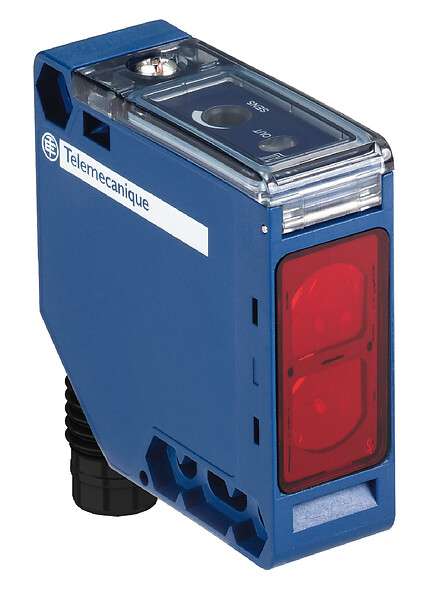
Telemecanique XUK9APANM12 Photoelectric Sensor: Compact Mid-Range Detection with Clear Documentation Governance
The Telemecanique XUK9APANM12 photoelectric sensor is commonly referenced as a compact 50 x 50 photoelectric device in the XUK family, suitable for industrial stations where a block-style housing improves installation efficiency and service access. In practice, compact sensors are often selected to standardize mounting envelopes across multiple machine types, enabling maintenance teams to carry fewer bracket variants and reduce time spent on physical integration.
Product identity and reference confirmation
The model has an official Telemecanique Sensors product reference page and manufacturer datasheet availability via downloads. Distributor catalog aggregations also list typical operating parameters such as DC supply and sensing distance context, reinforcing its use as a mid-range compact photoelectric option.
Technical profile (practical selection markers)
- Brand + code + type: Telemecanique XUK9APANM12 photoelectric sensor
- Documentation availability: Manufacturer datasheet PDF is available
- Catalog context: Aggregated technical listings commonly reference 12–24 VDC supply and ~5 m sensing distance context
Why compact sensors succeed or fail: the “station context” factor
When teams evaluate photoelectric sensors, the headline range number is often overemphasized. In real stations, success depends on how well the sensing principle matches the mechanical corridor and the target set. For the Telemecanique XUK9APANM12 photoelectric sensor, compact installation typically places the device near machine frames and moving elements. If the optical corridor includes reflective backgrounds, the station may require stricter aiming discipline or a different optical principle (such as reflex or BGS). The engineering approach is to define the station’s detection problem precisely: “detect this product at this location, while ignoring these backgrounds,” then validate in production conditions.
Commissioning governance that reduces nuisance stops
A governance-driven commissioning process improves reliability more than repeated hardware changes. A proven sequence is:
- Validate stable detection for minimum and maximum product size at normal speed.
- Confirm the sensor does not react to empty conveyor backgrounds or reflective guards.
- Test worst-case product optics: dark, matte, angled, or partially transparent surfaces.
- Run a sustained trial to identify drift from vibration, dust, or temperature changes.
Apply these checks after maintenance work as well. Compact sensors like the Telemecanique XUK9APANM12 photoelectric sensor are often disturbed during guarding access; revalidation prevents intermittent faults that only appear days later.
Controls documentation: your strongest reliability tool
In many plants, downtime is driven by incorrect substitutions rather than component defects. Therefore, documentation must treat the part number as a control element. Use the exact identifier Telemecanique XUK9APANM12 photoelectric sensor in PLC I/O comments, terminal schedules, and spare inventory lists. This makes procurement traceable and prevents replacing it with a different XUK sensor that may share a similar housing but differ in optical mode, output logic, or configuration behavior.
Maintenance focus: optical hygiene and bracket integrity
Most “sensor failures” are actually optical or mechanical: lens contamination, misalignment from bracket movement, or cable strain that slowly rotates the unit. Establish a routine that includes lens cleaning aligned with the process risk profile, and verify bracket tightness during planned maintenance. If the station uses high-pressure cleaning, confirm that cable sealing and connector management match the environmental needs and do not permit water ingress that can affect electrical stability.
For broader selection alignment and product-family mapping, consult Telemecanique sensor references.
Telemecanique XUK9APANM12 FAQ
- Where can official documentation for XUK9APANM12 be found?
An official product page exists and manufacturer datasheet PDFs are available via Telemecanique downloads. - Why do compact sensors sometimes become unstable after maintenance?
Guarding access can disturb alignment; revalidation after service prevents intermittent faults. - What is the most common non-electrical cause of detection issues?
Lens contamination and bracket drift are frequent root causes in compact installations. - Why is the exact part number important in PLC documentation?
It prevents wrong substitutions across similar housings and improves procurement traceability. - How should a troubleshooting sequence start?
Start with lens cleaning and bracket checks, then validate detection with worst-case products before replacing hardware.
Entity recap: The Telemecanique XUK9APANM12 photoelectric sensor is a compact XUK-family device with official product documentation availability, intended for mid-range detection when station governance and precise identification are applied.