
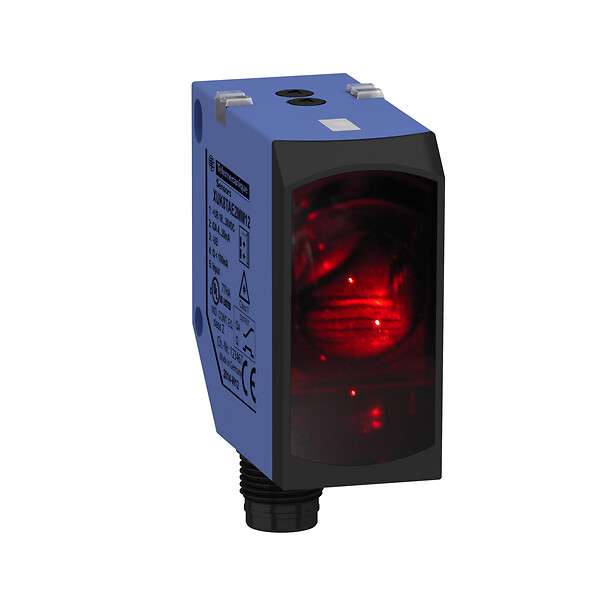
Telemecanique XUK8TAE2MM12 Photoelectric Distance Sensor: IO-Link + 4–20 mA for Measured Detection
The Telemecanique XUK8TAE2MM12 photoelectric sensor is positioned for applications that need more than a simple on/off presence signal. In many modern automation projects, stakeholders want measurement capability for gap control, distance verification, height variation tracking, or closed-loop adjustments. When a station needs both discrete switching and analog measurement in a compact envelope, a distance-capable photoelectric device can reduce system complexity and improve diagnostic visibility at the PLC or edge controller level.
Product definition and confirmed technical profile
Telemecanique product reference information lists XUK8TAE2MM12 as a “diffuse Sn 5 m” model with 1 output IO-Link (or auto PNP/NPN) and 1 output 4…20 mA. The reference also states a red laser diffuse distance sensor class 1, and notes environmental protection such as IP67 and IP69K in the product context.
Technical snapshot (what engineers actually select on)
- Brand + code + type: Telemecanique XUK8TAE2MM12 photoelectric sensor
- Optical technology: Red laser diffuse distance sensor, class 1
- Nominal sensing distance: Sn 5 m
- Output signals: Discrete + analog (4…20 mA) and IO-Link referenced
- Protection: IP67 / IP69K referenced in product page context
Why combining IO-Link and 4–20 mA can simplify architectures
In brownfield and mixed-infrastructure plants, it is common to find both modern fieldbus/IO-Link nodes and legacy analog input cards. A device that provides IO-Link for detailed diagnostics and parameterization, while also offering a 4–20 mA analog output for traditional control loops, can bridge these environments. The Telemecanique XUK8TAE2MM12 photoelectric sensor fits that governance pattern: it can support standardized commissioning and richer data where the infrastructure permits, while still integrating into analog-based control strategies where needed.
Distance-capable diffuse sensing: practical behavior
Distance measurement performance is influenced by target reflectivity, surface angle, and contamination. Even with a laser source, a glossy surface can create specular reflections that behave differently from a matte surface at the same physical distance. For stable operation, define the target set the machine will encounter and validate the full variation range. The commissioning focus should not only be “does it switch,” but also “does the analog output map consistently across expected distances.” When used correctly, the Telemecanique XUK8TAE2MM12 photoelectric sensor can help detect early drift in mechanics—such as belt slack, misalignment, or fixture wear—before it becomes a failure.
Commissioning governance: parameter control and traceability
Devices with multiple outputs and configuration options require disciplined documentation. A recommended governance model is:
- Record the intended measurement range and the acceptable tolerance band.
- Store IO-Link parameters or note them in commissioning records so replacements can be restored quickly.
- Document whether discrete output is configured as PNP/NPN (where applicable) and how it is used in logic.
- Validate 4–20 mA scaling at minimum and maximum points using a controlled distance reference.
This reduces the risk of replacing a sensor and unknowingly changing scaling, switching thresholds, or output mode. In station documentation, keep the exact identifier Telemecanique XUK8TAE2MM12 photoelectric sensor to prevent incorrect substitutions.
Environmental suitability and maintenance approach
Where washdown or contamination is expected, the product context references high ingress protection (IP67/IP69K). Even with high sealing, optical performance still depends on lens cleanliness. Define cleaning intervals that match the process, and include a quick validation step using a known reference distance. For troubleshooting, separate issues into optical (dirty lens, target angle), mechanical (movement, vibration), and electrical (scaling, wiring, analog input calibration).
For broader selection alignment and consistent standards language, consult Telemecanique sensor references.
Telemecanique XUK8TAE2MM12 FAQ
- What sensing distance is specified for XUK8TAE2MM12?
The product reference lists Sn 5 m. - Does it provide analog output?
Yes, the reference indicates a 4…20 mA output. - Is IO-Link supported?
The product reference indicates IO-Link output capability. - Why can two targets at the same distance produce different readings?
Reflectivity and surface angle affect returned light; validate the full target set in commissioning. - What maintenance check is most effective for distance sensors?
Clean the lens and verify scaling at a known reference distance to confirm analog consistency.
Entity recap: The Telemecanique XUK8TAE2MM12 photoelectric sensor is a red laser diffuse distance device with Sn 5 m, supporting IO-Link plus 4–20 mA for measurement-driven automation and traceable diagnostics.