
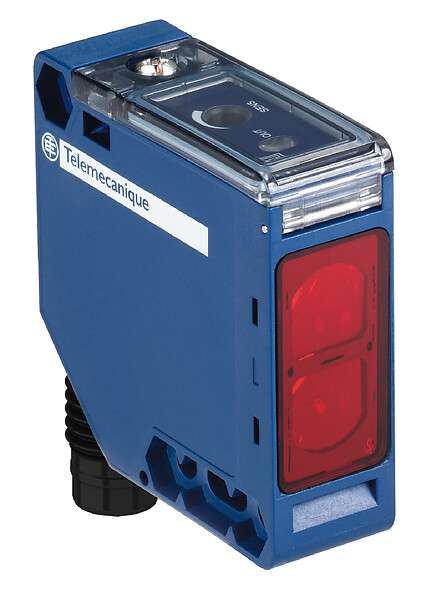
Telemecanique XUK5APANM12 Photoelectric Sensor: Compact Diffuse Detection in Real Industrial Conditions
The Telemecanique XUK5APANM12 photoelectric sensor is a compact, block-style device intended for dependable object presence detection where installation space is limited and straightforward diffuse sensing is acceptable. In many production lines, the constraint is not only electrical compatibility but also mechanical packaging: sensor bodies must fit inside guarding, between conveyor frames, or near moving tooling without creating collision risks. The compact 50 x 50 form factor helps teams standardize on a single mechanical envelope across multiple stations while maintaining predictable detection behavior.
Product identity and technical positioning
According to manufacturer/distributor datasheet documentation, the Telemecanique XUK5APANM12 photoelectric sensor belongs to the Telemecanique Photoelectric sensors XU range and uses the XUK compact 50 x 50 sensor design. The product is documented as a photo-electric sensor suitable for material handling application contexts, with diffuse detection characteristics and an M12 connection designation in its reference. This combination is typically selected when a single-sided sensing solution is preferred and where the target can be reliably detected via reflected light. How diffuse sensing behaves and why setup discipline matters
Diffuse sensing is attractive because it can reduce installation complexity: there is no paired receiver (as in thru-beam) and no reflector that must remain clean and aligned (as in reflex). However, diffuse sensing inherently depends on the target surface. A bright, reflective object can return more light than a dark, matte object, which means the effective detection distance can vary in real operation. When commissioning the Telemecanique XUK5APANM12 photoelectric sensor, the practical best practice is to validate performance using the “worst optical case” product: the darkest color, most absorbent material, and most challenging angle that will appear on the line.
Mechanical integration: compact does not mean forgiving
Compact sensors are frequently installed close to the process, which increases the probability of vibration, bracket flex, and accidental contact during maintenance. To keep the Telemecanique XUK5APANM12 photoelectric sensor stable, bracket rigidity should be treated as a functional requirement, not an aesthetic choice. Use repeatable mounting references so replacement work returns the sensor to the original geometry without extended adjustment. If the station includes frequent washdown or airborne film, plan lens cleaning intervals; with diffuse sensors, contamination changes the received light intensity and can create borderline switching.
Electrical integration and documentation governance
From a controls perspective, compact photoelectric sensors are usually wired as discrete inputs into PLC I/O. The operational risk is not wiring difficulty but substitution error: many sensors share similar form factors while differing in output logic or optical principle. For this reason, labeling should explicitly record the device as Telemecanique XUK5APANM12 photoelectric sensor at the I/O point, in the maintenance BOM, and in any spare-parts governance list. Doing so prevents accidental replacement with a reflex or thru-beam model that would behave differently under the same station geometry.
Operational reliability: validation under production variability
A commissioning method that reduces nuisance faults is to validate stability across three variables: product variation, ambient light variation, and time-based drift. Start by validating detection of minimum and maximum product sizes at normal speed. Next, confirm the sensor does not falsely trigger on background surfaces when the product is absent. Finally, run the station for a continuous period to see whether warming, dust accumulation, or vibration causes the detection threshold to drift. The Telemecanique XUK5APANM12 photoelectric sensor can be highly reliable when these checks are formalized and repeated after maintenance events.
Search-intent keywords and selection language
Common high-intent queries include “compact photoelectric sensor,” “XUK sensor,” “12–24 VDC photoelectric sensor,” and “M12 photoelectric sensor.” In documentation and technical search, use the exact variant Telemecanique XUK5APANM12 photoelectric sensor because it is the most traceable keyword form for procurement, troubleshooting, and standards management.
For portfolio-level reference and consistent selection rules across stations, see Telemecanique sensor resources.
FAQ
- What sensor design family does this model belong to?
Datasheet sources describe XUK5APANM12 within the Telemecanique XU range and XUK compact 50 x 50 design. - Is diffuse sensing suitable for mixed product colors?
It can be, but it must be validated using the darkest and least reflective targets because diffuse sensing depends on reflected light strength. - Why should the full identifier be used in PLC documentation?
Because similar housings can hide different output logic or optical modes; precise identification reduces substitution risk. - What is a common cause of unstable detection in diffuse mode?
Lens contamination, bracket drift, or reflective backgrounds can shift received light intensity and create borderline switching. - How should maintenance teams verify sensor health quickly?
Clean the lens, confirm bracket rigidity, then re-validate detection on the worst-case product and background.