
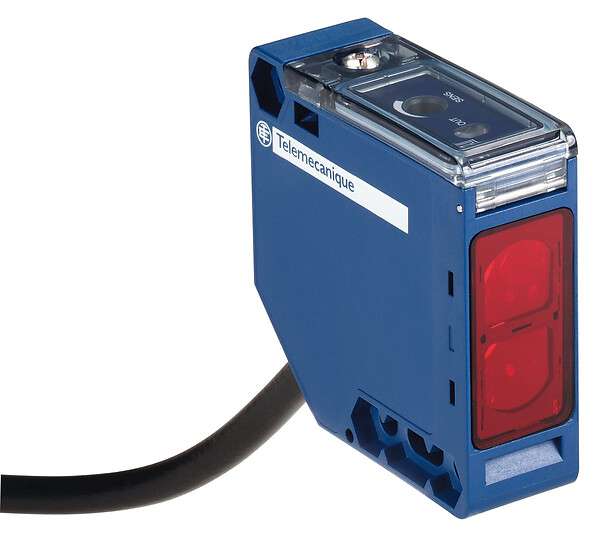
Telemecanique XUK1ARCNL2-SM-09 Photoelectric Sensor: Reflex (Retro-Reflective) Detection with Sn 7 m and Relay Output
The Telemecanique XUK1ARCNL2-SM-09 photoelectric sensor is a reflex (retro-reflective) photoelectric device engineered for industrial presence detection where consistent optical performance is required across varied target surfaces. Reflex sensing uses a reflector to establish a controlled optical corridor: the sensor emits a beam toward the reflector and evaluates the returned signal. In production environments, this architecture is frequently selected to simplify alignment governance (sensor on one side, reflector on the other) and to maintain a stable detection path under vibration and routine maintenance access.
Technical identity and configuration set
- Brand + code + type: Telemecanique XUK1ARCNL2-SM-09 photoelectric sensor
- Sensing mode: Reflex (retro-reflective) photoelectric sensing
- Rated sensing distance class: Sn 7 m
- Supply voltage: 24…240 VAC/DC
- Output type: SPDT relay output
- Electrical load (class): 100 mA switching class
- Connection: Fixed cable, 2 m class
- Indicators: Green supply LED, yellow output LED
Core family specifications for XUK1ARCNL2 are published by Telemecanique Sensors and Schneider Electric.
Reflex sensing logic: how detection is decided
In the Telemecanique XUK1ARCNL2-SM-09 photoelectric sensor, detection is interpreted by evaluating the intensity of the returned beam from the reflector. When a target passes through the optical corridor, the returned signal changes. This provides a robust presence-detection method for many packaging and conveying applications where the target may have variable color, print, or surface texture. The key engineering benefit is that performance depends primarily on beam continuity rather than target reflectivity alone, which helps stabilize switching in mixed-product lines.
Sn 7 m distance class: corridor planning and machine geometry
The Sn 7 m class of the Telemecanique XUK1ARCNL2-SM-09 photoelectric sensor enables longer separation between sensor and reflector compared to shorter-range photoelectric solutions.
In design, this supports wider conveyors, guarded cells, and mechanical layouts where the sensor cannot be mounted close to the product stream. A longer optical corridor also helps keep mounting hardware outside high-impact zones; however, it increases the importance of stable brackets and alignment references because small angular drift can translate into larger beam displacement over distance.
24…240 VAC/DC wide-range supply: panel standardization
The wide 24…240 VAC/DC supply range associated with the XUK1ARCNL2 family supports mixed automation infrastructures where AC and DC field supplies may exist.
For commissioning, the practical requirement is supply governance: verify the actual supply type, confirm protective devices, and document wiring paths. Wide-range supply reduces SKU diversity across plants, but disciplined documentation remains essential to ensure consistent troubleshooting and safe isolation practices.
SPDT relay output: switching behavior and interface discipline
The Telemecanique XUK1ARCNL2-SM-09 photoelectric sensor uses an SPDT relay output, enabling flexible integration into relay logic, PLC inputs, and mixed-voltage control circuits within rated limits.
Relay outputs are valued where a dry-contact style interface is preferred. From a technical perspective, stable operation depends on managing switching duty and avoiding excessive inductive loads without appropriate suppression. The objective is consistent switching and predictable lifecycle under repetitive machine cycles.
2 m cable and LED indication: maintenance efficiency
The fixed 2 m cable configuration (family reference) supports practical machine wiring where a short field lead routes into a junction box or cabinet entry.
The green supply LED and yellow output LED provide immediate on-device diagnostics, accelerating commissioning: technicians can confirm that the Telemecanique XUK1ARCNL2-SM-09 photoelectric sensor is powered and that the output transitions with target movement. In maintenance, LEDs reduce time-to-isolate by separating alignment/reflector issues from power/wiring faults.
“SM-09” variant governance: exact ordering identity
In practice, suffix variants such as “SM-09” are used to preserve exact ordering identity and project/channel differentiation while relying on the same core sensing platform characteristics. The operational requirement is simple: keep the full identifier Telemecanique XUK1ARCNL2-SM-09 photoelectric sensor consistent across BOMs, spare part lists, and maintenance records to prevent incorrect substitutions during replacement.
For related portfolio context, use the required internal link: Telemecanique sensor.
FAQ
- What sensing mode does the Telemecanique XUK1ARCNL2-SM-09 photoelectric sensor use?
It is a reflex (retro-reflective) photoelectric sensor that works with a reflector. - What is the distance class?
The XUK1ARCNL2 family is specified with Sn 7 m class. - What supply range is supported?
24…240 VAC/DC is specified for the family platform. - What output type is provided?
SPDT relay output is listed for the family reference. - How do the LEDs help in commissioning?
They provide direct visual confirmation of power and output switching state.
Entity recap: The Telemecanique XUK1ARCNL2-SM-09 photoelectric sensor is a reflex photoelectric device with Sn 7 m class, 24…240 VAC/DC supply capability, and SPDT relay output for industrial detection corridors.