
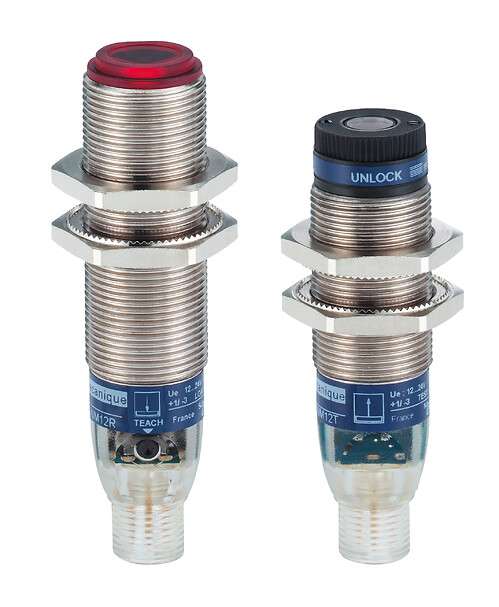
Telemecanique XUBLBPCNM12 Photoelectric Sensor: Compact Diffuse Detection up to 90 mm
Short-range object detection remains one of the most frequent requirements in automated production lines. Whether verifying part presence on a fixture, confirming product transfer between conveyors, or monitoring packaging alignment, reliability at close distance is critical. The Telemecanique XUBLBPCNM12 photoelectric sensor is engineered as a compact diffuse sensor designed for short-range detection with stable switching performance.
This article provides a structured technical overview of the Telemecanique XUBLBPCNM12 photoelectric sensor, including its detection principle, electrical characteristics, installation guidance, and integration strategy for PLC-controlled systems.
Detection Principle: Diffuse Sensing
The Telemecanique XUBLBPCNM12 photoelectric sensor operates using diffuse detection. In this method, the sensor emits a light beam and detects light reflected directly from the target object. Unlike reflex systems, no reflector is required. This simplifies mechanical design and reduces installation components.
The sensor is specified with a typical sensing distance class of approximately 90 mm, making it suitable for compact machine environments where detection windows are tightly controlled.
Core Technical Characteristics
- Detection system: Diffuse photoelectric
- Sensing distance class: up to 90 mm
- Output type: Discrete PNP
- Supply voltage: 10–30 V DC
- Electrical connection: M12 connector
- Housing format: Compact cubic body
- Ingress protection: Industrial sealing class (IP65/IP67 family standard)
These specifications position the Telemecanique XUBLBPCNM12 photoelectric sensor for precise, localized detection tasks in automation cells where repeatability is more important than long-distance sensing.
Electrical Integration and PLC Compatibility
The PNP discrete output of the Telemecanique XUBLBPCNM12 photoelectric sensor aligns with common PLC digital input modules. Integration discipline includes:
- Confirming correct sourcing input configuration in the controller
- Using standardized M12 cordsets for consistency
- Ensuring cable routing avoids high-frequency drive output wiring
Because detection occurs at short range, alignment stability directly influences reliability. Mechanical rigidity is therefore as important as electrical correctness.
Typical Application Areas
- Small component presence detection
- Packaging machine part verification
- Assembly jig confirmation
- Short conveyor transfer monitoring
In environments with reflective metallic backgrounds, proper angle adjustment ensures that unintended reflections do not trigger the output.
For broader integration practices and compatible accessories, refer to Telemecanique sensor ecosystem guidance.
FAQ
- What detection method does the Telemecanique XUBLBPCNM12 photoelectric sensor use?
It uses diffuse detection without a reflector. - What is the sensing distance?
It is designed for short-range detection up to approximately 90 mm. - What output type is provided?
It provides a PNP discrete switching output. - What connector does it use?
It uses an M12 connector interface. - What causes unstable switching?
Mechanical misalignment, reflective backgrounds, or unstable mounting brackets.
With disciplined mounting and controlled sensing geometry, the Telemecanique XUBLBPCNM12 photoelectric sensor delivers reliable short-range detection in compact automation systems.