
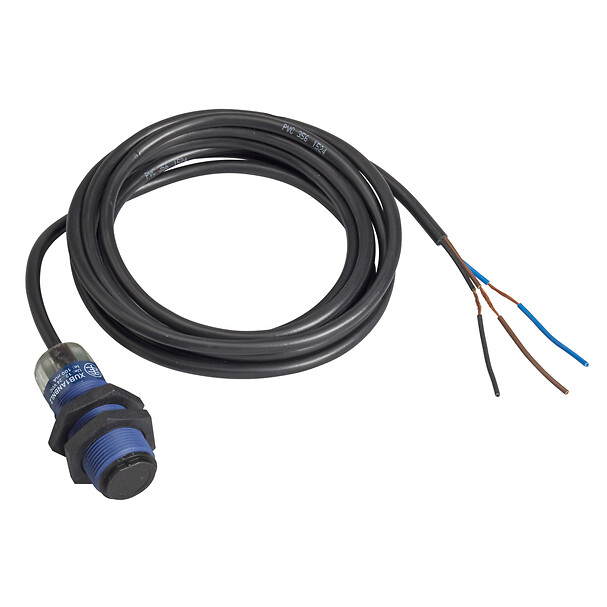
Telemecanique XUB2APANL2R Photoelectric Sensor Receiver Guide
The Telemecanique XUB2APANL2R photoelectric sensor receiver is a cylindrical M18 thru-beam receiver from the Telemecanique Photoelectric Sensors XU series. It is designed for industrial object detection where a separate transmitter sends an optical beam and the receiver monitors whether that beam is present or interrupted.
This model is particularly useful in automation systems that require stable detection across a defined path. Since thru-beam sensing does not depend heavily on the color or reflectivity of the target, it is often selected for conveyor lines, packaging machinery, counting stations, part detection, and material handling systems.
Main Technical Overview
The XUB2APANL2R is a photo-electric sensor receiver with a thru-beam detection system. It has a sensing range greater than 5 m and up to 15 m. Its nominal sensing distance is 15 m when used with the required transmitter. The sensor has an axial line of sight, which supports direct alignment between transmitter and receiver in straight-path installations.
The device uses a 3-wire DC supply circuit and operates at 12…24 V DC with reverse polarity protection. Its output type is PNP, and the output function is 1 NO. Electrical connection is provided by a cable, making it suitable for installations where a prewired sensor body is preferred.
Material and Electrical Performance
The sensor housing is made from PBT, while the lens uses PMMA. This combination supports practical durability in industrial operating conditions. The output is solid state, with a switching capacity up to 100 mA and built-in overload and short-circuit protection.
The switching frequency is 500 Hz, and both response and recovery delay are rated at 1 ms. These values make the XUB2APANL2R appropriate for many standard automation tasks where repeatable detection is more important than complex configuration. The model does not include sensitivity adjustment, which simplifies installation when the application requirements are clear and the optical path is properly aligned.
Environmental Capability
The XUB2APANL2R is rated IP65 and IP67 according to IEC 60529. These ratings support use in dusty or humid production spaces, depending on the installation and cable protection method. The sensor also offers vibration resistance and shock resistance, which are important for machinery where movement, mechanical impact, or production vibration may occur.
Where This Sensor Fits Best
This model is a good match for applications that need a 15 m thru-beam receiver with PNP output and cable connection. It can be used for detecting boxes, containers, parts, product gaps, moving items, and position confirmation in automation cells. Because the receiver depends on a separate transmitter, it performs best where the beam path can remain clear except when the target object passes through it.
For more information about Telemecanique, explore compatible industrial sensing products and related automation components.
Telemecanique XUB2APANL2R FAQ
What is the Telemecanique XUB2APANL2R?
It is a cylindrical M18 photoelectric sensor receiver for thru-beam detection. It receives the beam from a compatible transmitter and changes output state when the beam is interrupted.
What is the sensing distance?
The sensing range is greater than 5 m and up to 15 m, with a nominal thru-beam distance of 15 m when paired with the correct transmitter.
What output type does it have?
The XUB2APANL2R uses a PNP output with 1 NO output function. This makes it suitable for many DC industrial control systems using sourcing sensor outputs.
Does it use a connector or cable?
This version uses a cable connection. That can be helpful where a direct wired installation is preferred over a detachable connector arrangement.
Is sensitivity adjustment available?
No. This model is listed without sensitivity adjustment. Correct mechanical alignment between transmitter and receiver is therefore important during installation.
Which environments suit this sensor?
It is suitable for many industrial environments thanks to IP65 and IP67 protection, PBT housing, PMMA lens material, and resistance to vibration and shock.