
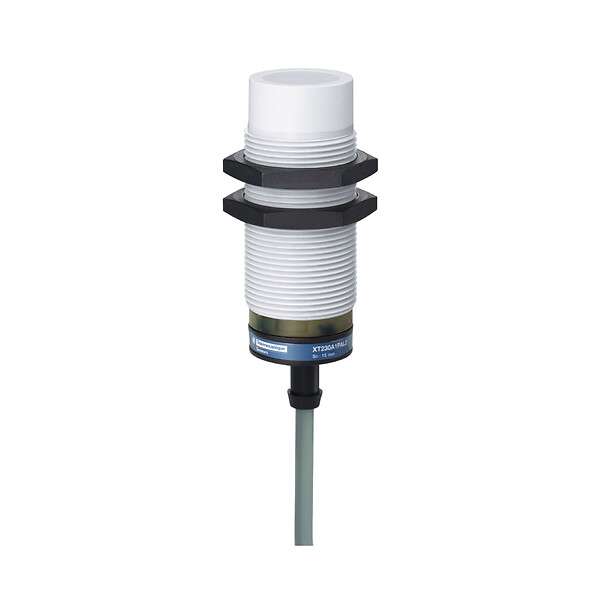
Telemecanique XT230A1FBL2 Capacitive Proximity Sensor: M30 AC NC Specifications
The Telemecanique XT230A1FBL2 capacitive proximity sensor is a two-wire AC capacitive sensor designed for detection of insulated or conductive materials. The key differentiator versus NO variants is the normally closed (NC) behavior, which is often selected for supervision-oriented logic where a defined “healthy” state is expected in the absence of a target or depending on the circuit strategy.
What the XT230A1FBL2 is
The Telemecanique XT230A1FBL2 capacitive proximity sensor is a cylindrical M30 plastic sensor specified as non flush mountable, with Sn 15 mm, 2-wire AC wiring, and 1 NC discrete output function. It operates on 24…240 V AC (50/60 Hz) and is supplied with a 2 m cable.
Key specifications
- Brand + code + type: Telemecanique XT230A1FBL2 capacitive proximity sensor
- Sensor design: Cylindrical M30, fixed body, size 74.5 mm
- Material: Plastic enclosure
- Mounting: Non flush mountable
- Nominal sensing distance (Sn): 15 mm
- Output: Discrete, 2-wire, AC, 1 NC
- Supply: 24…240 V AC (50/60 Hz)
- Response time: 30 ms
- Protection: IP67 double insulation
NC behavior: why teams select it
NC logic is often chosen for “supervised” circuits, because certain failure states can be detected as an abnormal condition—depending on how the control system interprets the loop. The operational requirement is clarity: specify the part as Telemecanique XT230A1FBL2 capacitive proximity sensor (2-wire AC, NC) in documentation so it is not replaced with a visually similar NO device during urgent corrective maintenance.
Capacitive detection and process variability
Capacitive sensors respond to changes in dielectric properties, which is why they can detect a wide range of materials. At the same time, that means process conditions matter: humidity, residue, and nearby structures can influence switching points. For the Telemecanique XT230A1FBL2 capacitive proximity sensor, stable performance depends on stable installation geometry and controlled sensitivity tuning.
Non-flush mounting and interference control
The non-flush requirement supports a more predictable sensing field by limiting interference from surrounding metal. Avoid recessing the sensor into conductive structures and maintain clearance around the sensing area. This reduces the likelihood of baseline drift that can cause an NC sensor to appear “stuck” in one state.
Application fit
- Material presence checks where targets are not purely metallic
- Packaging line detection with variable product composition
- Retrofit AC installations that standardize on two-wire sensors
- Supervision-oriented logic designs preferring NC behavior
Maintenance and troubleshooting mindset
If operation becomes inconsistent, first inspect for residue at the sensing face and verify bracket rigidity. Then review sensitivity settings under real process conditions. Finally, confirm AC wiring and the control system’s expectations for a 2-wire NC output device. This sequence prevents unnecessary part swapping and helps isolate whether the issue is environmental, mechanical, or electrical.
For system-level consistency in your sensor architecture, consult Telemecanique sensor references to align mounting rules and output conventions across machines.
FAQ
- Is the Telemecanique XT230A1FBL2 capacitive proximity sensor normally closed?
Yes. It is specified as 1 NC. - What is the nominal sensing distance?
Sn is 15 mm. - Is it a two-wire AC device?
Yes. It is 2-wire with output circuit type AC and 24…240 V AC supply. - Is it flush mountable?
No. It is specified as non flush mountable. - What protection rating does it have?
IP67 double insulation.