
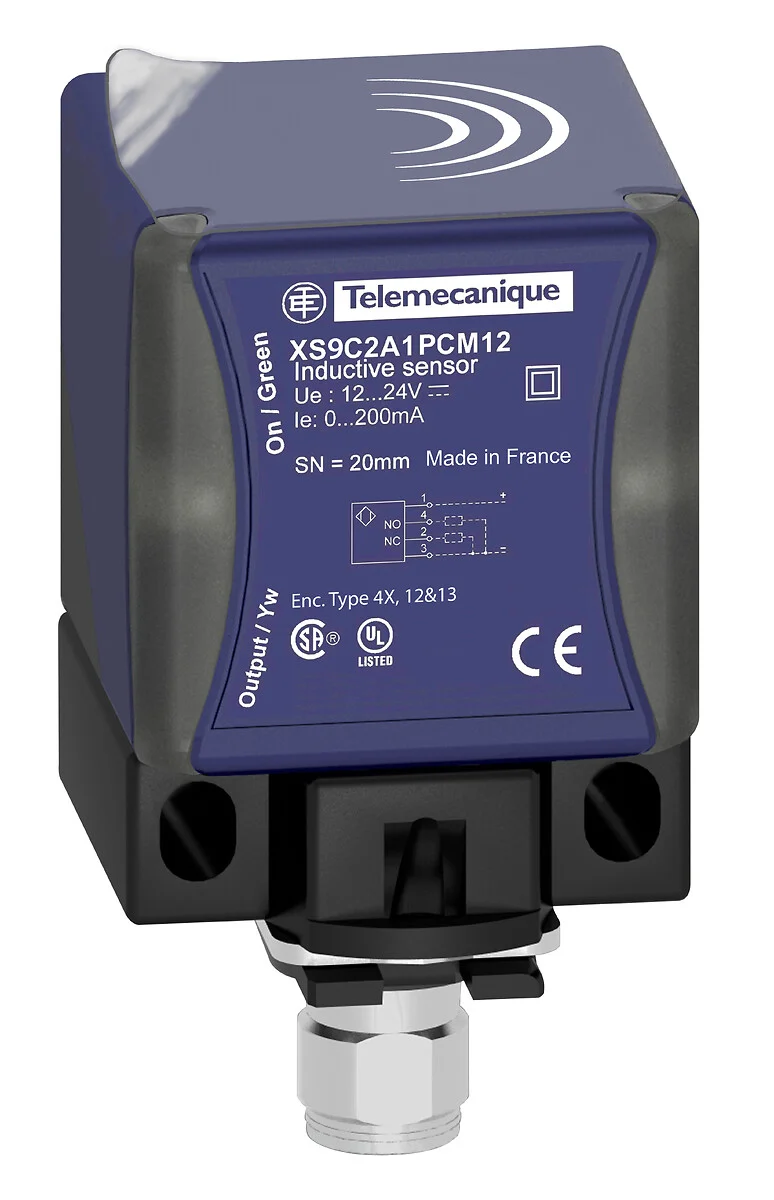
Telemecanique XS9C4A2A2G13 Inductive Proximity Sensor: Industrial 4–20 mA Analog Output
The Telemecanique XS9C4A2A2G13 inductive proximity sensor is built for industrial environments where analog signaling must remain resilient over distance and noise. With a 4…20 mA output, this model supports robust measurement-style integration—especially valuable in plants that standardize on current loops for reliability and diagnostic clarity.
Product definition
The Telemecanique XS9C4A2A2G13 inductive proximity sensor is an XS9 form factor device with a 40 × 40 × 117 body and PBT enclosure. It is non-flush mountable and uses screw-clamp terminals for electrical connection, aligning with cabinet-style wiring practices and structured commissioning workflows.
Technical specifications
- Brand + code + type: Telemecanique XS9C4A2A2G13 inductive proximity sensor
- Housing: Form 40 × 40 × 117, PBT
- Mounting: Non-flush mountable
- Nominal sensing distance (Sn): 25 mm
- Signal type: Analogue
- Analogue output range: 4…20 mA
- Wiring technique: 2-wire
- Supply: 12…24 V DC with reverse polarity protection
- Connection: Screw-clamp terminals (industrial panel integration)
- Protection: IP67, IP65, and IP69K
Why 4–20 mA is often the “operations” choice
Voltage signals can degrade more noticeably over long runs and noisy environments. Current loops, by design, are more tolerant. For the Telemecanique XS9C4A2A2G13 inductive proximity sensor, the 4–20 mA output is a strategic fit when you need stable readings and clear fault recognition (for example, detecting abnormal current levels when wiring is compromised).
Mounting strategy for analog stability
Because it is non-flush mountable, mounting clearance matters. Nearby metal can shift the sensor field and change the output curve. Treat the installation environment as part of the measurement system: bracket geometry, fastener location, and moving metal structures can all influence the analog output. The best practice is to validate the analog behavior in the assembled machine, not only on a bench test.
Terminal wiring and commissioning governance
Screw-clamp terminals can simplify structured panel builds, especially where cable glands and routed conductors are used. During commissioning, confirm that the receiving analog input is configured for 4–20 mA and document scaling so that operations teams interpret readings consistently. In asset lists, specify Telemecanique XS9C4A2A2G13 proximity sensor rather than “XS9 analog” to avoid substituting the 0–10 V variant by mistake.
Use cases
- Distance-related monitoring against a metal target within a controlled band
- Trend-based condition monitoring (drift as an early warning signal)
- Industrial environments where 4–20 mA is the standard analog interface
- Applications needing robust signaling in electrically noisy areas
Maintenance and diagnostics
If readings are unstable, investigate mechanical changes first: target alignment, new metal structures, or bracket deformation. If mechanical conditions are stable, check terminal tightness and verify loop integrity. A structured troubleshooting approach—mechanics, then wiring, then controller configuration—typically resolves issues faster than swapping parts without evidence.
For cross-family alignment and selection standards, consult Telemecanique sensor references to standardize outputs, connectors, and protection ratings across sites.
FAQ
- Does the Telemecanique XS9C4A2A2G13 inductive proximity sensor output 4–20 mA?
Yes. It provides an analog 4…20 mA output. - What is the nominal sensing distance?
It is specified with Sn 25 mm. - Is it a 2-wire device?
Yes. It uses a 2-wire wiring technique. - How is it connected electrically?
It uses screw-clamp terminals for panel-style wiring. - Is it flush mountable?
No. It is specified as non-flush mountable.