
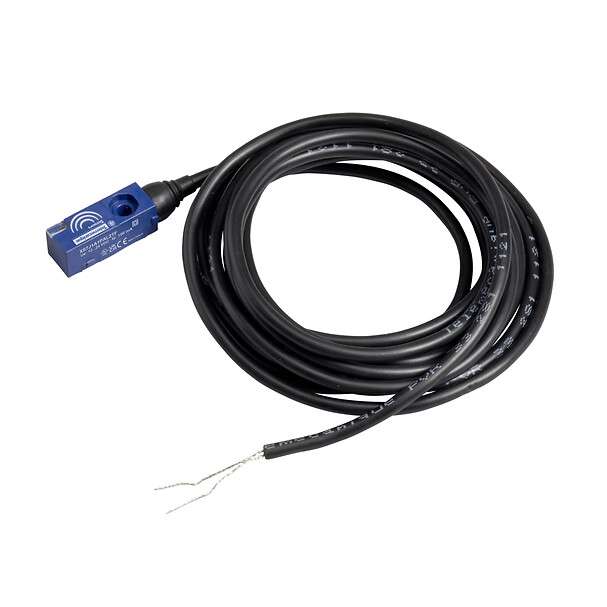
Telemecanique XS7J1A1PAL2 Inductive Proximity Sensor: Micro Flat Sensor for Tight Fixtures
The Telemecanique XS7J1A1PAL2 inductive proximity sensor is tailored for compact fixtures where millimeters matter. With a slim 8 × 22 × 8 flat-form body, this model supports precise metal detection in areas that cannot accommodate larger square sensors or cylindrical housings.
Product definition
The Telemecanique XS7J1A1PAL2 inductive proximity sensor is a small flat sensor built with a PBT enclosure and designed for flush mounting. It delivers discrete switching, making it suitable for PLC digital inputs and deterministic control sequences.
Technical specifications
- Brand + code + type: Telemecanique XS7J1A1PAL2 inductive proximity sensor
- Housing: Flat form 8 × 22 × 8, PBT
- Mounting: Flush mountable
- Nominal sensing distance (Sn): 2.5 mm
- Output: Discrete, 3-wire, PNP, 1 NO
- Supply: 12…24 V DC with reverse polarity protection
- Connection: Cable, 2 m
- Protection: IP67
- Switching frequency: up to 2000 Hz
Why a 2.5 mm sensor exists
At first glance, a 2.5 mm nominal sensing distance can look restrictive. In practice, it enables highly controlled switching in dense metal assemblies. The Telemecanique XS7J1A1PAL2 inductive proximity sensor is often used where close-range detection prevents accidental actuation from adjacent metal parts, improving signal integrity for high-speed automation sequences.
High switching frequency for fast motion
With a switching frequency specification reaching up to 2000 Hz, this model can support rapid actuation scenarios—provided the target geometry is consistent and the installation is rigid. For machine builders, the combination of compact housing and fast response is frequently useful in pick-and-place tooling, small indexing mechanisms, and compact feeder systems.
Installation discipline: the real performance driver
Small sensors amplify small mistakes. Keep the target surface stable, avoid bracket flex, and ensure the sensing face is aligned. If the sensor is installed on a moving carriage, use proper strain relief so the cable does not become the weakest point. In maintenance documentation, always specify Telemecanique XS7J1A1PAL2 proximity sensor to avoid substitution with similar-looking variants that may have different distances or protection ratings.
Typical use cases
- Micro fixtures with limited mounting area
- Small end-stop detection on compact actuators
- Feeder and escapement mechanisms requiring controlled actuation
- High-cycle applications where contact sensors would wear
Operational checks
When troubleshooting, verify target-to-sensor gap first. Because the sensing distance is short, small shifts can cause missed detection. Confirm supply voltage, then use LED output indication to see whether the sensor is switching even if the PLC input is not responding as expected. If the LED switches but the input does not, focus on wiring polarity and input configuration.
For consistent selection across compact sensor families, refer to Telemecanique sensor references to align mounting style and electrical output expectations.
FAQ
- What is the nominal sensing distance of the Telemecanique XS7J1A1PAL2 inductive proximity sensor?
It is specified with Sn 2.5 mm. - Is XS7J1A1PAL2 a PNP normally open sensor?
Yes. It is a 3-wire DC PNP sensor with 1 NO output. - What is the protection rating?
It is rated IP67. - What voltage does it require?
It operates on 12…24 V DC with reverse polarity protection. - Why choose this over a longer-range sensor?
Short range can improve selectivity in dense metal environments, reducing false triggers.