
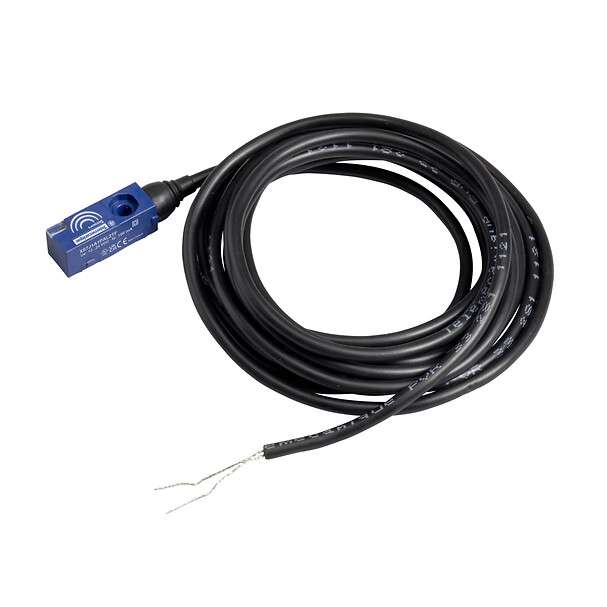
Telemecanique XS7D1A1PAL2 Inductive Proximity Sensor: Long-Range Flat 80×80 Detection
The Telemecanique XS7D1A1PAL2 inductive proximity sensor is built for applications that demand a longer sensing distance in a flat-form package. When mechanical constraints rule out cylindrical M30 bodies, a large flat sensor can deliver strong, repeatable detection across a wider operating zone—without introducing contact wear or alignment-sensitive mechanics.
Product definition
The Telemecanique XS7D1A1PAL2 inductive proximity sensor is a flat form 80 × 80 × 26 inductive sensor in a PBT enclosure. It is flush mountable, designed for general-purpose industrial use, and provides a discrete output for PLC-ready switching behavior.
Technical specifications
- Brand + code + type: Telemecanique XS7D1A1PAL2 inductive proximity sensor
- Housing: Flat form 80 × 80 × 26, PBT
- Mounting: Flush mountable
- Nominal sensing distance (Sn): 40 mm
- Output: Discrete, 3-wire, PNP, 1 NO
- Supply: 12…24 V DC with reverse polarity protection
- Connection: Cable, 2 m
- Protection: IP68
- Switching frequency: up to 100 Hz
When a 40 mm sensing distance changes the design
A key reason to specify the Telemecanique XS7D1A1PAL2 inductive proximity sensor is its 40 mm nominal sensing distance. In practice, that can allow you to mount the sensor farther from the target, which reduces the chance of mechanical damage in high-traffic machine areas. It also supports detection across thicker guards or protective covers, assuming the target and geometry are appropriate for inductive sensing.
Output behavior and commissioning discipline
This is a DC PNP sensor with a normally open output. During commissioning, technicians can rely on the output-state LED to verify real actuation before software interlocks are finalized. In documentation, write the full identifier—Telemecanique XS7D1A1PAL2 proximity sensor—so the maintenance team does not substitute a smaller XS7 variant with shorter range.
Mounting guidance for stable operation
Even though the sensor is flush mountable, long-range models can be more sensitive to nearby metal and moving structures. Keep the sensing face aligned to the target plane, and avoid placing large metal objects within the sensing field that could cause early switching. The goal is a predictable actuation point that does not drift with minor mechanical vibration.
Best-fit application scenarios
- Heavy-duty conveyors and transfer stations where clearance is needed
- Guard-door metal target detection with robust standoff distance
- Fixture presence checks in welding-adjacent environments (with proper placement)
- Automation cells where flat mounting simplifies the bracket design
Lifecycle checks and troubleshooting cues
For preventive maintenance, check the cable exit for strain, confirm mounting torque, and run a simple “target present / target absent” verification while observing the LED. If detection becomes intermittent, the root cause is frequently mechanical: target movement, changed metal mass near the sensor, or an altered mounting plane. Electrical issues typically show up as missing LED behavior or inconsistent PLC input state.
For selection across related sensors and standardization planning, see Telemecanique sensor references to align form factor, range, and output type across machines.
FAQ
- What is the nominal sensing distance of the Telemecanique XS7D1A1PAL2 inductive proximity sensor?
It is specified with Sn 40 mm. - Is XS7D1A1PAL2 a PNP sensor?
Yes. It is a 3-wire DC PNP sensor. - Is the output normally open?
Yes, the discrete output function is 1 NO. - What voltage range is required?
It operates on 12…24 V DC with reverse polarity protection. - Is it suitable for harsh environments?
It carries an IP68 rating; installation quality remains decisive for long-term stability.