
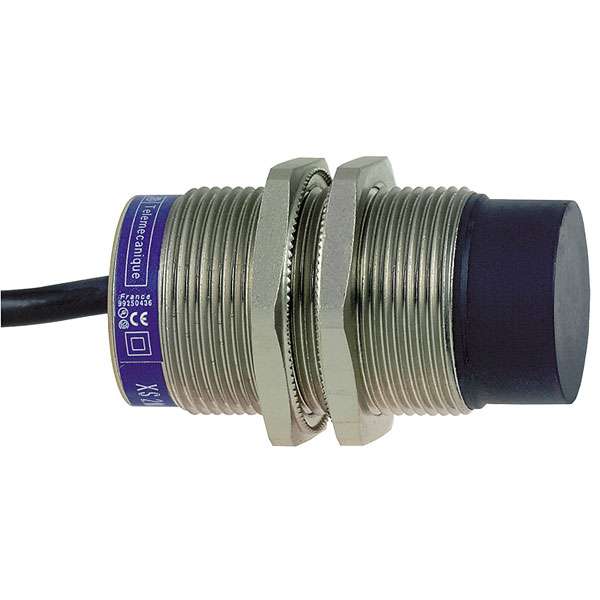
Telemecanique XS630B4MAL2 Inductive Proximity Sensor: AC/DC Two-Wire Details
The Telemecanique XS630B4MAL2 inductive proximity sensor is a practical choice when you need a wide AC/DC supply range and a simplified two-wire wiring concept. Within the XS family, this model targets general-purpose detection tasks where long-term reliability matters more than feature complexity, especially in mixed-voltage plants or retrofit scenarios.
Product identity and positioning
As a cylindrical M30 sensor with a metal enclosure, the Telemecanique XS630B4MAL2 inductive proximity sensor is engineered for metal target detection using inductive technology. Unlike many DC-only three-wire sensors, it uses a 2-wire AC/DC output approach, making it easier to integrate in legacy panels where wiring space and IO standards vary.
Telemecanique XS630B4MAL2 Key specifications
- Brand + code + type: Telemecanique XS630B4MAL2 inductive proximity sensor
- Form factor: Cylindrical M30, fixed body, 66 mm length
- Mounting: Non-flush mountable
- Nominal sensing distance (Sn): 22 mm
- Wiring: 2-wire
- Output function: 1 NO
- Supply: 24…240 V AC/DC (50/60 Hz on AC)
- Cable: 2 m cable connection
- Protection: IP68 and IP69K
Why “non-flush mountable” matters
Non-flush mounting is not a drawback; it is a design decision that typically supports longer sensing distance in an M30 package. With the Telemecanique XS630B4MAL2 inductive proximity sensor, plan mounting clearance to avoid unintended side detection. In tight mechanical assemblies, this simple detail is often the difference between stable switching and intermittent nuisance triggers.
Two-wire AC/DC integration considerations
The Telemecanique XS630B4MAL2 inductive proximity sensor uses an AC/DC output circuit and a two-wire topology. In operations teams, this is frequently appreciated because replacement is straightforward and the wiring resembles a series device in the loop. However, commissioning discipline is still essential: validate the load characteristics and input expectations of your control system, because two-wire sensors can behave differently from three-wire PNP/NPN models.
Performance notes for real environments
In industrial plants, the sensor’s electrical noise immunity is rarely “set and forget.” Route sensor cabling away from high-current conductors, and ensure that the cable jacket remains intact near moving parts. The presence of an output-state LED provides a quick, technician-friendly diagnostic signal during startups and maintenance rounds.
Application patterns
- Metal detection on conveyors and transfer lines in mixed-voltage facilities
- Gate and guard positioning where a rugged M30 body is preferred
- Retrofit replacements in panels that already use two-wire proximity sensing
- Harsh washdown zones, subject to correct sealing practices
Documentation hygiene for spares and procurement
When you standardize sensors, be explicit. Write “Telemecanique XS630B4MAL2 proximity sensor” in the bill of materials and include “2-wire AC/DC, NO, 24…240 V.” This prevents a common mistake: swapping in a DC-only PNP sensor that looks physically identical but cannot operate in the same circuit.
To compare the family and align form factors across machines, you can reference the broader Telemecanique sensor selection for mounting style and protection level matching.
FAQ
- Is the Telemecanique XS630B4MAL2 inductive proximity sensor compatible with AC supplies?
Yes. It is rated for 24…240 V AC/DC operation. - Is XS630B4MAL2 a two-wire sensor?
Yes. It uses a 2-wire wiring technique with an AC/DC output circuit. - Is the output normally open or normally closed?
It is specified as 1 NO output function. - What sensing distance should I expect?
The nominal sensing distance (Sn) is 22 mm, with non-flush mounting requirements. - Is it suitable for washdown?
It carries IP68 and IP69K ratings; correct installation and sealing practices remain essential.