
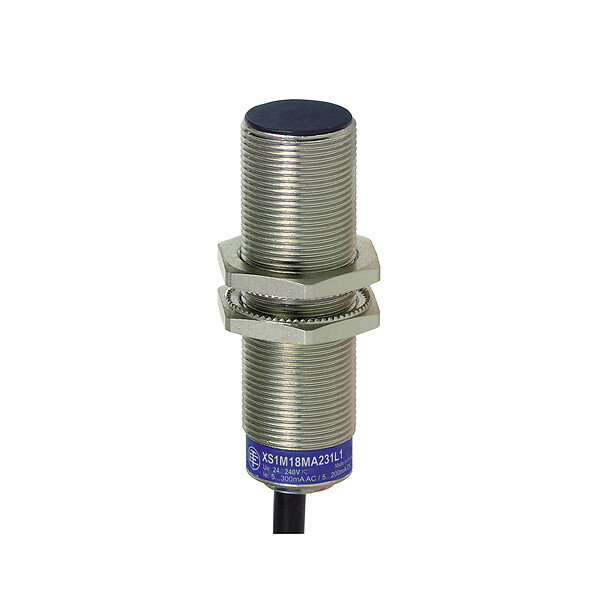
Telemecanique XS618B1DAL2 Inductive Proximity Sensor: M18 Sn 8 mm 2-Wire NO for High-Cycle Metal Detection
Inductive proximity sensing is frequently selected where reliability must be maintained across dust, oil mist, and variable ambient light—conditions that can degrade optical performance. The Telemecanique XS618B1DAL2 inductive proximity sensor is engineered for general-purpose metal detection with a defined sensing distance and a robust environmental profile. When implemented with disciplined mounting and spacing rules, inductive sensors become highly predictable process gates for position confirmation, part presence, and end-stop verification.
This technical article documents the specification set of the Telemecanique XS618B1DAL2 inductive proximity sensor, explains what Sn 8 mm means in real mechanical design, and provides integration practices that reduce false negatives and nuisance triggers.
Technical Identity and Core Specifications
The Telemecanique XS618B1DAL2 inductive proximity sensor is specified as an XS6 series cylindrical M18 inductive sensor with Sn 8 mm. It is flush mountable, uses a 2-wire wiring technique with a 1 NO discrete output, and is designed for 12…48 V DC supply with reverse polarity protection. Electrical connection is via cable with a 2 m length. Switching capacity is listed as ≤100 mA DC with overload and short-circuit protection. Environmental protection includes IP68 (double insulation) and IP69K. Switching frequency is specified as ≤2000 Hz DC.
- Sensor type: Inductive proximity sensor, XS6, cylindrical M18
- Nominal sensing distance (Sn): 8 mm
- Output: Discrete, 2-wire, 1 NO
- Supply: 12…48 V DC (limits up to 10…58 V DC)
- Switching frequency: ≤2000 Hz DC
- Protection: IP68, IP69K
These parameters place the Telemecanique XS618B1DAL2 inductive proximity sensor in the category of high-cycle, maintenance-friendly metal detection where fast switching and strong ingress protection are operational priorities.
Sn 8 mm in Practice: Designing for Margin
Sn is a nominal reference value. Operational reliability comes from designing a controlled gap so the sensor operates with margin rather than at the limit. For the Telemecanique XS618B1DAL2 inductive proximity sensor, the operating zone is specified up to 6.4 mm, which provides a practical guideline for stable target positioning. If a machine is designed so the target approaches near the edge of capability, normal mechanical drift—vibration, thermal growth, bracket looseness—can convert a stable signal into an intermittent one.
High-reliability designs treat the sensor gap as a governed dimension. The target is engineered to present sufficient metal area, and the bracket is designed to resist deflection. This reduces the likelihood that a sensor “passes commissioning” but fails intermittently in production.
2-Wire Integration: Consistent PLC Input Strategy
A 2-wire sensor architecture can simplify wiring, but it demands a consistent input strategy. The Telemecanique XS618B1DAL2 inductive proximity sensor is specified as 2-wire non-polarised with NO output behavior, which supports practical field maintenance when wiring conventions are standardized across machines. A robust governance approach includes:
- Documenting input ON meaning and mapping across all stations.
- Ensuring the PLC input module and wiring practice are aligned to 2-wire sensor behavior.
- Applying filtering only when necessary, aligned to the ≤2000 Hz switching capability.
With overload and short-circuit protection and defined voltage limits, the device is designed for industrial resilience. Still, routing and mechanical protection of the 2 m cable remain common lifecycle failure points if the cable is exposed to abrasion or repeated bending.
Mounting and Clearance: Avoiding Mutual Interference
Inductive sensors can influence each other when installed too close together. Minimum mounting distances are specified: side-by-side spacing ≥16 mm, face-to-face spacing ≥100 mm, and clearance when facing a metal object ≥25 mm. These values should be treated as engineering constraints, especially in compact fixtures where designers are tempted to cluster sensors tightly. Ignoring spacing rules can lead to unpredictable triggering that appears as “software noise” but is actually a physical interaction effect.
Environmental Resilience: IP68 and IP69K in Operations
IP68 and IP69K support demanding environments, including washdown expectations when connectors and routing are correctly managed. In practice, sealing performance is an end-to-end outcome: cable entries, routing, and mechanical protection must complement the sensor’s sealing design. The Telemecanique XS618B1DAL2 inductive proximity sensor benefits from a maintenance routine that checks bracket tightness and cable strain relief as part of preventive inspections.
For additional sensor ecosystem references and selection patterns, use Telemecanique sensor.
FAQ
- What is the Telemecanique XS618B1DAL2 inductive proximity sensor?
It is an XS6 cylindrical M18 inductive sensor with Sn 8 mm and a discrete NO output. - What wiring technique is specified?
The Telemecanique XS618B1DAL2 inductive proximity sensor uses a 2-wire technique. - What supply voltage range is listed?
Rated supply is 12…48 V DC with reverse polarity protection, with wider limits specified. - How fast can it switch?
Switching frequency is specified up to 2000 Hz DC. - What causes most false negatives?
Mechanical gap drift that pushes the target outside the stable operating zone and ignores spacing rules.
With governed gap design, documented PLC conventions, and enforced mounting clearances, the Telemecanique XS618B1DAL2 inductive proximity sensor delivers stable Sn 8 mm metal detection for high-cycle industrial automation.