
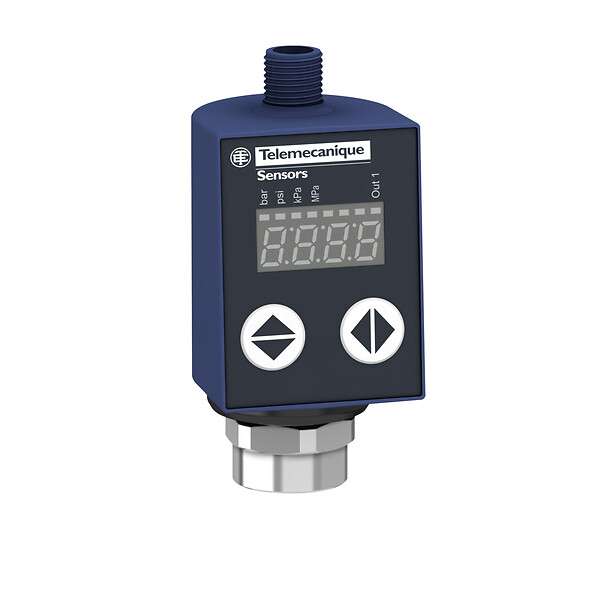
Telemecanique XMLR600M1P75 Electronic Pressure Sensor: 600 bar Monitoring with 0–10 V and PNP Switching
High-pressure applications do not forgive ambiguity. When a hydraulic line, test bench, or press circuit operates in the hundreds of bar, a pressure device must do more than provide a number—it must deliver repeatable signal behavior, clear local feedback, and predictable integration into control logic. The Telemecanique XMLR600M1P75 electronic pressure sensor is positioned for that environment, combining an analog output with a discrete switching output and a local display for commissioning clarity.
This technical article explains how the Telemecanique XMLR600M1P75 electronic pressure sensor is specified, how to integrate its 0–10 V output into a controller, and how to apply governance practices that reduce troubleshooting time when pressure alarms appear in production.
Technical Identity: What the Device Is Designed to Do
The product data sheet lists the Telemecanique XMLR600M1P75 electronic pressure sensor as an electronic pressure sensor in the XMLR family with a pressure rating of 600 bar. It provides analogue + discrete output behavior, including an 0…10 V analog output and a solid state PNP discrete output with NO/NC programmable switching. It also uses an M12, 4-pin electrical connection and a G 1/4 (female) fluid entry.
- Pressure rating: 600 bar
- Output signal: Analogue + discrete
- Analogue output function: 0…10 V
- Discrete output type: Solid state PNP, NO/NC programmable
- Maximum switching current: 250 mA
- Electrical connection: Male connector M12, 4 pins
- Materials in contact with fluid: 316L stainless steel
0–10 V Scaling: Turning Voltage into Pressure You Can Trust
In most control systems, the value of a 0–10 V sensor depends on how well the scaling is governed. A typical approach is to map 0 V to 0 bar and 10 V to 600 bar, then define alarm thresholds within that engineered window. The key is to document the scaling rule and keep it consistent across machines; otherwise, a replacement or program revision can silently shift interpretations and cause false trips.
The Telemecanique XMLR600M1P75 electronic pressure sensor also supports a discrete switching output (PNP, programmable NO/NC). This gives you an additional layer: analog for trending and diagnostics, discrete for deterministic interlocks. That combination is especially useful when safety or equipment protection depends on fast, unambiguous switching behavior.
Switching Logic Governance: NO/NC Is a Policy Decision
Because the discrete output is NO/NC programmable, you should treat the configuration as a governance decision rather than an installer preference. Define a plant convention—for example, “output ON equals pressure above setpoint”—and apply it consistently. This standardization reduces downtime because technicians do not have to mentally translate logic on each machine.
For dynamic processes, pay attention to the device’s response characteristics and the available time delay concepts in pressure control. The data sheet references switching descriptions such as hysteresis and window behaviors and time delay usage to filter fast transients. In practical terms, that means you can tune the system to avoid nuisance trips from short spikes while still catching real overpressure events.
Mechanical Installation: High Pressure Demands Discipline
The process connection and material stack are designed for demanding service (G 1/4 female and 316L stainless steel in contact with fluid). Still, reliability depends on how the sensor is installed:
- Use appropriate sealing and torque practices for the port and fittings.
- Route cables to avoid vibration-driven connector stress at the M12 interface.
- Consider mounting orientation guidance to avoid measurement distortion from trapped disposals if installed upside down.
Commissioning Workflow That Saves Time Later
A practical commissioning routine for the Telemecanique XMLR600M1P75 electronic pressure sensor includes:
- Confirm the analog scaling using a known pressure reference or calibrated gauge.
- Verify switching setpoint behavior by slowly ramping pressure through thresholds.
- Record configuration choices (NO/NC, setpoints, filtering strategy) in the asset history.
For broader ecosystem selection patterns and related device references, use Telemecanique sensor.
FAQ
- What is the maximum pressure rating of the Telemecanique XMLR600M1P75 electronic pressure sensor?
The product data sheet lists a pressure rating of 600 bar. - Which outputs are provided?
It provides analogue + discrete outputs, including 0…10 V and solid state PNP switching. - Is the switching output configurable?
Yes, the discrete output is PNP with NO/NC programmable switching. - What connector is used for wiring?
The electrical connection is a male M12 connector with 4 pins. - What is a common integration mistake?
Incorrect PLC scaling of 0–10 V, which shifts alarm thresholds and creates false overpressure events.
When scaling rules and switching conventions are documented, the Telemecanique XMLR600M1P75 electronic pressure sensor becomes a stable, high-pressure monitoring element that supports both diagnostics and deterministic protection logic.