
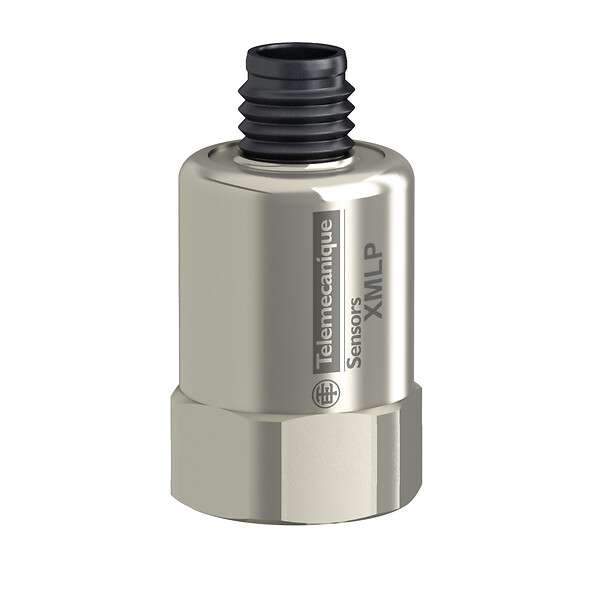
Telemecanique XMLP016BD790 Pressure Transmitter: 16 bar Measurement with 0–10 V Output
Pressure feedback is one of the most operationally “honest” signals in automation: it reveals pump health, regulator stability, valve performance, and early-stage blockage long before production quality visibly degrades. The Telemecanique XMLP016BD790 pressure transmitter is engineered as an electronic transmitter in the XM pressure sensor family, translating a defined pressure range into a stable analog voltage for controller-level interpretation.
This technical article explains how the Telemecanique XMLP016BD790 pressure transmitter is specified, what its mechanical and electrical interfaces mean in the field, and how to integrate it in a way that supports repeatable commissioning and reliable diagnostics across the equipment lifecycle.
Product Identity and Functional Role
The Telemecanique XMLP016BD790 pressure transmitter is an electronic pressure sensor designed for a 16 bar class range with an analogue 0–10 V output. It is intended for control circuits where continuous measurement is required rather than simple threshold switching. In practical terms, this makes it suitable for trend-based monitoring, closed-loop regulation, and predictive maintenance indicators that rely on gradual signal changes rather than binary events.
Core Technical Characteristics (Field-Relevant)
- Pressure rating: 16 bar (pressure setting range 0…16 bar).
- Output: analogue 0…10 V, 3-wire.
- Electrical connection: 1 male connector M12, 4 pins.
- Supply: 24 V DC SELV class (voltage limits 12…33 V).
- Fluid connection type: SAE 7/16-20UNF-2B (female) with Schrader.
- Accuracy: ±0.5% of the measuring range (typical datasheet statement).
- Response time: ≤2 ms (10…90% of full scale).
- Media context: listed for air, fresh water, hydraulic oil, gas, refrigeration fluid within stated temperature bands.
These specifications position the Telemecanique XMLP016BD790 pressure transmitter as a strong fit for compact skid assemblies and machine modules where an M12 ecosystem is already standardized and an analog voltage channel is available in the PLC or remote IO.
Mechanical Integration: Connection Strategy and Serviceability
The fluid interface is often the first integration risk. The Telemecanique XMLP016BD790 pressure transmitter uses an SAE 7/16-20UNF-2B female connection. That choice matters operationally: it influences adapter selection, sealing practice, torque discipline, and maintenance tooling. A commissioning-ready approach is to treat the pressure tap as a “design-controlled” point—document the fitting stack-up, define tightening torque conventions, and avoid introducing mechanical stress through rigid piping misalignment.
Positioning is also operationally relevant. The datasheet indicates suitability for “any position,” which helps when mounting constraints exist in dense machine frames. Still, good practice is to avoid placing the sensor at a point where trapped air pockets or dead legs produce readings that do not represent the live process pressure.
Electrical Integration: Scaling the 0–10 V Signal
Analog voltage integration is straightforward but benefits from disciplined scaling. In the PLC, map 0 V to the lower bound of the engineering range and 10 V to the upper bound (0…16 bar class). Then validate with a known reference such as a calibrated gauge or test pump. This prevents “quiet” commissioning defects where the system appears functional but alarms and thresholds are offset.
For stable measurement, route analog wiring away from VFD motor outputs and high-inrush contactors. Because the Telemecanique XMLP016BD790 pressure transmitter operates on a DC supply and produces an analog output, grounding and cable management choices directly affect signal stability under real production noise conditions.
Operational Diagnostics and Maintenance Value
A transmitter becomes most valuable when the signal is used beyond basic monitoring. With the Telemecanique XMLP016BD790 pressure transmitter, you can implement trend alarms (slow drift), rate-of-change checks (abrupt events), and correlation diagnostics (pressure vs. motor current). This transforms pressure from a “number on an HMI” into a measurable operational KPI that supports maintenance planning.
For broader ecosystem alignment across related sensing families and installation conventions, see Telemecanique sensor resources for cross-reference and integration patterns.
FAQ
- What output does the Telemecanique XMLP016BD790 pressure transmitter provide?
It provides an analogue 0…10 V output in a 3-wire configuration. - What is the pressure range class for Telemecanique XMLP016BD790 pressure transmitter?
It is specified for a 16 bar class range (0…16 bar setting range). - Which connector is used?
It uses an M12 male connector with 4 pins. - What is the fluid connection type?
It is specified with an SAE 7/16-20UNF-2B female fluid connection (with Schrader). - How should the analog signal be commissioned?
Scale 0–10 V to the engineering range in the PLC and validate at two reference pressure points to confirm mapping accuracy.
When integrated with controlled fittings, disciplined wiring, and validated scaling, the Telemecanique XMLP016BD790 pressure transmitter becomes a dependable measurement channel for both control performance and long-term operational analytics.