
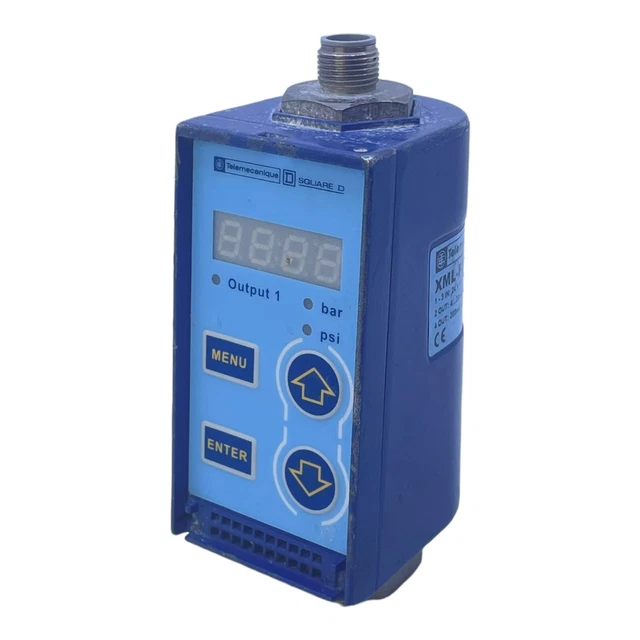
Telemecanique XMLF400D2025 Electronic Pressure Sensor (400 bar): Technical Overview and Lifecycle Notes
The Telemecanique XMLF400D2025 belongs to the XM pressure sensor family and is described as an electronic pressure sensor used for regulation between thresholds while also providing an analogue signal. This blend—control logic plus analogue output—makes it useful in high-pressure systems where both monitoring and process logic matter.
Common keyword patterns include Telemecanique XMLF400D2025 pressure sensor, XMLF400D2025 400 bar 4-20 mA, and Telemecanique XMLF400D2025 G1/4 female. In internal catalogs, the clearest naming is Telemecanique XMLF400D2025 electronic pressure sensor (Brand + product code + product type).
What XMLF400D2025 Is Designed For
In real installations, 400 bar pressure measurement typically appears in hydraulic systems: presses, injection equipment, test benches, and specialty machinery. The key challenge is not only the pressure level, but the behavior during pressure spikes, vibration, and temperature changes. An electronic pressure sensor used for regulation between thresholds supports logic such as “maintain within band” and can provide continuous feedback for trend monitoring.
Key Technical Characteristics
The published datasheet describes XMLF400D2025 as an electronic pressure sensor with 4-wire wiring technique, 400 bar pressure rating, and G 1/4 (female) fluid connection. It also indicates output flexibility such as NO or NC behavior and includes 4..20 mA as the analogue signal.
| Parameter | Value / Notes |
|---|---|
| Brand + Code + Type | Telemecanique XMLF400D2025 electronic pressure sensor |
| Pressure rating | 400 bar |
| Process connection | G 1/4 (female) (ISO 228) |
| Wiring technique | 4-wire |
| Signal / logic | 4..20 mA + programmable NO/NC behavior (as described) |
| Typical controlled fluids (not exhaustive) | Air and other listed media depending on temperature range |
Lifecycle Reality: Legacy Product Context
A critical operational detail: Telemecanique’s product reference page describes end of commercialisation and notes replacement options (e.g., XMLR series alternatives). In maintenance practice, that means planning is as important as specification: define what “equivalent” means for your plant (range, connection, output type, connector style, response).
When replacing a legacy device in a closed-loop control or regulation application, be careful: a newer model can have slightly different response characteristics. Even if the pressure range and signal type match, tuning might need validation. The safest approach is to record baseline behavior before replacement (pressure ripple, settling time, typical operating band) and verify those patterns after installation.
Integration Notes (4–20 mA + Threshold Regulation)
- Scaling discipline: document mapping of 4 mA and 20 mA to your engineering units. In a 400 bar sensor, clear scaling prevents dangerous misinterpretation.
- Electrical noise: route analogue wiring away from VFD motor cables and use your site’s standard grounding/shielding practice.
- Setpoint governance: if thresholds are adjustable, control access (procedures or locking) to avoid “operator drift” over time.
For consistent cross-linking in your sensor content hub: Telemecanique sensor.
FAQ: Telemecanique XMLF400D2025
Is XMLF400D2025 a pressure transmitter or a switch?
It is described as an electronic pressure sensor capable of regulation between thresholds and providing a 4..20 mA analogue signal, with NO/NC behavior referenced in the datasheet.
What is the process connection?
The datasheet specifies G 1/4 (female) conforming to ISO 228.
Why does lifecycle status matter in engineering documentation?
Because replacement planning affects downtime risk. When a reference is listed as replaced/end-of-service, your documentation should include successor strategy and validation steps.
How should I name it for procurement accuracy?
Use Telemecanique XMLF400D2025 electronic pressure sensor (Brand + code + type) plus key identifiers: 400 bar, G1/4 female, 4..20 mA, NO/NC.