
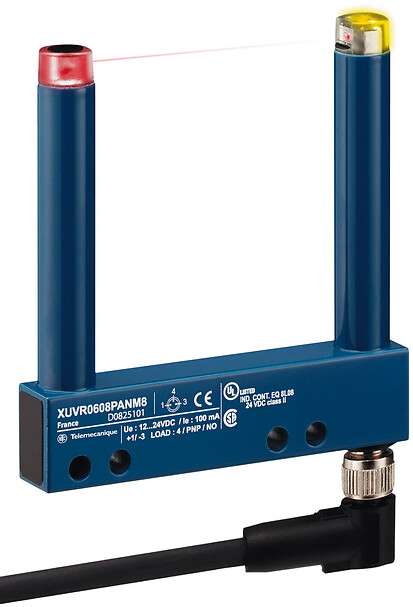
Telemecanique Sensors XUVR0303PANM8 Photoelectric Fork Sensor: 24 VDC PNP NO Detection for Object Passage Control
The Telemecanique Sensors XUVR0303PANM8 photoelectric sensor is a fork-style sensor designed to detect the passage of objects with strong repeatability. Fork sensors are often selected because they can simplify mechanical alignment: the detection gap is fixed by design, which reduces the number of variables that cause inconsistent detection in traditional opposed or diffuse setups.
Verified Technical Snapshot (Manufacturer Reference)
The official product reference page lists XUVR0303PANM8 under photoelectric sensors XU/XUV with key characteristics: material metal, DC supply, 4-wire wiring technique, PNP discrete output type, 1 NO output function, and M8 male connector, 3 pins. It also specifies the application as dynamic detection of passage of objects (and static detection), notes a 0…5 s off-delay range, and lists IP65 protection.
The same page indicates the rated supply voltage as 24 V DC with reverse polarity protection and a switching capacity of <= 100 mA (with overload/short-circuit protection).
Telemecanique Sensors XUVR0303PANM8 Why Fork Sensors Are Used in High-Repeatability Detection
In many lines, the real challenge is not detecting “an object,” but detecting it the same way every cycle. Fork sensors reduce alignment variables because the emitter and receiver geometry is fixed. This can help stabilize detection for:
- Small parts passing at speed
- Indexing mechanisms where timing matters
- Conveyor transfer points where vibration can shift external brackets
Operationally, a fork sensor becomes a “set and govern” component: once mounted securely and configured, it typically requires minimal readjustment.
Telemecanique Sensors XUVR0303PANM8 PNP NO Output and 4-Wire Wiring: Practical Control Integration
The device is listed with PNP discrete output and 1 NO function, plus a 4-wire wiring technique. In control design, the key governance decision is to standardize how “NO” is interpreted across the machine family and how the PLC program reports faults. A consistent approach reduces troubleshooting time and prevents replacement errors under pressure.
M8 3-Pin Connection: Installation Discipline
The sensor uses a male M8, 3-pin connector. This is common in compact installations, but reliability depends on good connector practices: correct mating, strain relief, and routing that avoids repeated flexing. Connector issues often present as intermittent faults that can be misdiagnosed as “sensor sensitivity” problems.
Off-Delay (0…5 s) and Application Fit
The reference page lists a 0…5 s off-delay capability.Telemecanique Sensors XUVR0303PANM8 Off-delay can be used to smooth control signals when brief interruptions should not stop the process, or where the PLC expects a minimum pulse width. It should be implemented with a clear policy: delays can hide real process anomalies if used indiscriminately. Treat delay as a deliberate engineering parameter, documented per station.
Telemecanique Sensors XUVR0303PANM8 Environmental Robustness: IP65
The listing specifies IP65. In practice, IP rating performance depends on connector sealing and mechanical protection. If the installation area is exposed to spray, dust, or impact, add mechanical guarding and cable strain relief.
Telemecanique Sensors XUVR0303PANM8 Required internal link: Telemecanique sensor.
FAQ: Telemecanique Sensors XUVR0303PANM8
What is XUVR0303PANM8 used for?
It is specified for dynamic detection of passage of objects.
What output does it provide?
The product page lists a PNP discrete output with 1 NO function.
What connector is used?
It uses a male M8 connector with 3 pins.
Is there a built-in delay function?
The page lists a 0…5 s off-delay time delay range.