
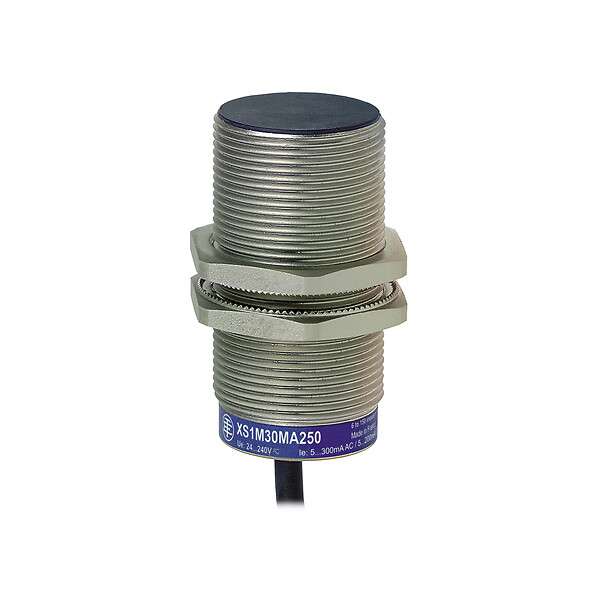
Telemecanique Sensors XS630B1MBL2 Inductive Proximity Sensor: M30, 15 mm, 2-Wire NC for 24–240 VAC/DC
The Telemecanique Sensors XS630B1MBL2 inductive proximity sensor is built for industrial detection tasks where a long sensing distance, sturdy construction, and wide supply flexibility are required. This model is an XS6-series cylindrical M30 sensor specified with a 15 mm nominal sensing distance. It is designed for 24…240 VAC/DC operation and uses a 2-wire wiring technique with an AC/DC circuit type. The discrete output function is normally closed (NC), and connection is via a 2 m fixed cable.
Where an M30 15 mm sensor delivers practical margin
Large-format sensors are often used where targets are physically large, distances vary, or mounting points are constrained by guarding and structure. In these situations, the most valuable attribute is not theoretical sensitivity but operational margin: the ability to keep a stable “target present” signal even as the machine vibrates or slowly drifts over time. The Telemecanique Sensors XS630B1MBL2 inductive proximity sensor provides that margin with its 15 mm nominal distance and M30 body.
This model is specified as flush mountable, meaning it can be integrated into metal brackets in a compact, protected way while maintaining intended behavior. That can be an advantage in heavy equipment where protruding components risk impact damage.
Technical profile: what the specification defines
XS630B1MBL2 is specified as a nickel-plated brass M30 inductive proximity sensor with a frontal detection face and PPS front material. It is a 2-wire sensor with an AC/DC circuit type, a NC discrete function, and a rated supply of 24…240 VAC/DC (50/60 Hz). Environmental protection is referenced as IP68 (double insulation) and IP69K.
Installation: use the flush capability intelligently
Because the Telemecanique Sensors XS630B1MBL2 inductive proximity sensor is flush mountable, it can be installed level with surrounding metal, helping protect it from mechanical impact. Ensure the threaded mount is rigid and properly torqued. When selecting the target, use a consistent metal surface area; thin, irregular, or perforated targets can reduce effective sensing margin and create inconsistent switching points.
- Flush mounting: Embed the sensor in stable metal structure where practical.
- Distance margin: Aim to operate comfortably within the operating zone rather than at the edge of sensing.
- Cable management: Protect the 2 m cable from abrasion and keep it away from heat sources where possible.
Commissioning: validate NC behavior and cycle repeatability
Commissioning should verify that NC behavior matches the control logic expectation. Test both target-present and target-absent states and confirm the PLC or input device interprets them correctly. Then validate switching under real machine speed and vibration. If switching appears late or inconsistent, adjust sensor position or target geometry. In most cases, intermittent behavior indicates mechanical tolerance or mounting movement rather than an inductive sensing limitation.
The Telemecanique Sensors XS630B1MBL2 inductive proximity sensor is frequently deployed as a robust reference signal for large carriers, mechanical stops, safety-related permissives (where allowed by design), and “station occupied” confirmations in material handling.
Maintenance: what to check before replacing hardware
Before replacement, inspect mounting tightness and the target path. If the bracket has shifted, the sensor may still be operating correctly. Also check for metallic debris buildup in the sensing area in ferrous environments. Finally, inspect the cable for cuts or crushing where it enters conduits or clamps. These practical checks often resolve recurring faults more effectively than swapping components.
For related product families and broader selection context, visit Telemecanique sensor.
Telemecanique Sensors XS630B1MBL2 FAQ
1) What is XS630B1MBL2?
The Telemecanique Sensors XS630B1MBL2 inductive proximity sensor is an M30 inductive sensor specified with 15 mm nominal sensing distance and an NC discrete function.
2) What supply range is specified?
It is specified for 24…240 VAC/DC operation (50/60 Hz).
3) What wiring technique is specified?
It is specified as a 2-wire sensor with an AC/DC output circuit type.
4) Is it flush mountable?
Yes. The specification lists it as flush mountable.
5) What ingress protection is referenced?
It is referenced with IP68 (double insulation) and IP69K.