
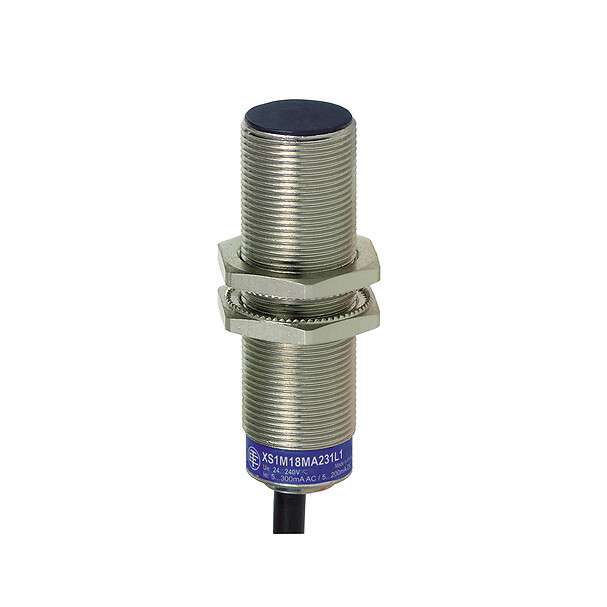
Telemecanique Sensors XS1M18AB120 Analogue Inductive Proximity Sensor: M18 Continuous Output for Metal Target Positioning
The Telemecanique Sensors XS1M18AB120 analogue inductive proximity sensor is built for applications where a control system benefits from more than a simple on/off presence signal. Instead of providing only a discrete switching event, this model is specified as an analogue-output inductive sensor in a cylindrical M18 format with a 5 mm nominal sensing distance and a 2-wire wiring concept. It operates on 12–24 VDC and is supplied with a 2 m fixed cable, supporting stable integration into machines where continuous information about distance-to-target can enhance monitoring or control behavior.
What an Analogue Inductive Sensor Changes in Practice
Many industrial detection tasks can be handled with a standard proximity switch. However, when a machine needs to detect gradual movement, approach speed, or relative position of a metal target within a small range, an analogue signal can provide meaningful operational value. The Telemecanique Sensors XS1M18AB120 analogue inductive proximity sensor supports that strategy by providing a continuously varying output that follows the target’s proximity rather than flipping only at one threshold.
This is useful for tasks such as monitoring the approach of a metal cam, detecting whether a component is drifting out of tolerance, or confirming that a mechanical assembly has reached the expected alignment before a clamp is applied. The goal is not to turn the sensor into a high-resolution metrology instrument, but to extract stable, trendable information that indicates whether the process is behaving normally.
Core Technical Identity
This model is specified as an M18 inductive sensor with a 5 mm nominal sensing distance, an analogue output characteristic, and a 2-wire wiring technique. The 12–24 VDC supply band matches common industrial control power. Because it is inductive, it responds to conductive metal targets and is generally resilient in environments where dust, oil mist, or surface contamination would degrade optical sensing. The Telemecanique Sensors XS1M18AB120 analogue inductive proximity sensor is therefore a practical option when the target is metallic and the environment is industrial rather than laboratory-clean.
Installation Strategy for Stable Analogue Behavior
Analogue sensors amplify the importance of mechanical consistency. A small change in alignment can translate into a noticeable signal change. To get consistent results from the Telemecanique Sensors XS1M18AB120 analogue inductive proximity sensor, the mounting should be rigid, and the target path should be repeatable. Avoid flexible brackets that can vibrate and create signal variation that looks like process instability.
- Mount rigidly: Use a stable threaded mount or clamp designed to resist vibration.
- Target consistency: Ensure the target’s metal surface and path remain consistent between cycles.
- Cable discipline: Protect the cable from bending stress and route away from high-noise power wiring.
Telemecanique Sensors XS1M18AB120 Commissioning: Establish a Baseline Signal
Commissioning should focus on establishing what “normal” looks like. Observe the analogue value with the target at known positions, then run the machine and check whether the signal stays within an expected band. If the band widens, investigate mechanical looseness, target wobble, or changes in the metal target geometry. The Telemecanique Sensors XS1M18AB120 analogue inductive proximity sensor is often the first component to reveal that a mechanical system is developing play or misalignment.
A practical approach is to store a baseline trace during a stable production period. Later, if a quality issue occurs, the analogue trend can provide evidence: the target may still be “detected,” but its approach profile may have changed.
Operational Benefits Without Overcomplication
Analogue sensors are most effective when used with a clear purpose. The best outcomes come from using the signal to detect drift, confirm approach behavior, or trigger alarms based on deviation from a stable band. The Telemecanique Sensors XS1M18AB120 analogue inductive proximity sensor can support that by giving continuous feedback while keeping the sensing principle simple and robust.
Maintenance and Troubleshooting
If the signal becomes noisy or unstable, check mounting tightness, target vibration, and cable routing first. If the signal shifts gradually, check whether the target geometry has changed due to wear. If the signal collapses, verify supply voltage and wiring integrity. In many cases, the sensor is performing correctly and reporting a mechanical reality that should be addressed.
For related product families and selection context, visit Telemecanique sensor.
Telemecanique Sensors XS1M18AB120 FAQ
1) What is XS1M18AB120?
The Telemecanique Sensors XS1M18AB120 analogue inductive proximity sensor is an M18 inductive sensor designed to provide a continuous analogue output related to target proximity.
2) What supply voltage is specified?
It is specified for 12–24 VDC operation.
3) What wiring style is specified?
It is specified with a 2-wire wiring technique.
4) What nominal sensing distance is specified?
It is specified with a 5 mm nominal sensing distance.
5) What is a common use case?
Monitoring metal target approach or detecting drift in mechanical positioning where a discrete on/off signal is not enough.