
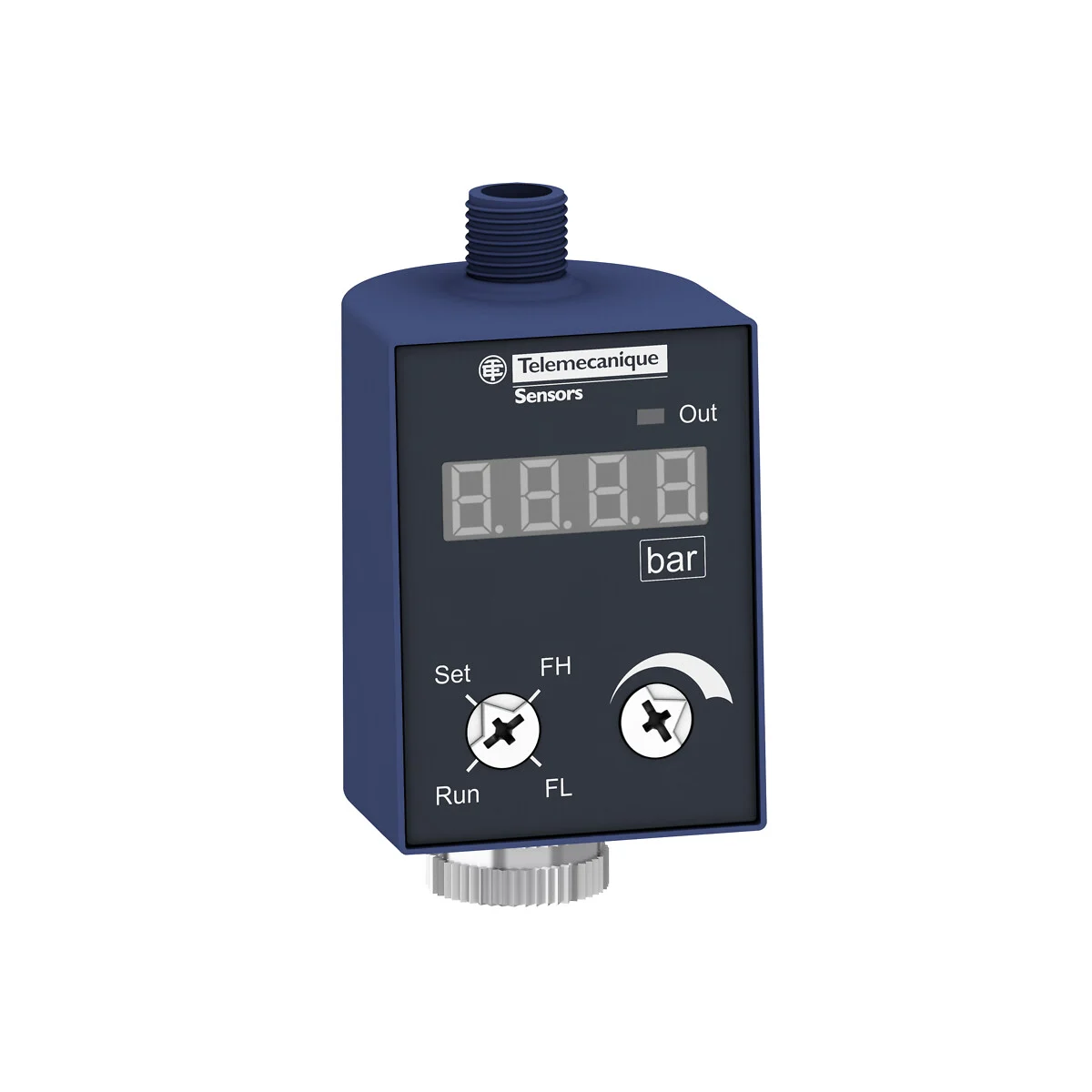
Telemecanique Sensors XMLP250MD21F Pressure Transmitter: 250 mbar Measurement with 4–20 mA Output
The Telemecanique Sensors XMLP250MD21F pressure transmitter addresses low-pressure measurement where small changes matter. In 250 mbar applications, the signal is often used to detect gentle pressure differences, confirm low-pressure utilities, or monitor processes where a minor variation is operationally significant. In these scenarios, continuous measurement is especially valuable because a threshold-only approach can miss early deviation and can hide process instability.
What XMLP250MD21F Is Referenced To Provide
The Telemecanique Sensors XMLP250MD21F pressure transmitter is referenced as a pressure transmitter with a 250 mbar pressure sensor size, a 4–20 mA output, a G 1/4A male process connection, and an M12 electrical connector. It is also referenced without a local display, which is typical when the PLC or HMI is the primary interface for reading values.
Why Low-Pressure Measurement Needs Clean Process Design
Low-pressure systems are sensitive to installation effects. Long tubing, small leaks, and temperature changes can influence readings more noticeably than in high-pressure systems. That means the measurement point selection matters: place the transmitter where it sees representative pressure, and avoid points where turbulence or pulsation dominates the signal.
When the Telemecanique Sensors XMLP250MD21F pressure transmitter is installed thoughtfully, its value is not only “pressure now,” but pressure behavior over time: slow decay patterns indicate leaks; oscillation patterns indicate unstable regulation; abnormal spikes indicate valve timing issues.
4–20 mA Output: Why It Works Well Even at Low Ranges
A current loop remains robust in electrically noisy industrial environments. It is also friendly to diagnostics: a broken wire can be detected as an abnormal loop condition. For low-pressure measurement, stability and noise resistance are decisive. A noisy signal can make low-pressure trends useless. Proper wiring discipline—routing away from high-power cables and maintaining clean grounding—helps protect the integrity of the measurement.
Installation: Make the Transmitter “See” Reality
Mechanically, keep the process port clean and ensure correct sealing practice for the connection approach in your system. Electrically, confirm the PLC analog input is set for 4–20 mA and scaled correctly. At low ranges, scaling errors become obvious because the displayed value may look plausible but does not match the process behavior.
Also consider how the system breathes and vents. Low-pressure lines can be influenced by trapped air or condensation, which changes pressure behavior. Good piping practice improves measurement reliability as much as sensor selection.
Commissioning: Validate Sensitivity Without Overreacting
Commissioning should validate that small changes are visible and meaningful. Compare with a reference method suited for low pressure where possible, then observe the trend in real operation. If the value hunts up and down, investigate process pulsation and wiring noise. If the value slowly drifts, consider temperature influence and leakage.
Once validated, the Telemecanique Sensors XMLP250MD21F pressure transmitter can enable smarter alarms: not only a low limit, but also “pressure decay faster than baseline,” which is often the earliest indicator of a developing issue.
For broader product context, visit Telemecanique sensor.
Telemecanique Sensors XMLP250MD21F FAQ
1) What is XMLP250MD21F?
It is a low-pressure transmitter providing a continuous analog signal for monitoring and control.
2) What pressure size is referenced?
It is referenced as a 250 mbar pressure transmitter.
3) What output is referenced?
It is referenced with a 4–20 mA output.
4) What connection types are referenced?
It is referenced with a G 1/4A male process connection and an M12 electrical connector.
5) Why do low-pressure readings drift more easily?
Small leaks, temperature effects, and line volume/tubing behavior can influence low-pressure systems significantly.