
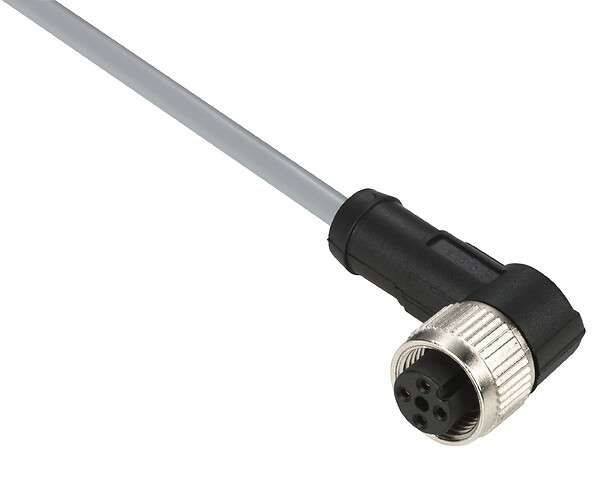
Telemecanique Sensors XMLP060BD790 Pressure Transmitter: 60 bar 0–10 V Measurement for Industrial Control
The Telemecanique Sensors XMLP060BD790 pressure transmitter is part of the Telemecanique Pressure Sensors XM family and is designed for continuous pressure monitoring in industrial control circuits. In real automation projects, a pressure transmitter becomes valuable when you need more than a “pressure OK / not OK” decision. Continuous measurement enables trending, early fault detection, and more stable machine behavior—especially when pressure dynamics affect product quality or cycle repeatability.
Verified Technical Snapshot (from the Product Datasheet)
The official product datasheet describes XMLP060BD790 as an electronic pressure sensor / pressure transmitter with a 60 bar pressure rating and a 0…10 V analogue output. It uses an M12 connector and a 7/16″ female process connection. The datasheet also lists typical controlled fluids (for example fresh water, air, and hydraulic oil) across the stated temperature envelopes, and indicates “no local display.” (See the PDF datasheet.)
- Device type: Pressure transmitter (XM electronic pressure sensors)
- Pressure rating: 60 bar
- Output: 0…10 V analogue
- Connection style: M12
- Process port: 7/16″ female
Telemecanique Sensors XMLP060BD790 Where 60 bar Transmitters Fit in Real Machines
The 60 bar class is often chosen when circuits can experience pressure peaks above low-range transmitters, but the system still benefits from a voltage signal that is easy to scale. Typical application clusters include:
- Hydraulic utility monitoring: supervision of auxiliary lines where pressure stability correlates with tool performance.
- Machine condition monitoring: trend pressure behavior to detect valve leakage, pump wear, or filter restriction before downtime.
- Protection & quality stability: implement high/low alarms with meaningful pre-alarm thresholds (warning before stop).
Unlike a pressure switch, a transmitter supports “soft” decisions: you can implement different logic paths based on the magnitude and rate-of-change of pressure, not only a single threshold crossing.
Telemecanique Sensors XMLP060BD790 0–10 V Output: Integration Benefits and Practical Limits
The datasheet specifies a 0…10 V analogue output. In PLC engineering, this typically maps to a voltage input module where scaling is straightforward (e.g., 0 V = 0 bar, 10 V = 60 bar, depending on the configured range). Voltage outputs are often selected when:
- cable runs are short to moderate,
- the control system already uses standardized 0–10 V inputs,
- the installation is contained within a machine frame rather than a distributed plant area.
However, voltage signals can be more sensitive to electrical noise than 4–20 mA loops. In environments with VFDs, high-current switching, or long parallel cable runs, engineering discipline matters: use shielding where appropriate, separate analogue and power routing, and keep grounding consistent across the cabinet standard.
Telemecanique Sensors XMLP060BD790 Mechanical and Installation Governance
Accuracy and reliability in pressure measurement is a system outcome—not only a sensor attribute. Practical measures that reduce field issues include:
- Mount where pressure represents the process: avoid turbulent zones near sharp restrictions.
- Manage pulsation: if your circuit produces spikes, consider damping practices that reduce stress on the sensing element.
- Protect cabling: M12 connections are service-friendly, but cable strain relief should be treated as mandatory in high-vibration environments.
- Document scaling: store scaling and units in PLC code comments and maintenance notes so replacements don’t introduce silent calibration drift.
Required internal link: Telemecanique sensor.
FAQ: Telemecanique Sensors XMLP060BD790
Is XMLP060BD790 a switch or a transmitter?
It is specified as an electronic pressure sensor / pressure transmitter in the XM range.
What output signal does it provide?
The datasheet specifies 0…10 V analogue output.
What is the pressure rating?
It is listed as 60 bar.
What connector and port are used?
The datasheet lists an M12 connection and a 7/16″ female process port.