
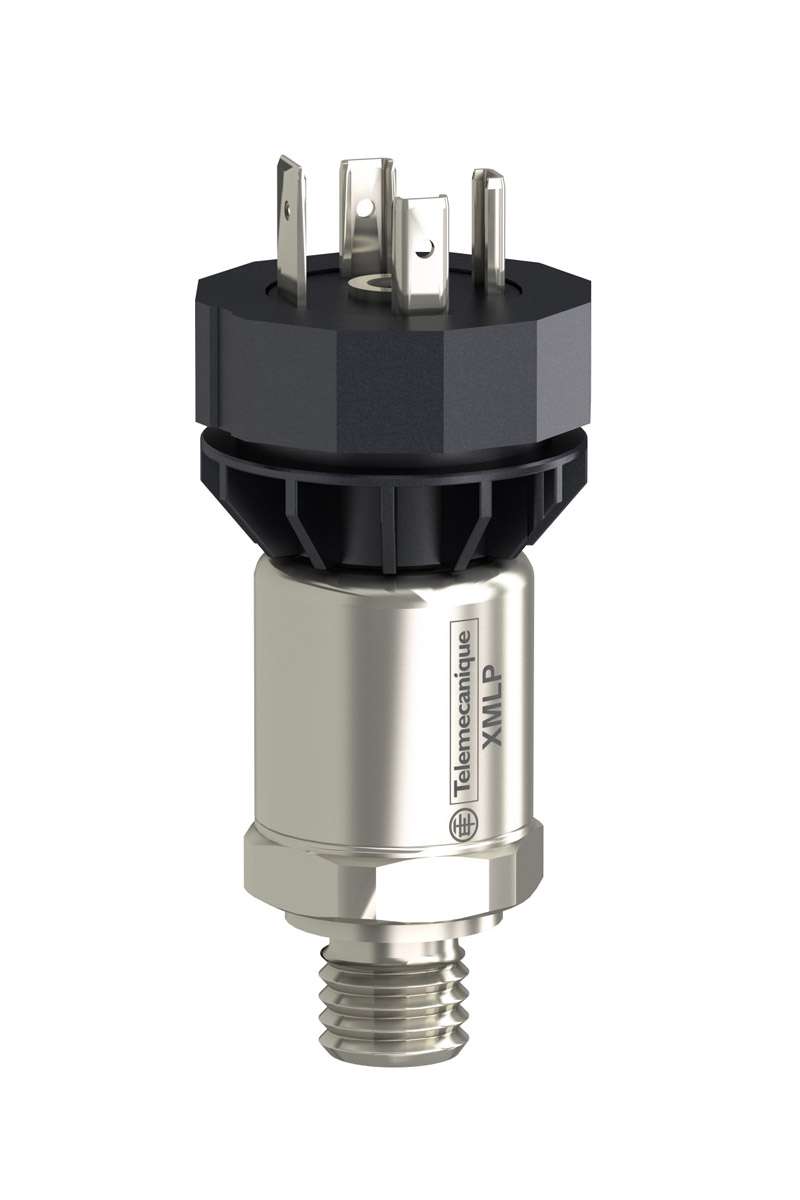
Telemecanique Sensors XMLP040BC21F-SM-01 Pressure Transmitter: 0–40 bar 4–20 mA for Rugged Industrial Measurement
The Telemecanique Sensors XMLP040BC21F-SM-01 pressure transmitter is designed for continuous pressure monitoring where the operating band extends beyond typical plant air and enters higher-pressure utility or auxiliary hydraulic territories. In many machines, the practical challenge is not only the nominal pressure, but also the transient peaks created by valve events, rapid actuator motion, or pump ripple. A 40 bar transmitter is often selected specifically to handle these realities without pushing the device near its upper limit.
Verified Technical Profile (Base Reference: XMLP040BC21F)
The product datasheet for XMLP040BC21F describes it as an electronic pressure transmitter with a 0…40 bar pressure setting range, 4…20 mA analogue output in a 2-wire configuration, and a rated supply of 12…24 V DC SELV (limits 7…33 V). The process connection is G 1/4A (male) conforming to DIN 3852-E. Electrical connection is listed as a male connector EN 175301-803-A (ex DIN 43650), 3 pins. Wetted materials include stainless steel AISI 316L and FPM. The datasheet also lists 120 bar maximum permissible accidental pressure and 240 bar destruction pressure.
- Brand + Code + Type keyword variant: Telemecanique Sensors XMLP040BC21F-SM-01 pressure transmitter
- Range: 0…40 bar
- Output: 4…20 mA, 2-wire
- Supply: 12…24 V DC SELV (limits 7…33 V)
- Port: G1/4A male, DIN 3852-E
- Connector: EN 175301-803-A (ex DIN 43650) 3-pin
- Overpressure references: accidental 120 bar, destruction 240 bar
Why 0–40 bar is a Useful Band in Real Machines
40 bar coverage is widely used when equipment experiences higher peaks than “standard” pneumatic and utility lines. It offers practical headroom for transients while still allowing meaningful measurement across the working range. Typical use cases include:
- Auxiliary hydraulic monitoring where pressure is moderate but dynamic.
- Industrial process skids requiring stable supervision of pressure conditions over time.
- Machine protection where trending pressure is part of condition monitoring (e.g., valve health, filter state, pump efficiency).
For maintenance organizations, the most valuable aspect is trend visibility: pressure behavior often changes gradually before failures occur, and a transmitter provides the data needed to intervene early.
4–20 mA Loop Integration: What Engineers Typically Standardize
With a 2-wire 4–20 mA transmitter, good results come from consistency:
- Standard scaling templates: map 4–20 mA to 0–40 bar consistently across machines.
- Two-tier alarming: implement warning thresholds before shutdown thresholds to avoid unnecessary downtime.
- Diagnostic interpretation: treat loop values well below 4 mA as likely wiring/power faults rather than real process changes.
This disciplined approach is what makes data-driven maintenance practical at scale, rather than a one-off commissioning exercise.
Installation Notes: Protect the Sensor, Protect the Reading
- Manage pulsation: if your circuit produces spikes, use damping/snubbing practices to reduce mechanical stress.
- Pick a representative measurement point: turbulence near restrictions can create noisy signals and false alarms.
- Electrical hygiene: route analogue wiring away from switching power conductors; keep grounding consistent.
- Document tightening practices: apply correct torque standards for fittings and connectors to reduce leakage and intermittent faults.
Required internal link: Telemecanique sensor.
FAQ: Telemecanique Sensors XMLP040BC21F-SM-01
What is Telemecanique Sensors XMLP040BC21F-SM-01 used for?
It is a pressure transmitter used for continuous monitoring in systems where the pressure range extends up to 40 bar.
What output signal does it provide?
The datasheet specifies a 4…20 mA analogue output in a 2-wire configuration.
What are the overpressure references?
The datasheet lists 120 bar maximum permissible accidental pressure and 240 bar destruction pressure
Which connection standards are used?
It uses G 1/4A (male) process connection (DIN 3852-E) and a DIN 43650-style 3-pin connector (EN 175301-803-A).
What does “-SM-01” indicate?
It is typically a commercial suffix used by distributors/ERP systems. Confirm supplier equivalence to the base XMLP040BC21F reference before purchase.