
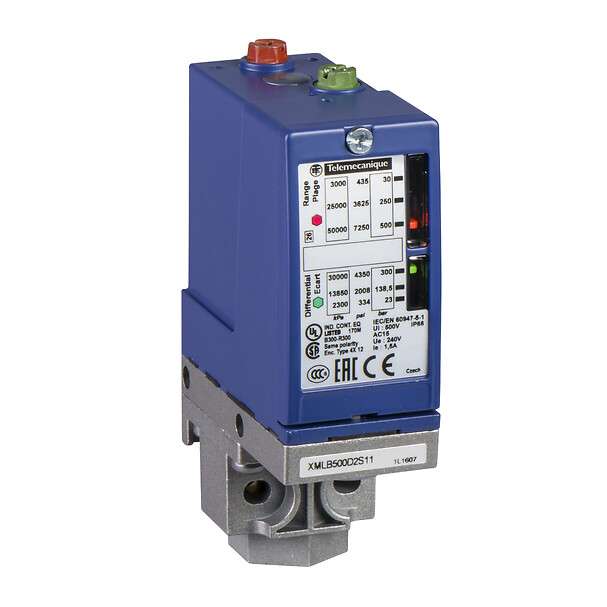
Telemecanique Sensors XMLA500D2S11 Pressure Switch: High-Pressure Threshold Control from 3000 to 50000 kPa
The Telemecanique Sensors XMLA500D2S11 pressure switch is engineered for high-pressure applications where a control system needs a dependable, on/off decision rather than a continuously varying measurement. In many industrial environments—hydraulic power units, test rigs, and high-pressure tooling—process stability is strongly tied to clear pressure confirmation. A pressure switch supports that by turning a pressure condition into a discrete electrical change the PLC can trust.
What Telemecanique Sensors XMLA500D2S11Is Built to Do
The Telemecanique Sensors XMLA500D2S11 pressure switch is referenced with a working pressure range of 3000 to 50000 kPa (equivalent to 3 to 50 MPa) and a G 1/4 female connection. This positioning makes it relevant for high-pressure hydraulic circuits where reaching and maintaining a threshold is operationally critical. Instead of asking the controller to interpret analog noise or drift, the switch provides a straightforward state: below threshold or above threshold.
That “binary clarity” is valuable in sequences like clamp confirmation, pressure-ready interlocks, and high-pressure enable logic. When pressure falls unexpectedly, the controller can stop a cycle or trigger an alarm without ambiguity.
Why a High-Pressure Switch Changes Maintenance Behavior
In high-pressure systems, small issues escalate fast. A minor leak can become a performance problem, and pressure spikes can become a component stress factor. Using the Telemecanique Sensors XMLA500D2S11 pressure switch as a control checkpoint helps teams detect abnormal patterns early—particularly when the machine history shows that a threshold used to be reached quickly, but now takes longer. That is often the first sign of pump wear, valve leakage, or restriction.
Connection Discipline: G 1/4 Female Is Only “Standard” If Installed Correctly
G-thread connections are common, but reliability depends on installation hygiene. Before installation, keep the port clean so no debris enters the hydraulic line. Apply the correct sealing approach for the fitting strategy in your system design, and avoid overtightening that can damage threads or distort sealing surfaces. In high-pressure contexts, mechanical integrity is non-negotiable.
Commissioning: Validate the Switch as a Decision Point
Commissioning should confirm the switch behaves consistently at the chosen setpoint. The best practice is to validate against a calibrated reference gauge during the first setup. Bring the system pressure up slowly, observe the change of state, and repeat several times. The aim is not only to confirm that the switch changes state, but that it does so repeatably and without chatter.
If you observe unstable behavior near the threshold, look at the process first. Many high-pressure systems experience pulsation. If pulsation crosses the switching point repeatedly, it can look like an electrical fault even though it is a process reality. In such cases, hydraulic damping, accumulator strategy, or measurement point relocation often improves stability.
Operational Fit: When a Switch Is Preferable to a Transducer
There are plenty of applications where continuous pressure trending is valuable. But if the control logic only needs a confirmation (pressure reached) or protection (pressure too low/high), a switch is often the cleanest tool. The Telemecanique Sensors XMLA500D2S11 pressure switch supports that kind of “control-centric” design: minimal configuration, direct input, and straightforward troubleshooting.
Maintenance Checks That Solve Most Issues
When a pressure threshold is not reached, teams sometimes blame the switch. In reality, the switch is frequently the messenger. Start by checking pump performance, relief valve settings, leakage paths, and filter restrictions. Then inspect installation: verify the pressure tapping point is not clogged and that the port sealing remains intact. Only after those checks should you consider replacing the device.
For related Telemecanique product families and selection context, you can review Telemecanique sensor.
Telemecanique Sensors XMLA500D2S11 FAQ
1) What is Telemecanique Sensors XMLA500D2S11?
It is a high-pressure electromechanical pressure switch used to signal a threshold condition in control circuits.
2) What pressure range is associated with this reference?
It is referenced with a working range of 3000 to 50000 kPa.
3) What port connection is referenced?
It is referenced with a G 1/4 female connection.
4) Why can switching appear unstable near the setpoint?
Pressure pulsation in hydraulic circuits can cross the threshold repeatedly; damping or relocation can help.
5) What should be checked first if the switch does not trigger?
Check system pressure behavior (pump, leaks, relief valves) and the cleanliness of the pressure tapping point.