
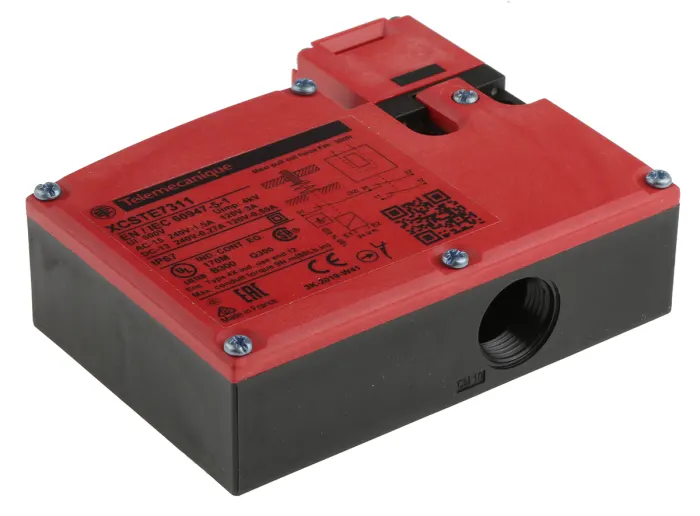
Telemecanique Sensors XCSTE7311 Solenoid Interlock Safety Switch: Rectangular Plastic Design for Controlled Guard Access
The Telemecanique Sensors XCSTE7311 solenoid interlock safety switch is designed for guard applications where access must be managed, not only monitored. It is specified as a rectangular plastic safety switch with a key operated turret head, 2 NC contacts, slow-break operation, and a 24 V solenoid concept, with 1 entry tapped Pg 11 for cable gland wiring. This structure supports common industrial control cabinet standards while keeping the device compact and easy to mount on guard frames.
Why Solenoid Interlocking Is Used
Many machines do not become safe instantly when a stop command is pressed. A conveyor may coast, a spindle may spin down, a robot may decelerate to a stop, or pressure may remain in a pneumatic system. In these cases, a guard that opens immediately can create a hazard. Solenoid interlocks support a disciplined approach where the control system can allow unlocking only when a defined safe state is reached.
XCSTE7311 fits installations where a plastic housing is suitable and where the machine design benefits from a clear, controlled guard-access behavior. The rectangular form can also simplify mounting on flat frames and panels.
Understanding the 2NC Contact Setup
Telemecanique Sensors XCSTE7311 is specified with 2 NC contacts. In practical wiring, NC channels are often used in monitored guard circuits because an open circuit can indicate either an opened guard or a wiring fault. This supports structured troubleshooting: if the safety circuit opens unexpectedly, technicians can check the guard condition and then inspect wiring continuity.
The slow-break contact operation means the contact transition follows the actuator motion rather than a snap transition. During commissioning, it is useful to confirm the control logic expectations match how the contacts behave as the door begins to open.
Mechanical Installation: The Key to Reliability
The most common source of nuisance faults in interlocks is mechanical drift. If the actuator approach is marginal, the switch may read “closed” only when the door is pushed firmly, or it may fluctuate with vibration. To prevent this:
- Mount to a rigid frame: avoid flexible sheet metal that can move under vibration.
- Maintain hinges: door sag changes the actuator insertion angle.
- Keep the actuator bracket stiff: short, rigid brackets reduce twist and rubbing.
A practical field check is repeatability: close the guard gently ten times and confirm the same engagement feel and the same electrical response each time. If it varies, correct alignment before going live.
Telemecanique Sensors XCSTE7311 Wiring with Pg 11 Entry and Cable Management
The device is specified with 1 entry tapped Pg 11. Choose a suitable gland and ensure the cable diameter matches. Sealing and reliability depend on correct gland tightening and strain relief. In high-use guards, repeated motion can fatigue cables if the bend radius is too tight or if the cable is pulled at the entry point. The best practice is to route the cable with a controlled loop and use protection near hinge edges where abrasion can occur.
Telemecanique Sensors XCSTE7311 Commissioning: Validate Behavior Under Real Conditions
Commissioning should include real operator behavior and real machine conditions:
- Test lock/unlock behavior during end-of-cycle, stop, and restart scenarios.
- Test with the machine warmed up; thermal expansion can shift alignment slightly.
- Test with guards and panels installed; the final configuration is what matters.
This approach prevents surprises after handover, when production rhythm and vibration reveal borderline conditions.
Telemecanique Sensors XCSTE7311 Maintenance: Fast Checks That Prevent Stops
When faults occur, inspect the basics first: actuator screws, hinge wear, and cable strain. Many issues are resolved by re-aligning the actuator and stabilizing the door mechanics. Keeping a small alignment checklist in preventive maintenance often eliminates repeated nuisance trips.
For related Telemecanique options and overview, see Telemecanique sensor.
Telemecanique Sensors XCSTE7311 FAQ
1) What is XCSTE7311 intended for?
It is intended for guard monitoring with solenoid-based access control, helping manage when a guard can be opened.
2) What contacts are specified?
It is specified with 2 normally closed (2NC) contacts.
3) Telemecanique Sensors XCSTE7311 What supply voltage is specified?
It is specified for 24 V.
4) What cable entry is specified?
It is specified with one Pg 11 tapped entry.
5) What causes most nuisance faults?
Most nuisance faults are caused by mechanical misalignment (door sag, actuator shift) or cable strain, not the device electronics.