
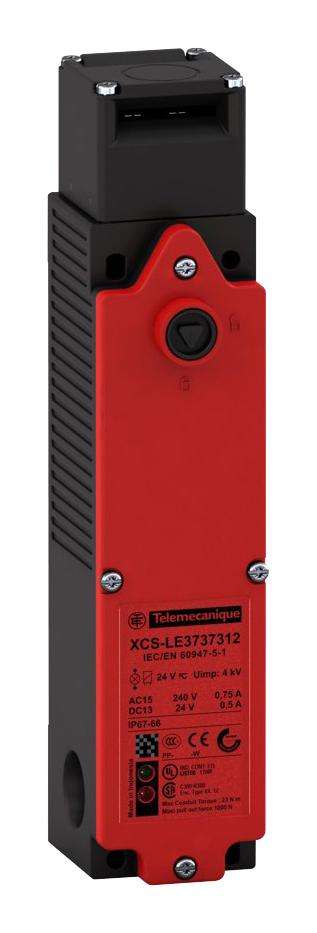
Telemecanique Sensors XCSLE3737312 Solenoid Interlock Safety Switch: Slim Plastic Interlock with 4NC+2NO Contacts
The Telemecanique Sensors XCSLE3737312 solenoid interlock safety switch is designed for guard applications where access needs to be controlled, not only detected. In many automated machines, a stop signal does not instantly remove all hazards. Motion can continue briefly, pressure can remain in a system, or a robot can settle into position after deceleration. A solenoid interlock supports a structured approach: the control system can keep the guard locked until a defined safe condition exists.
Where Telemecanique Sensors Telemecanique Sensors XCSLE3737312 Makes Practical Sense
This model is especially relevant in machines that run at high cycle rates and require frequent operator access for adjustments. A slim plastic interlock body can simplify mounting on narrow doors or compact frames, and can reduce interference with handles, hinges, and cable routing. The objective is a clean mechanical installation that stays stable over time.
Common placements include packaging doors, access panels on automated assembly cells, and sliding covers near conveyor transfers. In these areas, installation quality determines reliability more than the “paper” specification.
Telemecanique Sensors XCSLE3737312 What the Technical Specification Means for the User
Telemecanique Sensors XCSLE3737312 is described as a plastic safety switch in the XCSLE slim family with slow-break contact operation, a 24 V solenoid concept, and 3 entries tapped M20. It is also described with 4 NC + 2 NO contact composition in product data sheets and distributor references for this exact reference. Multiple contacts provide flexibility: NC channels can be used for monitored guard circuits, while NO channels can support indication or supplementary logic depending on the machine design.
Slow-break operation matters because the contact movement follows a defined mechanical motion during guard opening and closing. In practical commissioning, it’s important to confirm the expected state changes match the control logic assumptions, especially if the machine uses timing windows during stop sequences.
Telemecanique Sensors XCSLE3737312 Mechanical Integration: How to Keep It Stable
Interlocks live or die by alignment. The actuator must enter the head smoothly every time. If the door is even slightly twisted, the actuator can rub, bind, or only partially engage. That creates nuisance faults and accelerates wear.
To protect stability:
- Mount on rigid surfaces: a flexible bracket can drift under vibration.
- Control door sag: hinge wear is one of the most common causes of long-term misalignment.
- Use a consistent approach path: the actuator should enter straight, not at an angle.
A simple practical test is to close the guard gently and watch whether engagement feels smooth and repeatable. If an operator must “lift” or “push” the door to engage, the installation is marginal and will degrade.
Wiring with Three M20 Entries
Three M20 entries help installers route wiring in a structured way, especially where multiple devices share a wiring path along a machine frame. However, sealing and reliability still depend on correct gland selection and strain relief. The most common field wiring failures occur at the hinge side: repeated flexing can break conductors or crack cable jackets. Using cable guides, protective conduit, or flexible loop management often prevents those failures.
Commissioning: Prove Access Control Behavior
Commissioning should verify both detection and access control:
- Confirm the guard “closed” signal is stable across repeated cycles.
- Confirm the guard cannot be opened during hazardous phases if the machine design requires locking.
- Confirm unlocking occurs only when the control system permits it (end-of-cycle, safe stop, or defined safe state).
It is also wise to test under real conditions: with the machine warmed up, with guards installed, and with normal vibration. Borderline alignment issues often appear only under those conditions.
Maintenance Tips That Save Time
If an interlock begins to fault intermittently, check the mechanical basics first: door alignment, actuator screws, hinge wear, and cable routing. Most downtime is caused by these physical issues rather than a device defect. Keeping fasteners tight and hinges maintained tends to prevent repeated service calls.
For additional Telemecanique solutions and overview, see Telemecanique sensor.
Telemecanique Sensors XCSLE3737312 FAQ
1) What isTelemecanique Sensors XCSLE3737312 designed to do?
It is designed for guard monitoring with solenoid-based access control, supporting controlled opening of guards.
2) What contact configuration is specified?
It is specified with 4 NC + 2 NO contacts.
3) What supply voltage is specified?
It is specified for 24 V.
4) What cable entries are specified?
It is specified with three M20 tapped cable entries.
5) What is the most common cause of nuisance faults?
Misalignment caused by door sag or actuator shift is the most frequent root cause, followed by cable strain near hinges.