
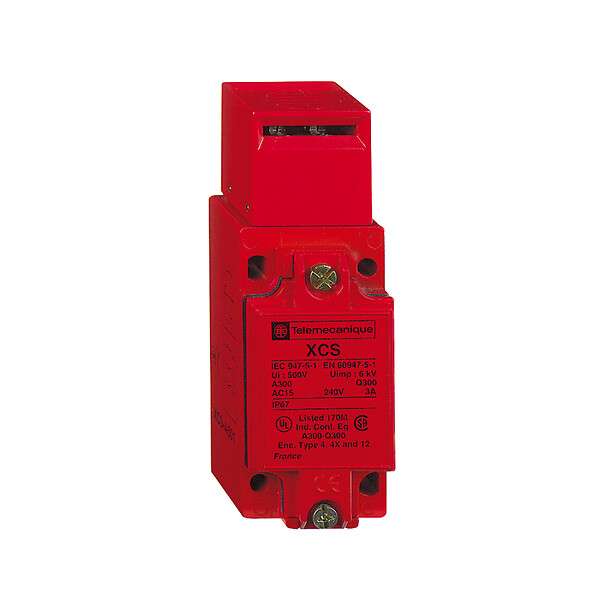
Telemecanique Sensors XCSA501 Safety Interlock Switch: Key-Operated Metal Interlock for Guard Monitoring
The Telemecanique Sensors XCSA501 safety interlock switch is part of the Telemecanique Safety switches XCS family, in the metal XCSA design. The product data sheet describes it as a safety switch with a key operated turret head, 1 NC + 2 NO contact composition, slow-break contact operation, and 1 entry tapped Pg 13.5 cable entry.
What Telemecanique Sensors XCSA501 Designed to Do
Key-operated interlock switches are typically used to monitor the position of machine guards, doors, or access panels. The operational goal is to provide a defined, repeatable electrical state when the guard is closed and the actuator key is engaged. In practical machine architecture, the interlock signal is often one layer of the overall risk reduction strategy, with safety design implemented through the correct safety controller, relays, and validation practices as required by the machine’s safety function.
From the product definition, XCSA501 belongs to an industrial metal safety switch family and uses a key-operated turret head, which is commonly implemented on hinged doors or sliding guard arrangements where an actuator key can enter the head reliably.
Contacts and Slow-Break Behavior
The data sheet specifies 1 NC + 2 NO and slow-break, break before make. This matters in wiring design because it defines how contact transitions occur as the key is inserted or withdrawn. In real troubleshooting, understanding slow-break behavior helps technicians interpret timing differences: a contact may remain engaged slightly longer during withdrawal compared with a snap-action device, depending on the mechanism design.
Distributor references also describe XCSA501 as a non-locking interlock with a 3PST-type arrangement consistent with multiple contacts.
Telemecanique Sensors XCSA501 Mechanical Installation: Alignment Is the Reliability Driver
Key-operated interlocks depend heavily on actuator alignment. If the actuator key approaches at an angle or if the door sags over time, the key may not enter smoothly, which can create intermittent states or accelerated wear. In field practice, reliability improves when:
- Mounting surfaces are rigid: avoid thin sheet brackets that flex during door closing.
- Hinges are maintained: worn hinges change key alignment, causing nuisance signals.
- Actuator approach is straight: avoid forcing the key into the head at an angle.
Cable Entry and Wiring Practices
The XCSA501 data sheet specifies 1 entry tapped Pg 13.5 cable entry, which frames gland selection and sealing expectations. In industrial environments, sealing integrity is a function of correct gland selection, correct cable diameter, and proper tightening.
For wiring documentation, it is best practice to label each contact channel and clearly state the intended logic usage (for example, NC used as the primary guard-closed channel, NO used for status indication). Clarity here reduces downtime when maintenance teams replace the unit under pressure.
Telemecanique Sensors XCSA501 Operational Checks That Prevent Downtime
- Check door sag: confirm the key enters without rubbing.
- Inspect fasteners: loose mounting screws cause misalignment over time.
- Verify gland tightness: sealing failures often start at the cable entry, not the housing.
For additional compatible sensing and safety-switch solutions, visit Telemecanique sensör.
Telemecanique Sensors XCSA501 FAQ
1) What head type is specified for XCSA501?
A key operated turret head is specified. (XCSA501 product data sheet)
2) What contact composition is provided?
1 NC + 2 NO is specified.
3) What contact operation is listed?
Slow-break, break before make is specified.
4) What cable entry is specified?
One entry tapped Pg 13.5 is specified.
5) Where is XCSA501 typically used?
It is typically used for guard and door position monitoring where a key actuator engages the switch head.