
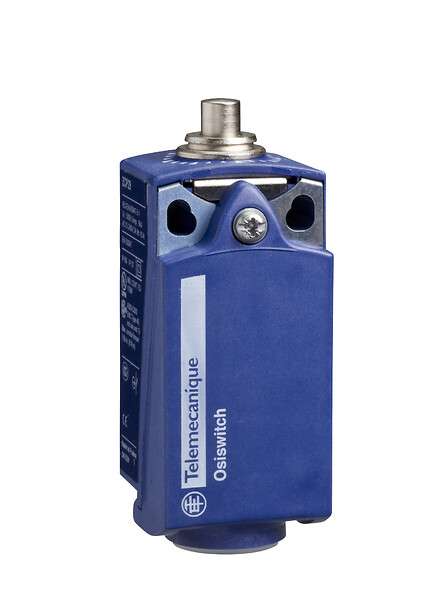
Telemecanique Sensors XCKT2106P16 Limit Switch: Cat’s Whisker Actuator for Multi-Directional Mechanical Detection
The Telemecanique Sensors XCKT2106P16 limit switch is a compact XC Standard model designed for industrial automation systems where the actuation direction may vary or where a simple “touch” detection approach is preferred. The defining feature of this device is its cat’s whisker actuator, which supports multi-directional mechanical engagement. The switch is specified with a 1 NC + 1 NO contact set, snap action switching, and two M16 x 1.5 cable entries for efficient wiring in machine installations.
Why Cat’s Whisker Actuation Matters in Machine Design
Many machines do not offer perfect mechanical alignment at every detection point. Guards, shuttles, pusher arms, and transfer components can approach a sensing point with small variations in angle or position. In those cases, a traditional plunger or roller can require tight alignment, otherwise it risks side loading or inconsistent trip points.
The cat’s whisker actuator is designed to be tolerant of such variation. It can be engaged by an approaching part from multiple directions, which can reduce the need for precision cam design in certain applications. In practical terms, the Telemecanique Sensors XCKT2106P16 limit switch is often used where the machine simply needs to confirm that a moving element has reached a region, not a micrometer-precise stop.
Electrical Contacts and Switching Behavior
This model provides 1 NC + 1 NO contacts and uses snap action switching. Snap action is engineered to deliver a crisp transition once the mechanism crosses the switching threshold. That decisiveness supports stable PLC input interpretation and can reduce false states when the actuator is moved slowly or when slight vibration exists at the trip point.
Actuation Characteristics and Practical Implications
The datasheet indicates the switch can be actuated by any moving part, matching the cat’s whisker “touch” detection style. In commissioning, this characteristic simplifies setup: you focus on ensuring consistent physical contact rather than shaping a precise cam profile. However, good engineering discipline still applies—controlled contact force and avoiding aggressive impacts will extend service life and improve signal stability.
Wiring and Cable Entry
The Telemecanique Sensors XCKT2106P16 is specified with screw-clamp terminals and 2 entries tapped for M16 x 1.5 cable glands (commonly used with cables in the 4–8 mm outer diameter range, depending on the cable and gland system). These dual entries can simplify cable routing, especially when the switch is placed mid-run on a machine frame and the installer prefers a straightforward pass-through wiring approach. Repeat accuracy is specified as 0.1 mm on tripping points with 1 million operating cycles, supporting repeatable behavior when the mounting is stable and contact is consistent.
Environmental Protection
The device is listed with IP66 and IP67 protection. In real industrial environments, these ratings depend on installation quality: cable glands must match cable diameter, threads must be fully engaged, and strain must be managed so the entry does not loosen over time.
Telemecanique Sensors XCKT2106P16 Implementation Tips for Consistent Signals
- Use gentle, repeatable contact: the whisker should be engaged consistently without harsh impacts.
- Prevent snagging: route nearby cables and hoses so they cannot catch on the whisker.
- Mount rigidly: bracket flex can cause inconsistent contact and intermittent signals.
For a broader view of compatible sensing solutions, see Telemecanique sensor.
Telemecanique Sensors XCKT2106P16 FAQ
1) What actuator type is used inTelemecanique Sensors XCKT2106P16?
It uses a cat’s whisker actuator designed for multi-directional mechanical engagement.
2) What contact set does it provide?
It provides 1 NC + 1 NO contacts with snap-action operation.
3) How is the switch intended to be actuated?
The technical description indicates actuation by any moving part, consistent with touch-style detection.
4) What cable entry does it use?
It is specified with two M16 x 1.5 cable-gland entries.
5) What protection ratings are listed?
It is listed with IP66 and IP67 protection.