
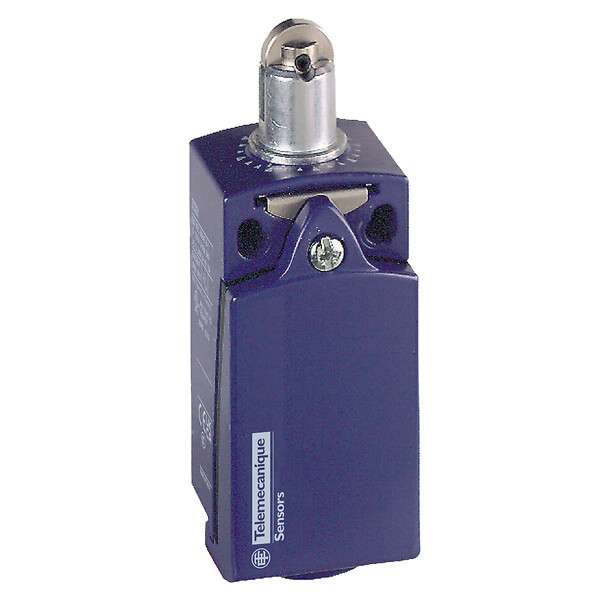
Telemecanique Sensors XCKT2102P16 Limit Switch: Steel Roller Plunger for Stable Cam-Driven Position Detection
The Telemecanique Sensors XCKT2102P16 limit switch is built for industrial automation environments where mechanical end-position feedback needs to be both reliable and easy to service. This model is part of the XC Standard compact format and uses a steel roller plunger with a 1 NC + 1 NO contact set and snap action switching. It is designed for cam-based actuation and is frequently selected in packaging, material handling, and general machine automation where a mechanical target can physically engage the actuator.
What Makes the Telemecanique Sensors XCKT2102P16Technically Distinct
In mechanical limit switches, the actuator interface is the engineering “front end.” The XCKT2102P16 uses a roller plunger that reduces sliding friction at the contact point. Instead of scraping along a cam face, the roller is meant to rotate during engagement, which typically lowers wear on both the cam and the switch actuator.
This model is specified for switch actuation by 30° cam, a common approach for creating predictable switching points in moving mechanisms. With a properly profiled cam, the switch can transition cleanly through the snap-action point without excessive shock loading.
Telemecanique Sensors XCKT2102P16 Contacts, Switching Behavior, and Control Integration
The 1 NC + 1 NO arrangement supports flexible PLC input design, interlocks, and sequence control. Snap action is particularly useful in real machines because it produces a decisive state change once the actuator crosses the switching threshold, helping to avoid “grey zone” signals when motion is slow or slightly vibrating near the trip point.
Wiring and Installation Practicalities
The Telemecanique Sensors XCKT2102P16 uses screw-clamp terminals and is specified with 2 entries tapped for M16 x 1.5 cable glands, supporting cable diameters typically in the 4–8 mm range (depending on the gland and jacket). This dual-entry concept is valuable for straightforward machine wiring layouts—especially when routing a cable in and out without additional junction boxes. Repeat accuracy is specified as 0.1 mm on tripping points with 1 million operating cycles, which supports stable sequencing over long production runs when the mounting is rigid and the cam is consistent.
Environmental Protection and Mechanical Robustness
Industrial sealing is not only about the enclosure—it is equally about how carefully the gland is selected and tightened. The XCKT2102P16 is listed with IP66 and IP67 protection levels, supporting dusty and washdown-adjacent environments when installed correctly. In practical commissioning, protecting the seal means choosing the right cable outer diameter for the gland, ensuring jacket integrity, and avoiding strain that can loosen the entry over time.
Telemecanique Sensors XCKT2102P16 Mounting Discipline for Repeatable Switching
- Rigid bracket: flex in the mounting surface can shift the effective switching point.
- Cam finish: a smooth cam face supports consistent rolling contact and reduces impact.
- Controlled overtravel: enough travel to pass the snap point confidently, without excessive force that accelerates wear.
For broader selection and standardization across projects, you can review the sensor family via Telemecanique sensor.
Telemecanique Sensors XCKT2102P16 FAQ
1) How is the XCKT2102P16 intended to be actuated?
It is specified for actuation by a 30° cam, supporting controlled engagement and repeatable switching.
2) What contact configuration does it provide?
It provides 1 NC + 1 NO contacts with snap-action switching.
3) What cable entry does it use?
It is specified with two tapped entries for M16 x 1.5 cable glands.
4) What protection ratings are listed?
It is listed with IP66 and IP67 protection.
5) What repeatability is specified?
Repeat accuracy is specified as 0.1 mm on tripping points with 1 million operating cycles.